


Featured Resources
-
STORM Therapeutics: From Lead to Pre-Candidate Nomination in 18 Months

STORM Therapeutics: From Lead to Pre-Candidate Nomination in 18 Months
Case study
📣From lead to pre-candidate nomination in 18 months. Explore the STORM Therapeutics case study




July 30, 2015

Inobrodib, an exciting, first-in-class oral anti-cancer drug in clinical development by CellCentric, was collaboratively designed, synthesised and supported on its pre-clinical journey by an integrated project team at Sygnature Discovery. Inobrodib is now showing promising results in Phase I and II trials for multiple myeloma and other cancer types.

At Sygnature Discovery, we deliver world-leading drug discovery solutions to accelerate your compound from idea to clinic.

Our leadership team brings diverse experience and insight, driving collaboration and innovation across drug discovery.

Explore careers at Sygnature Discovery and join a global team committed to science, collaboration, and integrity.
Inobrodib, an exciting, first-in-class oral anti-cancer drug in clinical development by CellCentric, was collaboratively designed, synthesised and supported on its pre-clinical journey by an integrated project team at Sygnature Discovery. Inobrodib is now showing promising results in Phase I and II trials for multiple myeloma and other cancer types.
At Sygnature Discovery, we deliver world-leading drug discovery solutions to accelerate your compound from idea to clinic.
Our leadership team brings diverse experience and insight, driving collaboration and innovation across drug discovery.
Explore careers at Sygnature Discovery and join a global team committed to science, collaboration, and integrity.
scientific solutions | in vivo pharmacology
Translational models and integrated technologies reveal how compounds impact relevant pathways helping you make confident, timely decisions in CNS and pain drug discovery.

SUPPORTING YOUR RESEARCH
We offer a comprehensive portfolio of in vivo and ex vivo models and assays, combining human-relevant rodent models with sensitive endpoints and advanced technologies. From small molecules to biologics, we assess how drug candidates influence behavior and biomarkers with precision and clarity.
Recognizing that adequate target tissue exposure remains a major challenge in CNS drug discovery, our cross-disciplinary services are designed to evaluate and optimize exposure, target engagement, and efficacy.

in vivo CNS Model Expertise
Our CNS portfolio supports discovery across psychiatric, neurological and behavioral disorders. Using translational rodent models and sensitive endpoints, we help you evaluate efficacy, mechanism of action and safety with confidence.
We use pharmacologically induced rodent models to study therapeutics targeting psychotic disorders. These models typically involve NMDA receptor antagonists or dopamine agonists to replicate core behavioral and cognitive symptoms.
Our validated rat model uses chocolate as a hedonistic food to simulate BED, characterized by increased impulsivity and compulsivity. The model is benchmarked with Vyvanse (lisdexamfetamine, LDX).
We assess novel treatments using rodent models that mimic human drug-seeking and drug-taking behaviors. Techniques include drug self-administration and behavioral observation.
To investigate the pharmacology and target engagement of novel compounds with psychedelic-like properties, we offer ex vivo and in vitro 5-HT2A receptor occupancy studies alongside the in vivo head twitch assay.
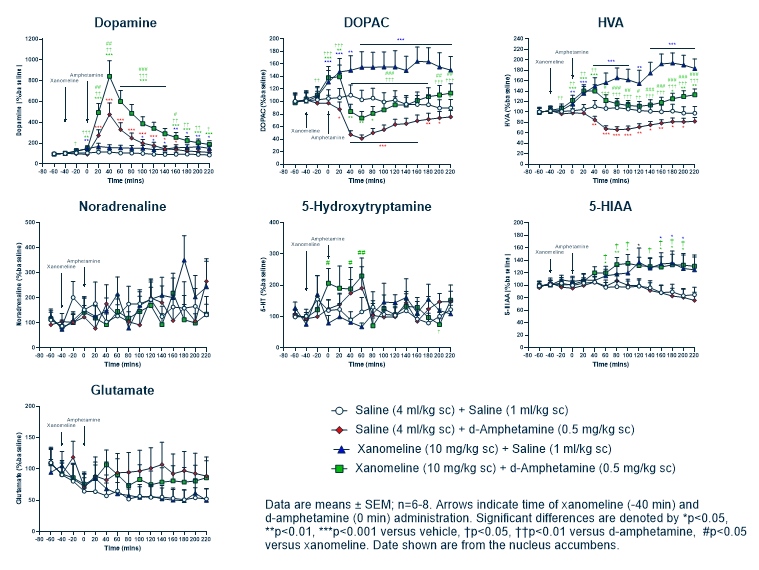
We measure unbound drug concentrations in the brain in real time, providing critical data on blood-brain barrier penetration and target-site pharmacokinetics. This technique can be combined with behavioral analysis via video and includes downstream analysis of neurotransmitters, metabolites, and compound levels.
For broad characterization of CNS-active compounds, we provide a range of in vivo assays including open field, Irwin test, pupillometry, grip strength, and rotarod. These models support early safety profiling and functional assessment across diverse mechanisms.
in vivo Pain Model Expertise
Our pain portfolio spans acute, inflammatory and chronic pain states . We tailor models to your therapeutic modality and endpoint needs, supporting both analgesic discovery and mechanistic studies.
This thermally evoked acute nociceptive pain model uses a temperature-controlled water bath to simulate the tail in mice. It is ideal for exploring how novel agents affect pain transmission from the periphery to central pain centres.
We inject lambda-carrageenan into the glabrous paw skin of mice to induce acute inflammation. Swelling is measured with a plethtsmometer, while hyperalgesia is assessed using Hargreaves or von Frey tests.
A subcutaneous injection of diluted formalin into the paw caused prolonged spontaneous pain reactions. The model includes an early acute phase, a quiescent interphase, and a late phase linked to the central sensitization. We offer this model in rats and mice, with pain behaviors captured via custom video recording.
Mono-iodoacetate (MIA) is a glycolytic inhibitor that, when injected into the pain joint, induces cartilage damage and joint pain resembling human osteoarthritis. We offer the rat MIA model of OA joint pain, using Bioseb automated dynamic weight bearing system to measure limb loading deficits in freely moving rats. The model includes an early phase (5-7 days) responsive to NSAIDs, and a later phase (from two weeks post-injection) that is NSAID-insensitive and believed to involve neuropathic components.
Our ex vivo platforms extend behavioral and physiological insights, offering deeper mechanistic understanding.
ex vivo Binding Studies
These studies assess target engagement and receptor occupancy in relevant tissues after in vivo dosing. They support compound optimization through integrated PK/PD analysis.
• Central administration of test drugs (e.g., ICV)
• in vivo models of CNS function
• Target engagement using in vitro and ex vivo CNS receptor occupancy
• Initial behavioral safety assessment such as Irwin rest and Rotarod
• Side effect profiling including catalepsy, pupillometry, prolactin release, weight gain and more
• Brain and CSF drug exposure
Sygnature Discovery’s CNS research is built on a broad portfolio of validated behavioral and disease models, deep neuropharmacology expertise, and integrated in vivo–in vitro capabilities. Our advanced biomarker and imaging platforms, combined with a collaborative, translational approach, help you discover and optimize novel therapeutics for neurological and psychiatric disorders.
Proven experience across CNS and pain indications, with validated behavioral, disease, and ex vivo models.
Connect molecular targets to behavioral outcomes through PK/PD, biomarker and imaging integration.
Work directly with our neuropharmacologists to design studies that answer your specific translational questions.
Resource hub


We bring together a dynamic blend of new talent and experienced pharmaceutical industry experts from a round the world, delivering excellence across every stage of discovery.

Integrated solid form and formulation strategies reduce risk, improve stability and solubility, and accelerate progression from candidate selection to clinic.

Integrated DMPK solutions combining advanced assays, modeling, and bioanalysis delivering predictive insights that reduce risk and guide candidate selection.
Validated in vivo models deliver clinically relevant data across therapeutic areas, accelerating confident decisions and reducing risk in drug development.
Yes, our scientists have experience with multiple lines of transgenic animals, such as models of Alzheimer’s, Parkinson’s and Huntington’s disease. We also offer colony management services in partnership with our providers even if cryopreserved lines are the only available option.
Yes, we hold a license to work with and have a strong track-record in assisting our clients in programs involving all types of controlled substances.
Our experienced group of statisticians are constantly updating our historical data aiming at calculating the power analysis necessary for each study design. With that ensuring an appropriately powered study to fit the clients’ needs.
Yes, if your project requires ex-vivo support such as PK bioanalysis or biomarkers quantification, we will assist you in designing the study to accommodate the ex-vivo requirements.
We include in our offerings the development of bespoke assays. Considering our extensive scientific experience, we can implement such assays in association with the client. If your assay is not listed, send us a message and we will evaluate the necessary steps to implement your assay of choice.

Peak Proteins, NuChem Sciences, and SB Drug Discovery have now fully integrated with Sygnature Discovery.