
Harnessing iPSC Cell Models to Advance Neuroscience Drug Discovery
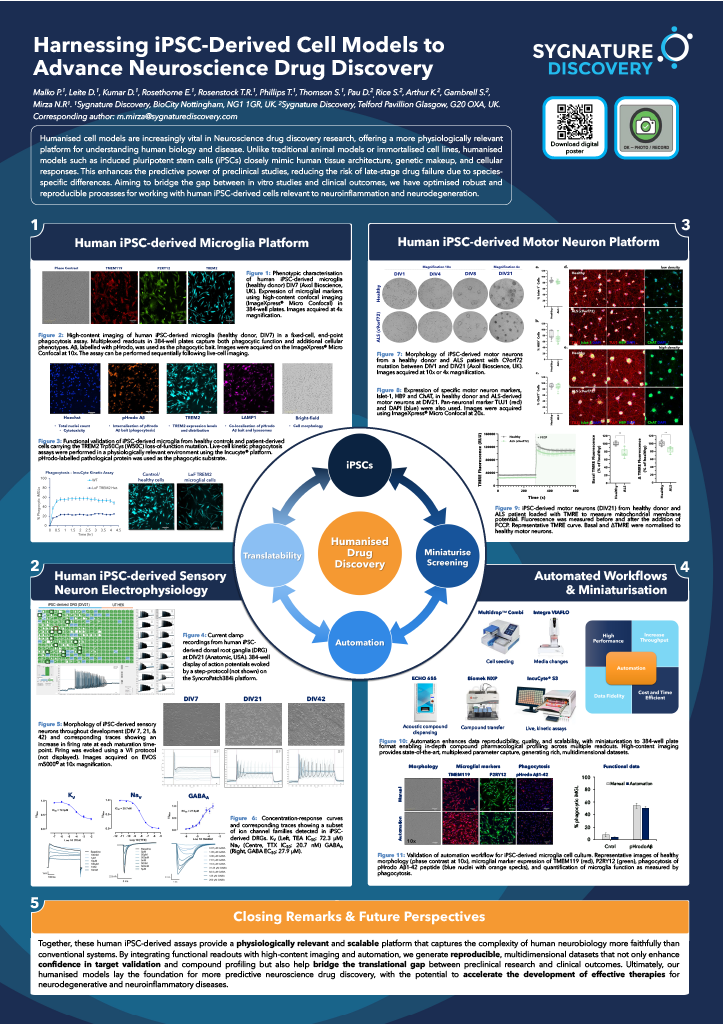
Humanised cell models are increasingly vital in Neuroscience drug discovery research, offering more physiologically relevant platforms for understanding human biology and disease. Unlike traditional animal models or immortalised cell lines, humanised models such as induced pluripotent stem cells (iPSCs) closely mimic human tissue architecture, genetic makeup, and cellular responses. This enhances the predictive power of preclinical studies, reducing the risk of late-stage drug failure due to species-specific differences. Aiming to bridge the gap between in vitro studies and clinical outcomes, we have optimised robust and reproducible processes for working with human iPSC-derived cells relevant to neuroinflammation and neurodegeneration.
Using iPSC-derived microglia, we have developed a kinetic phagocytosis assay that can be used to measure the internalisation of various neurodegenerative-disease related proteins including Aβ. To complement this, end-point high-content phagocytosis phenotypic assays that multiplex immunofluorescence imaging provide information on cell health, phagocytosis, protein of interest expression and sub-cellular localisation. With our automated patch clamp system, we have optimised electrophysiological assessment of ion currents from iPSC-derived sensory neurons, facilitating characterisation of changes in spontaneous and evoked firing activity with increasing maturation of cells in culture. Additionally, we have developed a range of assays to compare iPSC-derived motor neurons from healthy and disease-affected donors, providing information on changes in protein of interest expression, mitochondrial and lysosomal function, and oxidative stress. One such assay, using TMRE as an indicator of mitochondrial membrane potential, has been used to investigate mitochondrial dysfunction in ALS.
Assay workflows have been automated where possible to increase data reproducibility, quality and scalability, and for compatible assays, miniaturisation to a 384-well format supports in-depth compound pharmacological profiling while reducing costly reagent requirements. Further, using High Content Imaging, we measure multiple endpoints providing more comprehensive datasets. Our human iPSC assays have the potential to be amenable to drug discovery screening campaigns and deeper pharmacological characterisation of key compounds.