



Ressources
-
STORM Therapeutics: From Lead to Pre-Candidate Nomination in 18 Months

STORM Therapeutics: From Lead to Pre-Candidate Nomination in 18 Months
Case study




Discover precise insights into brain neurochemistry with Sygnature Discovery's in vivo microdialysis and cOFM services. With over 20 years of expertise, we design bespoke studies that reveal how compounds modulate neurotransmitter systems in health and disease. Using UHPLC/HPLC with electrochemical detection or mass spectrometry, we deliver robust PK/PD data to support confident CNS decision making.


juillet 30, 2015

Inobrodib, an exciting, first-in-class oral anti-cancer drug in clinical development by CellCentric, was collaboratively designed, synthesised and supported on its pre-clinical journey by an integrated project team at Sygnature Discovery. Inobrodib is now showing promising results in Phase I and II trials for multiple myeloma and other cancer types.

In drug discovery, generating targets is no longer the challenge. The real question is how to identify the few worth investing months of research and significant resources to pursue. Hear expert perspectives on how AI, pathway analysis and scientific expertise are shaping modern target identification.
juillet 7, 2026

Tenez‑vous au courant des dernières mises à jour de l’entreprise, des étapes clés et des annonces importantes.
Découvrez les conférences et rencontres scientifiques à venir, où vous pourrez échanger avec notre équipe.

Chez Sygnature Discovery, nous fournissons des solutions de découverte de médicaments de classe mondiale pour accélérer la progression de vos composés, de l’idée jusqu’à la clinique.

Notre équipe de direction rassemble une diversité d’expériences et de ressources, favorisant la collaboration et l’innovation dans l’ensemble du processus de découverte de médicaments.

Explorez les opportunités de carrière chez Sygnature Discovery. Rejoignez une équipe internationale qui obtient des résultats exceptionnels grâce à la collaboration, à l’innovation et à l’intégrité.
Inobrodib, an exciting, first-in-class oral anti-cancer drug in clinical development by CellCentric, was collaboratively designed, synthesised and supported on its pre-clinical journey by an integrated project team at Sygnature Discovery. Inobrodib is now showing promising results in Phase I and II trials for multiple myeloma and other cancer types.
Chez Sygnature Discovery, nous fournissons des solutions de découverte de médicaments de classe mondiale pour accélérer la progression de vos composés, de l’idée jusqu’à la clinique.
Notre équipe de direction rassemble une diversité d’expériences et de ressources, favorisant la collaboration et l’innovation dans l’ensemble du processus de découverte de médicaments.
Explorez les opportunités de carrière chez Sygnature Discovery. Rejoignez une équipe internationale qui obtient des résultats exceptionnels grâce à la collaboration, à l’innovation et à l’intégrité.
Focusing on the craving phase of addiction, this article examines how behavioral pharmacology models capture cue‑driven drug seeking and relapse vulnerability.
One of the greatest challenges in sustaining abstinence for people with substance use disorders is intense drug craving. These cravings are often triggered by exposure to social and special cues such as people, places or activities associated with prior drug use.
Cue-reward associated are a normal part of human behavior. Everyday examples include craving coffee when passing a café, wanting sweets at a shop checkout, or checking our phone in response to a notification. However, in substance use disorders, these learned associations can trigger powerful cravings that drive relapse back to drug use. As a result, reducing cravings it a potential target in treating substance use disorder.
Cue-induced craving can be modelled in animals using a reinstatement paradigm. In these studies, animals are first trained to self-administer drugs where animals are required to perform a behavior to obtain the drug. Access to the drug is then removed and, over time, the rats learn that their behavior no longer provides the drug. Once drug-seeking behavior has declined, specific cues are reintroduced to reinstate response, even in the absence of reward. Lever pressing or nose-poking during this phase provides a measurable readout of craving-driven drug seeking.
Three main classes of cues are used to reinstate drug-seeking behavior in animals, reflecting clinically relevant relapse triggers:
Exposure to the drug itself can trigger craving. For example, if rats that had access to cocaine are given a single cocaine injection, they will lever press even if it doesn’t give access to more cocaine.
2. Environmental cue-induced reinstatement
In this model, drug delivery during the training is paired with an environmental cue. The environmental cue can vary but often a flashing light or audible tone are used. Re-exposure to these cues alone during abstinence reinstates drug-seeking behavior.
3. Stress-induced reinstatement
Stress can be used as a cue for drug seeking. This can be observed in people who comfort eat or drink alcohol following a stressful day. Similarly, stress can reinstate drug seeking in animal models. Stress can be applied to the rat through physical means, such as foot shocks, or pharmacologically using compounds such as yohimbine.
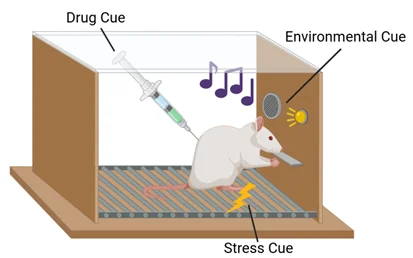
Lever pressing can be induced in rats that have previously had access to a drug with abuse potential by exposure to the drug, environmental cues or stress cues.
Just as simultaneous cues can cause increased craving in people, combining these cues can increase drug seeking in animals. For example, pairing a drug cue with environmental cues can have a synergistic effect that results in exaggerated drug seeking behaviors.
At Sygnature Discovery, we tested whether varenicline, an approved smoking cessation therapy, would decrease drug seeking in our nicotine reinstatement model. In the clinic, varenicline reduces cravings for nicotine products. We validated our reinstatement model with a clinically relevant control so that it can be utilized in assessing efficacy of novel treatments.
Rats were implanted with a jugular vein catheter for efficient drug delivery. Rats were then given daily access to a lever, which when pressed administer a small dose of nicotine. Every delivery of nicotine was paired with a tone and light cue. Rats quickly associated the lever with the nicotine reward and were performing approximately 80 lever presses during each 1.5-hour session.
During the abstinence phase, both nicotine and the associated cue were removed, leading to a reduction in response to less than 20 lever presses per session. Finally, the tone and light cues were reintroduced, and rats were administered a single nicotine dose before each session. To assess the ability of varenicline at reducing nicotine cravings, vehicle or varenicline was administered in combination with the nicotine.
In vehicle-treated rats, presentation of the conditioned cues induced lever pressing comparable to those seen during nicotine availability, despite no drug being delivered. In contract, varenicline-treated rats markedly reduced lever pressing in a dose-dependent manner. At the highest dose, rats performed, on average, on one lever press per session.
These results confirm that varenicline reduced nicotine-seeking behavior is response to drug and environmental cues, closely mirroring its clinical effects in people with nicotine use disorder.
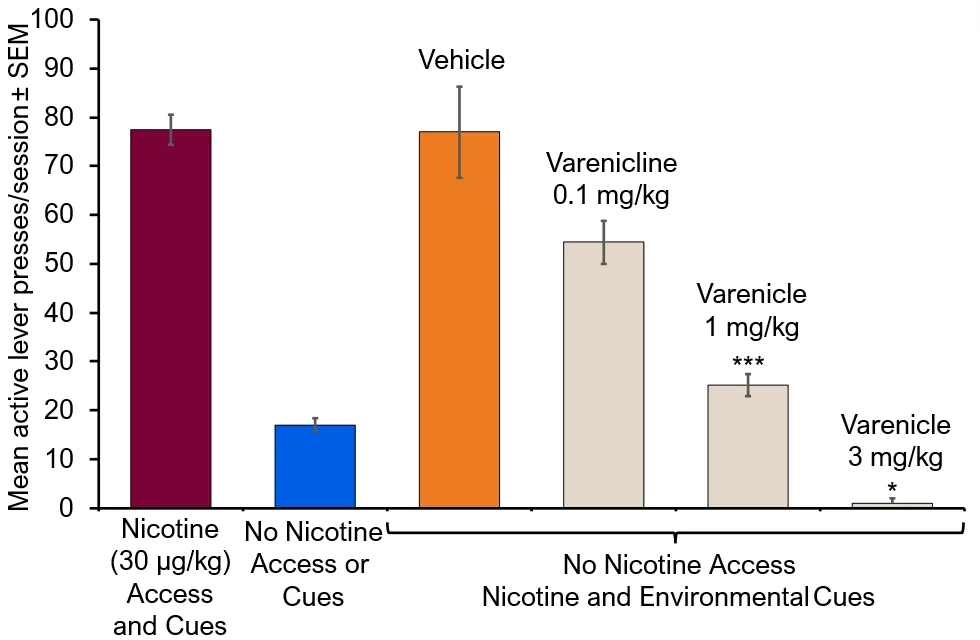
Mean active lever presses per session when responding for; 1) nicotine with paired cues 2) no nicotine access or cues (lever presses are counted but have no response) 3) reinstatement following vehicle pre-treatment 4) reinstatement following varenicline (0.1, 1 % 3 mg/kg) pre-treatment. *p<0.05, **p<0.01 versus vehicle pre-treatment.
This article forms part of a four-part series exploring substance use disorders through the three-phase model of addiction and the preclinical behavioral pharmacology models used to support drug discovery.
Together, these articles examine how addiction develops, why it is so persistent, and how validated in vivo models are used to assess new therapeutic approaches.
An introduction to substance use disorders, the three-phase addiction model, and the role of behavioral pharmacology.
How reward-driven drug use and escalation are modelled in vivo.
Assessing dependence, withdrawal symptoms and maintenance therapies.
Understanding cue-induced relapse using reinstatement paradigms.

Addiction research depends on validated in vivo behavioral pharmacology models to assess reward, reinforcement, dependence and relapse-relevant behaviors.
These approaches form part of Sygnature Discovery’s CNS & pain in vivo pharmacology capabilities, supporting translational neuroscience and substance use disorder drug discovery from early research through to clinical decision-making.

Test