


Featured Resources
-
STORM Therapeutics: From Lead to Pre-Candidate Nomination in 18 Months

STORM Therapeutics: From Lead to Pre-Candidate Nomination in 18 Months
Case study




Discover precise insights into brain neurochemistry with Sygnature Discovery's in vivo microdialysis and cOFM services. With over 20 years of expertise, we design bespoke studies that reveal how compounds modulate neurotransmitter systems in health and disease. Using UHPLC/HPLC with electrochemical detection or mass spectrometry, we deliver robust PK/PD data to support confident CNS decision making.


July 30, 2015

Inobrodib, an exciting, first-in-class oral anti-cancer drug in clinical development by CellCentric, was collaboratively designed, synthesized and supported on its pre-clinical journey by an integrated project team at Sygnature Discovery. Inobrodib is now showing promising results in Phase I and II trials for multiple myeloma and other cancer types.

February 3, 2026

Stay up to date with the latest company updates, milestones, and announcements.
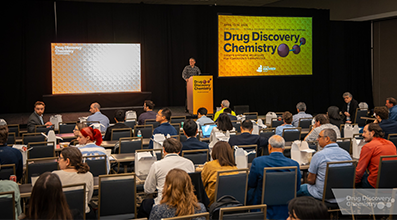
Explore upcoming conferences and scientific meetings where you can connect with our team.

At Sygnature Discovery, we deliver world-leading drug discovery solutions to accelerate your compound from idea to clinic.

Our leadership team brings diverse experience and insight, driving collaboration and innovation across drug discovery.

Explore careers at Sygnature Discovery and join a global team committed to science, collaboration, and integrity.
Inobrodib, an exciting, first-in-class oral anti-cancer drug in clinical development by CellCentric, was collaboratively designed, synthesized and supported on its pre-clinical journey by an integrated project team at Sygnature Discovery. Inobrodib is now showing promising results in Phase I and II trials for multiple myeloma and other cancer types.
At Sygnature Discovery, we deliver world-leading drug discovery solutions to accelerate your compound from idea to clinic.
Our leadership team brings diverse experience and insight, driving collaboration and innovation across drug discovery.
Explore careers at Sygnature Discovery and join a global team committed to science, collaboration, and integrity.

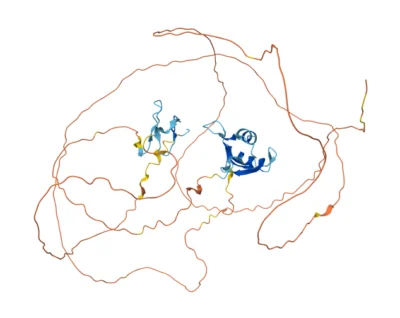
When we think about proteins, we usually picture them as having a well-defined, three-dimensional, globular shape; however, this doesn’t apply to intrinsically disordered proteins or regions (IDPs/IDRs), which lack a fixed structure. IDPs/IDRs constitute at least 33% of the eukaryotic proteome.1,6 IDPs are of significant interest to biotech and pharmaceutical companies because they are involved in many pathologies. As a result, IDPs have emerged as promising candidates for drug design.
In this blog we delve into the world of IDPs to understand their biophysics and their significance both to biology and drug design.
By definition, an IDP is a polypeptide chain that lacks a stable structure and remains highly dynamic under physiological conditions, a characteristic crucial for their biological functions. These proteins can adopt transient, non-globular conformations, possessing secondary or tertiary structures.1,2,3 Short disorder regions are associated with flexible linker or loops, while long disordered regions are associated with recognition sites for protein – protein interactions due to their structural and functional independence from the rest of the protein core.1
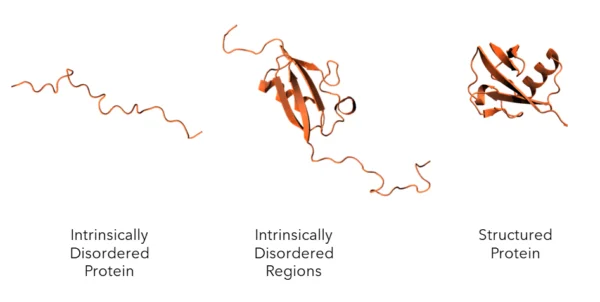
IDPs are found in the proteomes of all kingdoms of life and play vital roles in various biological processes, often by participating in protein-protein interactions that govern key cellular functions such as transcription and cell-cycle regulation. While all proteins are made of amino acids linked by peptide bonds, disordered proteins have a different amino acid composition compared to globular proteins, resulting in a wider range of conformational and structural heterogeneity. IDPs generally favor hydrophilic amino acids over hydrophobic residues. As a result, they are typically rich in arginine, glutamine, glutamic acid, lysine, proline, and serine, while being deficient in cysteine, isoleucine, leucine, phenylalanine, tryptophan, tyrosine, and valine.
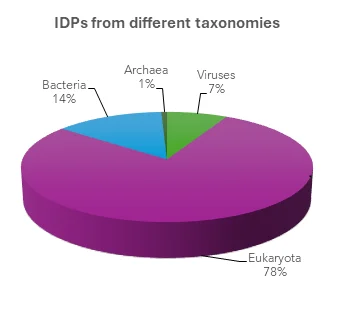
The proportion of structural disorder increases with genome complexity, from bacteria to archaea to eukaryotes. Approximately 78% of eukaryotic proteins contain long intrinsically disordered regions (IDRs), compared to 12-14% in bacteria and 1% in archaea.
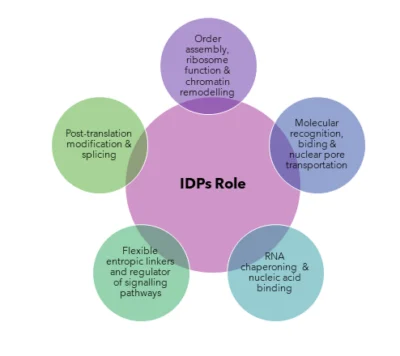
The primary roles of IDPs and IDRs are in signaling and regulation within and between cells. They are involved in processes such as post-translational modification, alternative splicing, cell division, nucleic acid replication and repair, and response to external stimuli. Their lack of stable structure allows IDPs to interact with multiple partners, facilitating complex signaling networks. Phosphorylation and other post-translational modifications (PTMs), which are predominantly located in IDRs, significantly influence their conformation and interactions8,9. Additionally, alternative splicing often affects disordered regions, making it less disruptive compared to structured regions10.
IDPs play crucial roles in cellular functions, and their dysregulation can lead to diseases, particularly neurodegenerative disorders and cancer11. The tendency of IDPs to form aggregates is a hallmark of numerous neurodegenerative diseases12. For example, the IDP alpha-synuclein can form toxic aggregates that disrupt cellular functions, leading to Parkinson’s disease.
Targeting IDPs for therapeutics presents a series of challenges. Their natural dynamics make them difficult targets for traditional strategies, which typically involve small molecules binding to well-defined pockets.13 However, the ability of short amino acid sequences to bind diverse molecules suggests that rationally identifying small-molecule drugs targeting disordered proteins is feasible based on their sequence characteristics11. Recent advances in drug discovery and protein engineering suggest that stabilizing certain IDP conformations could prevent protein-protein interactions and mitigate toxic aggregation, making IDPs potential therapeutic targets.
The structural plasticity of IDPs makes them difficult to study with traditional drug discovery biophysics approaches. However, Nuclear Magnetic Resonance (NMR) spectroscopy in solution is valuable for exploring protein-ligand interactions in IDPs for therapeutic purposes. These techniques are available within the Protein & Structure department at Sygnature Discovery.
Understanding the structural and dynamic properties of proteins is crucial for drug discovery. Historically, most attention has been given to well-structured proteins. However, this subset of disordered proteins is now at the forefront of research.
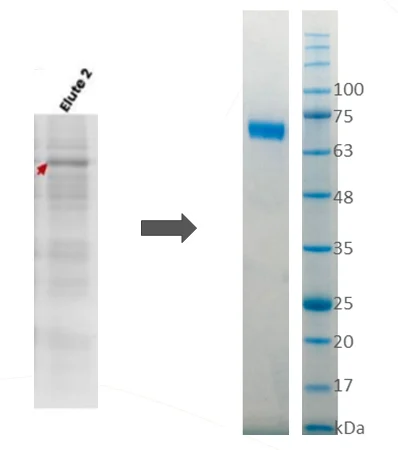
Here at Sygnature Discovery, we pride ourselves on our extensive experience of working with these fascinating molecules. Our team possesses extensive expertise in protein biochemistry, cell science, structural biology, and biophysics, all dedicated to unraveling the complexities of IDPs and IDRs. We have led challenging projects related to IDPs, successfully expressing, purifying, and structurally characterizing these targets. Our successes include:



Peak Proteins, NuChem Sciences, and SB Drug Discovery have now fully integrated with Sygnature Discovery.