


Featured Resources
-
STORM Therapeutics: From Lead to Pre-Candidate Nomination in 18 Months

STORM Therapeutics: From Lead to Pre-Candidate Nomination in 18 Months
Case study




Discover precise insights into brain neurochemistry with Sygnature Discovery's in vivo microdialysis and cOFM services. With over 20 years of expertise, we design bespoke studies that reveal how compounds modulate neurotransmitter systems in health and disease. Using UHPLC/HPLC with electrochemical detection or mass spectrometry, we deliver robust PK/PD data to support confident CNS decision making.


July 30, 2015

Inobrodib, an exciting, first-in-class oral anti-cancer drug in clinical development by CellCentric, was collaboratively designed, synthesized and supported on its pre-clinical journey by an integrated project team at Sygnature Discovery. Inobrodib is now showing promising results in Phase I and II trials for multiple myeloma and other cancer types.

In drug discovery, generating targets is no longer the challenge. The real question is how to identify the few worth investing months of research and significant resources to pursue. Hear expert perspectives on how AI, pathway analysis and scientific expertise are shaping modern target identification.
July 7, 2026

Stay up to date with the latest company updates, milestones, and announcements.
Explore upcoming conferences and scientific meetings where you can connect with our team.

At Sygnature Discovery, we deliver world-leading drug discovery solutions to accelerate your compound from idea to clinic.

Our leadership team brings diverse experience and insight, driving collaboration and innovation across drug discovery.

Explore careers at Sygnature Discovery and join a global team committed to science, collaboration, and integrity.
Inobrodib, an exciting, first-in-class oral anti-cancer drug in clinical development by CellCentric, was collaboratively designed, synthesized and supported on its pre-clinical journey by an integrated project team at Sygnature Discovery. Inobrodib is now showing promising results in Phase I and II trials for multiple myeloma and other cancer types.
At Sygnature Discovery, we deliver world-leading drug discovery solutions to accelerate your compound from idea to clinic.
Our leadership team brings diverse experience and insight, driving collaboration and innovation across drug discovery.
Explore careers at Sygnature Discovery and join a global team committed to science, collaboration, and integrity.
Discover precise insights into brain neurochemistry with Sygnature Discovery’s in vivo microdialysis and cOFM services. With over 20 years of expertise, we design bespoke studies that reveal how compounds modulate neurotransmitter systems in health and disease. Using UHPLC/HPLC with electrochemical detection or mass spectrometry, we deliver robust PK/PD data to support confident CNS decision making.
Sygnature Discovery is a leading provider of intracerebral microdialysis services in rats and mice using passive methodologies and has just introduced the use of cerebral open flow microperfusion technology as part of its neurochemistry offering. Our dedicated team of experts have been conducting microdialysis studies for more than 20 years and can design bespoke studies to meet clients’ precise needs.
Microdialysis is a technique which studies the effects of drugs on free concentrations of neurotransmitters and neuromodulators in different brain regions of freely moving or anesthetized rodents. Typically, these studies evaluate the mode of action and/or efficacy of candidate compounds with potential for the treatment of CNS and metabolic disorders by characterizing their effects on neurochemistry in normal rodents and/or rodent models of a disease state.
cOFM is an evolution of microdialysis that replaces the membrane at the tip of the probe with an open matrix, allowing direct sampling of the interstitial fluid as opposed to the passive diffusion method utilized by standard microdialysis. This in turn allows for greater recovery of analytes. The materials the cOFM probes are made from are designed to be as low bind as possible, allowing better recovery of lipophilic compounds and endogenous analytes. Their materials are also more inert than the membranes of traditional microdialysis probes meaning tissue reactivity to cOFM probes is minimal, significantly reducing glial scarring associated with long term implantation. This lends them to being ideal for PK/PD assessments as the disruption to the blood-brain barrier from implantation can be left to heal prior to sampling (recommended 2‑week recovery period for complete healing of BBB) leading to better compartmentalization between ISF, CSF and plasma.
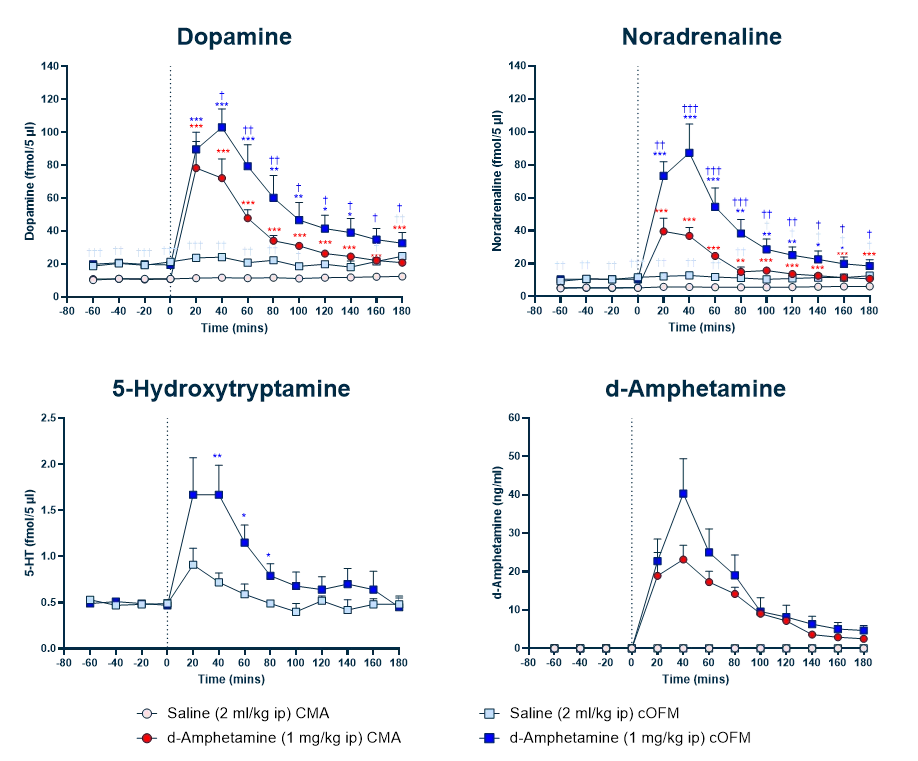
Results are adjusted means; n=6 (CMA) n=5-6 (cOFM). SEMs are calculated from the residuals of the statistical model. Comparisons to vehicle for each probe are by the multiple t test. Significant differences vs vehicle: *p<0.05, **p<0.01, ***p<0.001. Comparisons to the CMA probe (†p<0.05, ††p<0.01, †††p<0.001) are by a mixed linear model.
For either microdialysis or cOFM studies, the design is customizable to the clients’ needs including:
Single-probe studies measure the effects of drugs on multiple neurotransmitters and their metabolites from a single region of interest in the same study.
Dual-probe studies allow investigation multiple brain areas simultaneously in the same study.
Our model also makes it possible to combine rat neurochemistry with behavioral assessment (using the Ethovision software, Noldus or Raturn, BASi) and automated stress-free blood sampling (using the Culex Bambino/Raturn System; BASi) for PK measurements to generate a detailed PK/PD assessment.
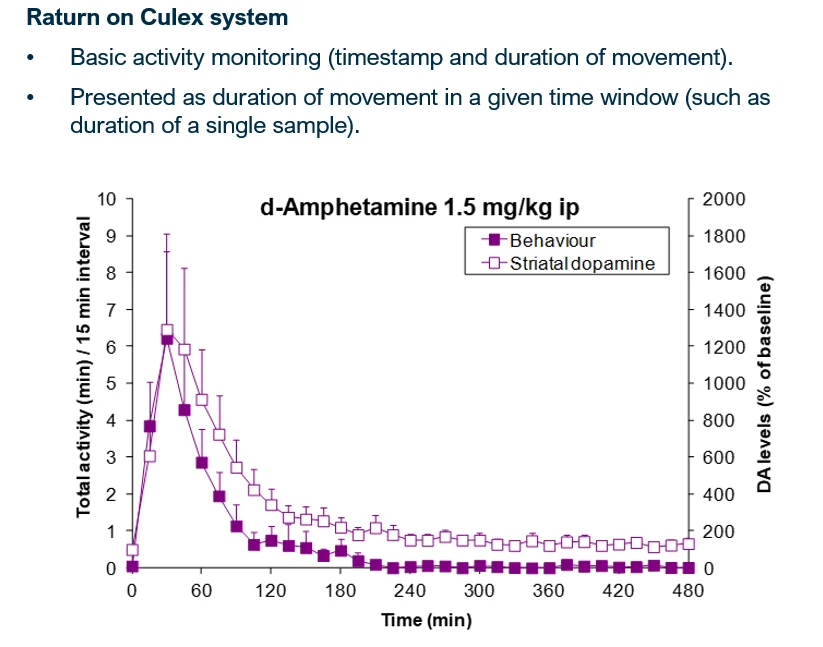
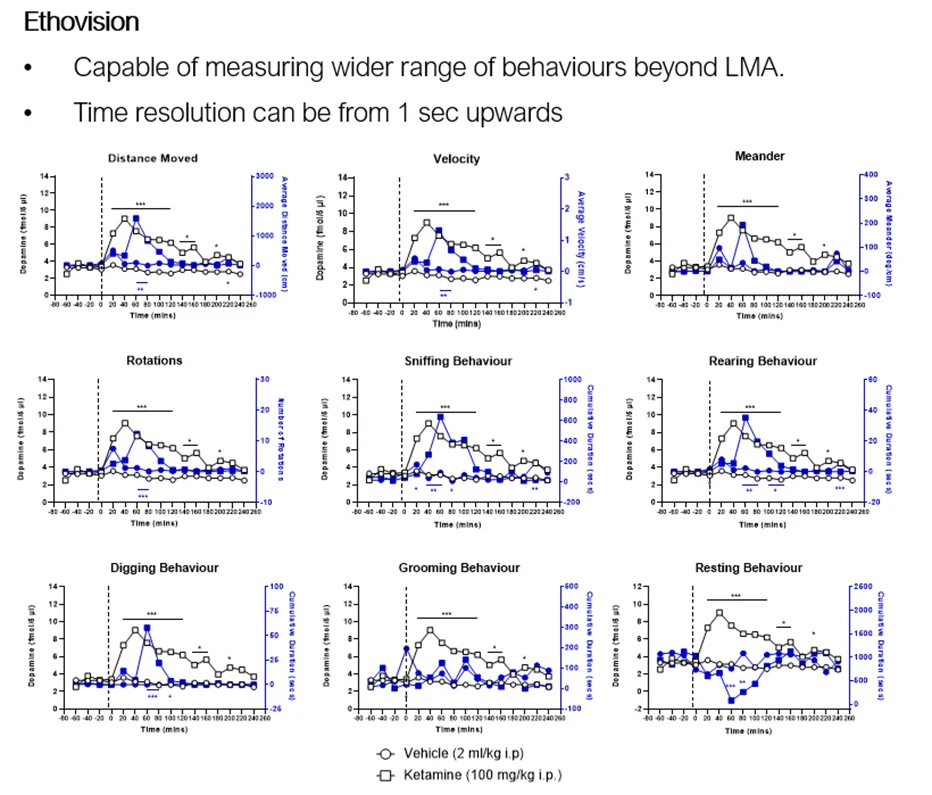
Samples generated from neurochemistry studies can also be used to look at the recovery and measurement of free drug concentrations in the brain, or to measure drug and neurotransmitter levels in the same dialysate sample.
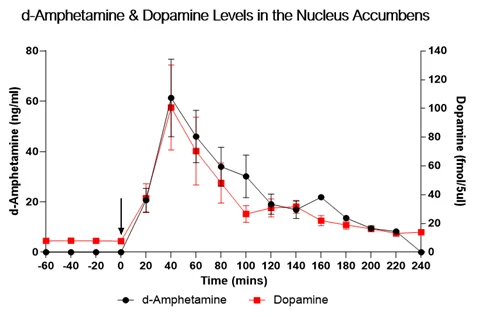
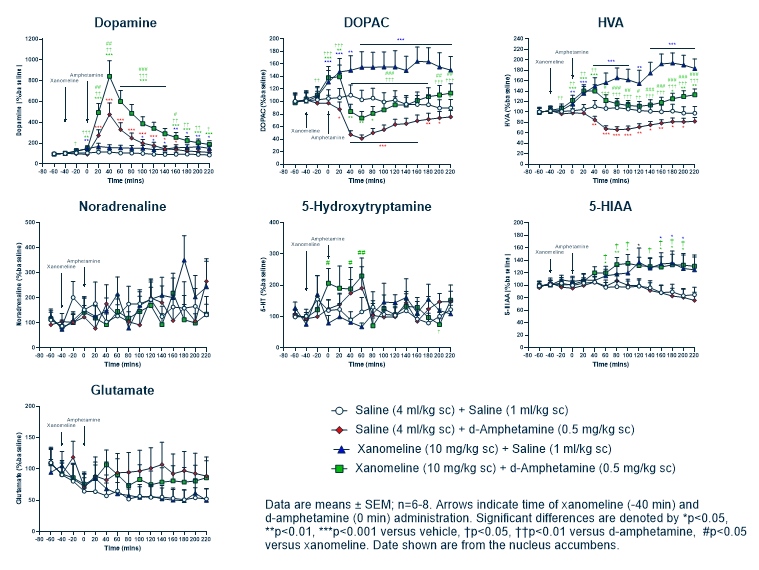
Neurochemistry plays a critical role in assessing abuse liability. Many drugs of abuse are associated with increased extracellular dopamine in the rat nucleus accumbens. Using microdialysis, we can monitor how novel treatments for substance use disorders influence this response, or whether a novel drug is likely to possess abuse potential.
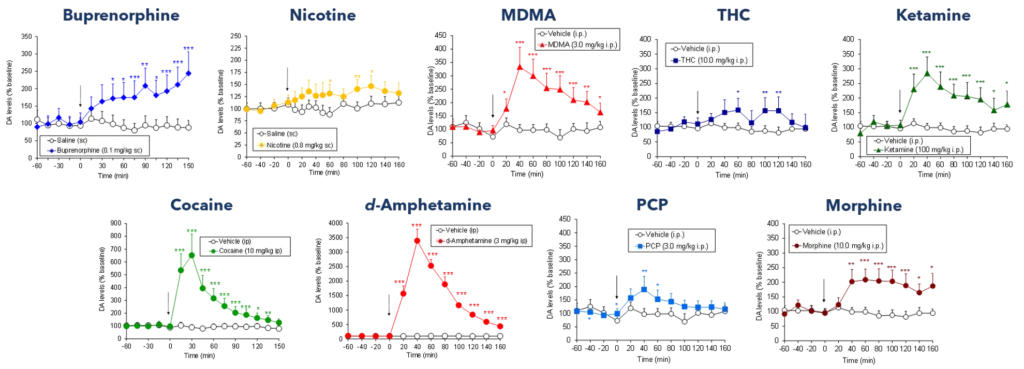
Data are means; n=5-10. Vertical arrows indicate time of drug administration (0 min). Significant differences vs vehicle: *p<0.05, **p<0.01, ***p<0.001.
Contact us to discuss how intracerebral microdialysis or cOFM could support your CNS program.

Peak Proteins, NuChem Sciences, and SB Drug Discovery have now fully integrated with Sygnature Discovery.