


Featured Resources
-
STORM Therapeutics: From Lead to Pre-Candidate Nomination in 18 Months

STORM Therapeutics: From Lead to Pre-Candidate Nomination in 18 Months
Case study


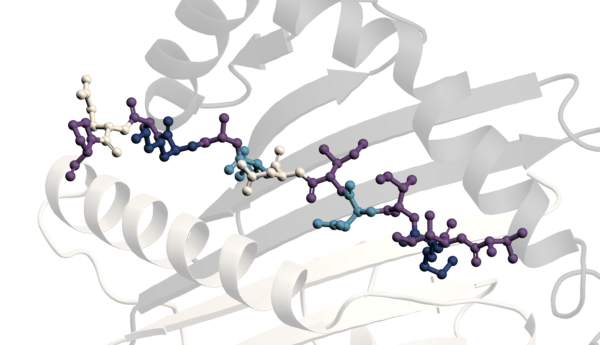


Discover precise insights into brain neurochemistry with Sygnature Discovery's in vivo microdialysis and cOFM services. With over 20 years of expertise, we design bespoke studies that reveal how compounds modulate neurotransmitter systems in health and disease. Using UHPLC/HPLC with electrochemical detection or mass spectrometry, we deliver robust PK/PD data to support confident CNS decision making.


July 30, 2015

Inobrodib, an exciting, first-in-class oral anti-cancer drug in clinical development by CellCentric, was collaboratively designed, synthesised and supported on its pre-clinical journey by an integrated project team at Sygnature Discovery. Inobrodib is now showing promising results in Phase I and II trials for multiple myeloma and other cancer types.

In drug discovery, generating targets is no longer the challenge. The real question is how to identify the few worth investing months of research and significant resources to pursue. Hear expert perspectives on how AI, pathway analysis and scientific expertise are shaping modern target identification.
July 7, 2026

Stay up to date with the latest company updates, milestones, and announcements.
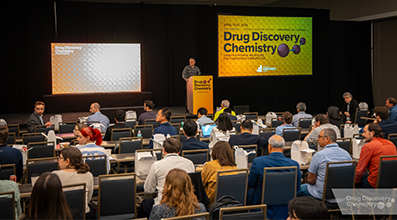
Explore upcoming conferences and scientific meetings where you can connect with our team.

At Sygnature Discovery, we deliver world-leading drug discovery solutions to accelerate your compound from idea to clinic.

Our leadership team brings diverse experience and insight, driving collaboration and innovation across drug discovery.

Explore careers at Sygnature Discovery and join a global team committed to science, collaboration, and integrity.
Inobrodib, an exciting, first-in-class oral anti-cancer drug in clinical development by CellCentric, was collaboratively designed, synthesised and supported on its pre-clinical journey by an integrated project team at Sygnature Discovery. Inobrodib is now showing promising results in Phase I and II trials for multiple myeloma and other cancer types.
At Sygnature Discovery, we deliver world-leading drug discovery solutions to accelerate your compound from idea to clinic.
Our leadership team brings diverse experience and insight, driving collaboration and innovation across drug discovery.
Explore careers at Sygnature Discovery and join a global team committed to science, collaboration, and integrity.
Sygnature Discovery’s Plasma Protein Binding (PPB) assay evaluates the extent to which drug molecules bind to plasma proteins across multiple preclinical species. Using a Rapid Equilibrium Dialysis (RED) system, the assay determines the fraction of unbound drug in the plasma through LC-MS/MS quantification of compound concentrations across plasma and buffer samples. Only unbound drug is available to distribute into tissues, interact with its biological target, undergo metabolism, or be cleared from the body. As a result, accurate PPB assessment is a fundamental component of early-stage drug discovery, supporting comparison of binding across species, informing translation, dose predictions and in vitro to in vivo extrapolation assessment.
Validation studies assessed binding across five species (Human, Rat, Mouse, Dog and Monkey) using panels of structurally diverse compounds, spanning a wide range of acid/base classes, molecular weights and lipophilicities. Compounds included Levofloxacin, Propranolol, Nicardipine, Oxaprozin and Itraconazole, representing a spectrum of binding capabilities from moderate to highly bound (>99%).
The workflow supports efficient processing of multiple compounds, offering a scalable and reproducible platform suitable for early discovery PPB screening as well as more detailed characterisation of highly bound compounds where the fraction unbound must be resolved with confidence (ICH M12 guidelines). Because the method captures both binding and recovery data, it offers a comprehensive assessment of compound behaviour in plasma.
The PPB assay workflow is initiated when test compounds are spiked into plasma and transferred to the relevant matrix compartment within the RED device, while buffer is loaded into the adjacent chamber. During incubation, unbound drug diffuses across the semi-permeable membrane while bound drug remains confined to the plasma due to the membranes molecular weight cut-off. Over the course of the incubation, an equilibrium is established between the two compartments.
After completion of the incubation period, samples from both chambers undergo matrix matching and protein precipitation before LC–MS/MS analysis. Quantitative assessment of fraction unbound, percentage bound and compound recovery is achieved using a calibration curve and determination of mass balance. The method relies on established analytical procedures, ensuring consistent and high‑quality quantification across diverse matrices.
Validation results across both the standard and 18-hour PPB assay setups demonstrated strong reproducibility across all species evaluated.
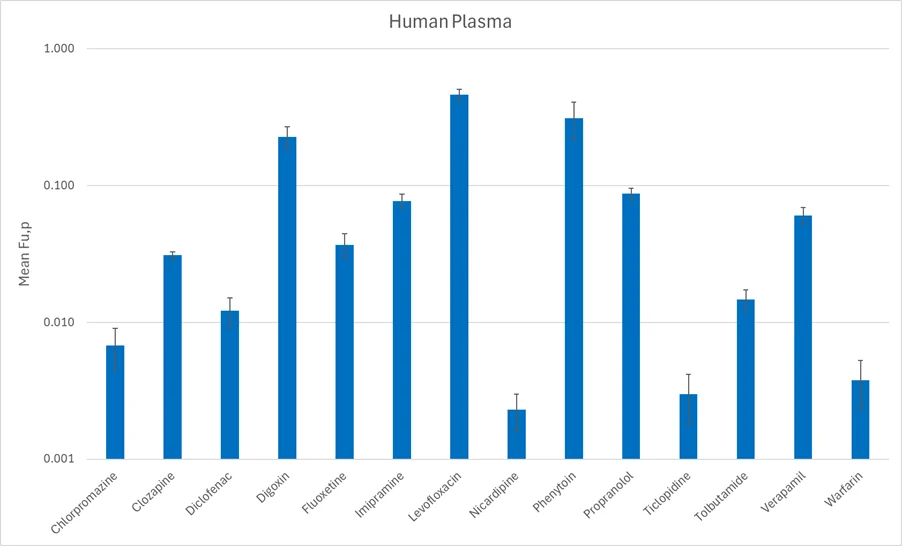
Standard PPB Assay – The human plasma dataset included 14 compounds with mean percentage bound values ranging from 53.80% to >99.77%, and coefficients of variation (CV) generally below 1%, indicating excellent assay precision. Mouse, rat, dog and monkey plasma results showed similarly robust performance, with binding values and CVs demonstrating consistent cross‑species reliability.
The graph below presents the validated inter-assay performance of human plasma.
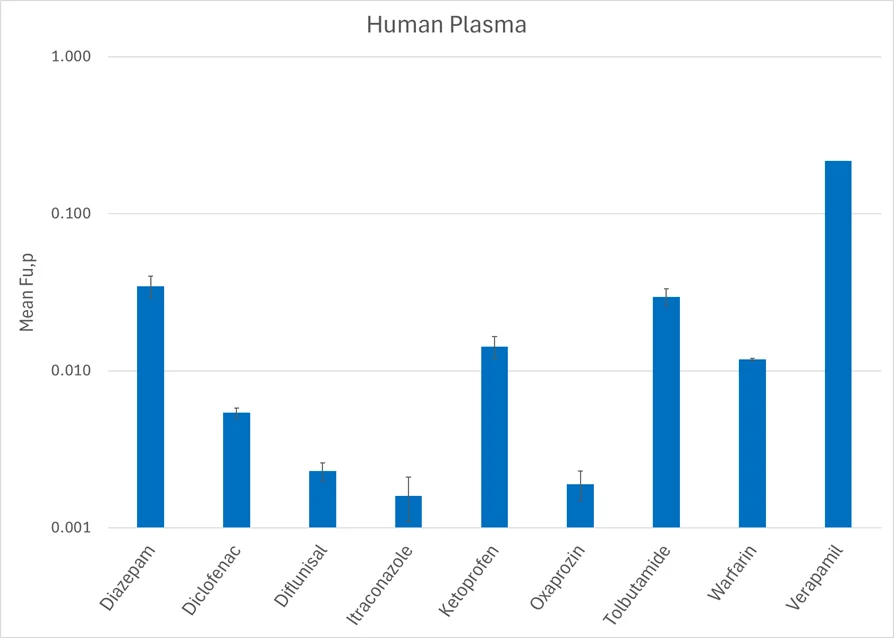
18-hour PPB Assay – A diverse test set of nine compounds was assessed in human plasma, with mean binding values ranging from 78.24% to 99.84% and CVs typically below 1%, demonstrating excellent inter‑assay consistency. Mouse, rat, dog, and monkey plasma also showed consistently low variability and strong reproducibility, confirming that the extended‑duration method performs reliably across all evaluated species.
The graph below presents the validated inter-assay performance of human plasma.
Peak Proteins, NuChem Sciences, and SB Drug Discovery have now fully integrated with Sygnature Discovery.