


Featured Resources
-
STORM Therapeutics: From Lead to Pre-Candidate Nomination in 18 Months

STORM Therapeutics: From Lead to Pre-Candidate Nomination in 18 Months
Case study




Discover precise insights into brain neurochemistry with Sygnature Discovery's in vivo microdialysis and cOFM services. With over 20 years of expertise, we design bespoke studies that reveal how compounds modulate neurotransmitter systems in health and disease. Using UHPLC/HPLC with electrochemical detection or mass spectrometry, we deliver robust PK/PD data to support confident CNS decision making.


July 30, 2015

Inobrodib, an exciting, first-in-class oral anti-cancer drug in clinical development by CellCentric, was collaboratively designed, synthesised and supported on its pre-clinical journey by an integrated project team at Sygnature Discovery. Inobrodib is now showing promising results in Phase I and II trials for multiple myeloma and other cancer types.

In drug discovery, generating targets is no longer the challenge. The real question is how to identify the few worth investing months of research and significant resources to pursue. Hear expert perspectives on how AI, pathway analysis and scientific expertise are shaping modern target identification.
July 7, 2026

Stay up to date with the latest company updates, milestones, and announcements.
Explore upcoming conferences and scientific meetings where you can connect with our team.

At Sygnature Discovery, we deliver world-leading drug discovery solutions to accelerate your compound from idea to clinic.

Our leadership team brings diverse experience and insight, driving collaboration and innovation across drug discovery.

Explore careers at Sygnature Discovery and join a global team committed to science, collaboration, and integrity.
Inobrodib, an exciting, first-in-class oral anti-cancer drug in clinical development by CellCentric, was collaboratively designed, synthesised and supported on its pre-clinical journey by an integrated project team at Sygnature Discovery. Inobrodib is now showing promising results in Phase I and II trials for multiple myeloma and other cancer types.
At Sygnature Discovery, we deliver world-leading drug discovery solutions to accelerate your compound from idea to clinic.
Our leadership team brings diverse experience and insight, driving collaboration and innovation across drug discovery.
Explore careers at Sygnature Discovery and join a global team committed to science, collaboration, and integrity.
Sygnature Discovery’s Blood Plasma Partitioning (BPP) assay quantifies how test compounds distribute between whole blood and plasma, expressed as the blood-to-plasma ratio (B:P). This distribution is influenced by factors such as lipophilicity, non-specific binding, red blood cell uptake, ion trapping and plasma protein binding. By determining how a compound partitions between plasma and cellular blood components, the assay provides insight into the most appropriate biological matrix for pharmacokinetic interpretation enabling more accurate in vivo predictions.
The assay was validated using human blood and a panel of nine structurally diverse compounds, which exhibit a range of blood-plasma partitioning profiles. The compounds selected were: Methazolamide, Sumatriptan, Chlorpromazine, Digoxin, Midazolam, Metoprolol, Chloroquine, Diclofenac, and Verapamil.
The assay workflow begins with parallel incubation of each test compound in both whole blood and plasma (N=2). Test articles are prepared from concentrated stock solutions and diluted into each matrix before undergoing a controlled incubation period with intermittent mixing to ensure homogeneity. Post‑incubation, centrifugation is used to isolate plasma from the whole blood. Samples then undergo protein precipitation using organic solvent and centrifugation, after which sample supernatants are collected and quantified via LC‑MS/MS.
Mean LC–MS/MS responses are used to determine the blood-to-plasma ratio (B:P) i.e. spiked plasma:plasma derived from blood. The spiked plasma provides a dependable reference point for whole blood response and subsequent B:P determination. As both sets of samples are matrix-matched, we eliminate any differences in matrix‑dependent variability and recovery, while also eliminating the additional complexities associated with analysing whole blood samples.
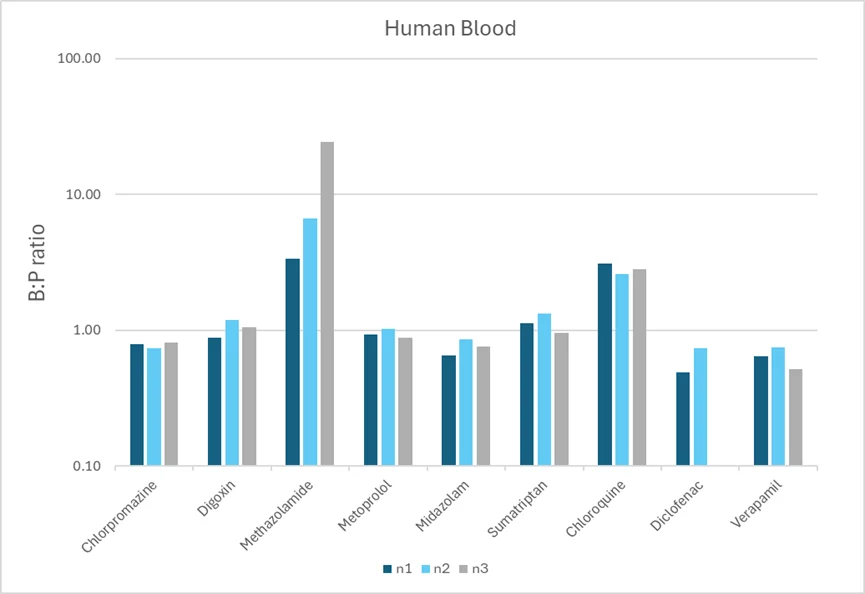
Validation demonstrated strong technical performance using human blood, with B:P ratios determined for all nine compounds. Inter-assay reproducibility was assessed by %CV across B:P replicates, with the majority of compounds demonstrating acceptable reproducibility. Intra-assay precision was assessed separately for plasma obtained from blood and directly spiked plasma, these datasets confirm good repeatability, with most compounds exhibiting mean intra-assay %CV values within acceptable boundaries.
Compounds known to have a preference for the cellular component of blood e.g. Methazolamide and Chloroquine returned B:P values >1. Compounds known to have a preference for blood plasma e.g. Diclofenac returned B:P values <1 and compounds such as Digoxin and Metoprolol known to distribute evenly between both components returned B:P values ~1.
The graph below shows inter-assay performance of the assay in human blood:
Peak Proteins, NuChem Sciences, and SB Drug Discovery have now fully integrated with Sygnature Discovery.