



Featured Resources
-
STORM Therapeutics: From Lead to Pre-Candidate Nomination in 18 Months

STORM Therapeutics: From Lead to Pre-Candidate Nomination in 18 Months
Case study




Discover precise insights into brain neurochemistry with Sygnature Discovery's in vivo microdialysis and cOFM services. With over 20 years of expertise, we design bespoke studies that reveal how compounds modulate neurotransmitter systems in health and disease. Using UHPLC/HPLC with electrochemical detection or mass spectrometry, we deliver robust PK/PD data to support confident CNS decision making.


July 30, 2015

Inobrodib, an exciting, first-in-class oral anti-cancer drug in clinical development by CellCentric, was collaboratively designed, synthesised and supported on its pre-clinical journey by an integrated project team at Sygnature Discovery. Inobrodib is now showing promising results in Phase I and II trials for multiple myeloma and other cancer types.

In drug discovery, generating targets is no longer the challenge. The real question is how to identify the few worth investing months of research and significant resources to pursue. Hear expert perspectives on how AI, pathway analysis and scientific expertise are shaping modern target identification.
July 7, 2026

Stay up to date with the latest company updates, milestones, and announcements.
Explore upcoming conferences and scientific meetings where you can connect with our team.

At Sygnature Discovery, we deliver world-leading drug discovery solutions to accelerate your compound from idea to clinic.

Our leadership team brings diverse experience and insight, driving collaboration and innovation across drug discovery.

Explore careers at Sygnature Discovery and join a global team committed to science, collaboration, and integrity.
Inobrodib, an exciting, first-in-class oral anti-cancer drug in clinical development by CellCentric, was collaboratively designed, synthesised and supported on its pre-clinical journey by an integrated project team at Sygnature Discovery. Inobrodib is now showing promising results in Phase I and II trials for multiple myeloma and other cancer types.
At Sygnature Discovery, we deliver world-leading drug discovery solutions to accelerate your compound from idea to clinic.
Our leadership team brings diverse experience and insight, driving collaboration and innovation across drug discovery.
Explore careers at Sygnature Discovery and join a global team committed to science, collaboration, and integrity.
The CYP450 Reaction Phenotyping (RePh) assay determines which human CYP450 isoforms are responsible for metabolising a test compound using recombinant enzymes expressed in E.coli bactosomes. This mechanistic assay supports early DMPK decision‑making by identifying metabolic pathways, potential drug–drug interaction liabilities, and whether clearance occurs through multiple CYP450 enzymes. The assay evaluates metabolism across the major human isoforms—CYP1A2, CYP2B6, CYP2C8, CYP2C9, CYP2C19, CYP2D6 and CYP3A4/5—using substrate depletion as the measurement endpoint. By monitoring loss of parent drug over time, the assay quantifies intrinsic clearance (CLint), elimination rate constant (k) and half‑life (t½), generating a clear profile of isoform‑selective metabolism. RePh includes FDA, EMA and ICH‑recommended probe substrates as positive controls, ensuring regulatory relevance. Because the bactosome system contains isolated, individually expressed recombinant CYPs, it enables unambiguous assessment of isoform involvement without confounding secondary pathways. Combined with high‑sensitivity LC‑MS/MS quantification, the assay delivers robust, reproducible enzyme‑specific clearance data. This makes RePh an essential screen for identifying metabolic soft spots, prioritising chemistry optimisation strategies and informing human PK predictions. Overall, the assay provides high‑confidence attribution of CYP involvement in NCE metabolism and is a critical component of modern DMPK workflows.
The RePh workflow begins with preparation of recombinant CYP bactosomes, probe substrates and test compounds. Bactosomes are thawed, diluted and combined with buffer components and test articles to create isoform‑specific incubation mixtures. After an initial equilibration step, reactions are initiated by cofactor addition, allowing CYP‑mediated metabolism to proceed. Samples are removed at scheduled timepoints to capture parent‑drug depletion profiles. A parallel control incubation using an empty‑plasmid bactosome preparation is run for each compound, supporting correction for non‑specific compound loss. Reaction termination is achieved by addition of acetonitrile, followed by centrifugation and sampling of supernatant for LC‑MS/MS analysis. Chromatographic methods quantify remaining parent compound across all timepoints. The subsequent analysis step calculates intrinsic clearance and related parameters using first‑order depletion kinetics, with results summarised on a per‑isoform basis. Collectively, this protocol yields a high‑quality comparison of metabolic turnover across each CYP isoform, enabling mechanistic attribution of clearance pathways and early identification of potential drug–drug interaction risks.
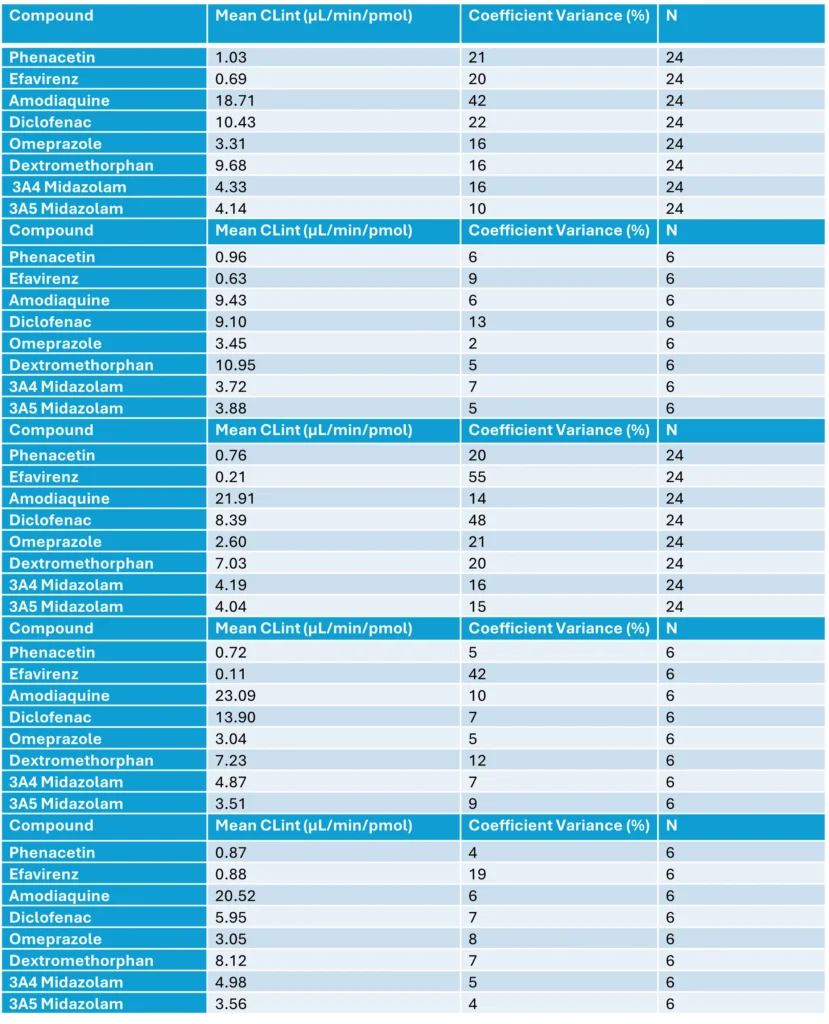
Validation demonstrated that the RePh assay delivers reliable and reproducible intrinsic clearance measurements across all major CYP450 isoforms using recombinant bactosomes. Inter‑assay performance was assessed using eight FDA‑recommended probe substrates, each tested in four independent assay runs with six technical replicates per run. The resulting intrinsic clearance values showed strong reproducibility, with coefficients of variation that confirm robust assay precision. Intra‑assay consistency was likewise strong, with low variability across replicate measures. Freeze–thaw stability was evaluated to confirm whether bactosome preparations maintained activity after multiple freeze–thaw cycles. Most CYP isoforms retained acceptable performance, with intrinsic clearance values remaining consistent and coefficients of variation below 25%, confirming that the reagent system is stable for limited reuse. Correction using control bactosomes further increased confidence in the accuracy of depletion‑based assessments by accounting for background disappearance not attributable to CYP‑mediated turnover. The collective dataset confirms that RePh provides dependable, mechanistically meaningful CYP phenotyping results suitable for informing early DMPK decisions.


Peak Proteins, NuChem Sciences, and SB Drug Discovery have now fully integrated with Sygnature Discovery.