



Featured Resources
-
STORM Therapeutics: From Lead to Pre-Candidate Nomination in 18 Months

STORM Therapeutics: From Lead to Pre-Candidate Nomination in 18 Months
Case study


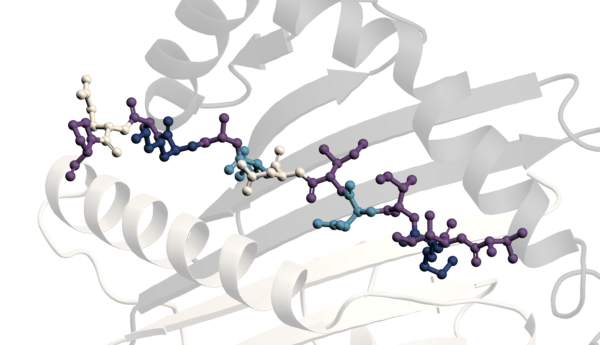


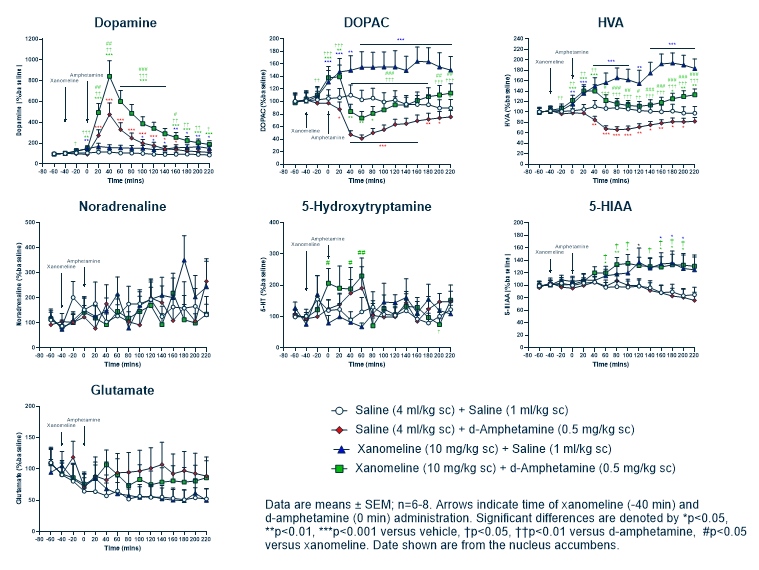
Discover precise insights into brain neurochemistry with Sygnature Discovery's in vivo microdialysis and cOFM services. With over 20 years of expertise, we design bespoke studies that reveal how compounds modulate neurotransmitter systems in health and disease. Using UHPLC/HPLC with electrochemical detection or mass spectrometry, we deliver robust PK/PD data to support confident CNS decision making.


July 30, 2015

Inobrodib, an exciting, first-in-class oral anti-cancer drug in clinical development by CellCentric, was collaboratively designed, synthesised and supported on its pre-clinical journey by an integrated project team at Sygnature Discovery. Inobrodib is now showing promising results in Phase I and II trials for multiple myeloma and other cancer types.

In drug discovery, generating targets is no longer the challenge. The real question is how to identify the few worth investing months of research and significant resources to pursue. Hear expert perspectives on how AI, pathway analysis and scientific expertise are shaping modern target identification.
July 7, 2026

Stay up to date with the latest company updates, milestones, and announcements.
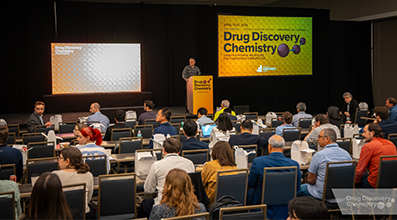
Explore upcoming conferences and scientific meetings where you can connect with our team.

At Sygnature Discovery, we deliver world-leading drug discovery solutions to accelerate your compound from idea to clinic.

Our leadership team brings diverse experience and insight, driving collaboration and innovation across drug discovery.

Explore careers at Sygnature Discovery and join a global team committed to science, collaboration, and integrity.
Inobrodib, an exciting, first-in-class oral anti-cancer drug in clinical development by CellCentric, was collaboratively designed, synthesised and supported on its pre-clinical journey by an integrated project team at Sygnature Discovery. Inobrodib is now showing promising results in Phase I and II trials for multiple myeloma and other cancer types.
At Sygnature Discovery, we deliver world-leading drug discovery solutions to accelerate your compound from idea to clinic.
Our leadership team brings diverse experience and insight, driving collaboration and innovation across drug discovery.
Explore careers at Sygnature Discovery and join a global team committed to science, collaboration, and integrity.
The CYP Inhibition assay evaluates reversible inhibition of seven major human CYP450 isoforms – CYP1A2, CYP2B6, CYP2C8, CYP2C9, CYP2C19, CYP2D6, and CYP3A4 (two substrates, Midazolam and Testosterone). These enzymes are key determinants of drug clearance, and inhibition can lead to clinically relevant drug–drug interactions. Test compounds are incubated with human liver microsomes and FDA‑recommended probe substrates specific to each isoform, allowing selective monitoring of metabolite formation via LC‑MS/MS. Inhibition of metabolite formation reflects reversible inhibition of the CYP active site, allowing determination of IC50 values. The assay supports early DMPK risk assessment and provides data essential for candidate selection.
Seven test compound concentrations are incubated with human liver microsomes and NADPH in the presence of the isoform-specific probe substrate for 5 minutes (or 15 minutes for CYP2C19) at 37 °C shaking at 700 rpm. Selective CYP inhibitors are screened alongside the test compounds as positive controls. Reactions are terminated by sampling into cold MeCN before being centrifuged at 3,000 rpm for 30 minutes at 4 °C. Formation of the metabolite is monitored by LC-MS/MS.
Formation of metabolite is measured in each sample and a percent activity calculated, 100 % is defined as the metabolite formed in the incubation containing vehicle with no test compound. Non-linear regression is used to fit a four-parameter logistic curve to a plot of percent activity against concentration of test compounds (where test concentration is plotted on a log scale). An IC50 value is obtained, this is the concentration of test compound at which 50% inhibition is achieved. Positive control compounds with known inhibition against each isoform are included.
Validation confirmed that the CYP Inhibition assay is robust, reproducible, and suitable for multi‑isoform screening across seven human CYP450 enzymes. Time and protein linearity assessments demonstrated that metabolite formation proceeded consistently within the linear phase, with incubation times and protein concentrations selected accordingly. Km and Vmax were determined, with the Km selected as the substrate concentration to be used in the assay. Repeated IC50 assessments of positive controls confirmed excellent intra‑ and inter‑assay consistency, establishing strong confidence in assay performance.
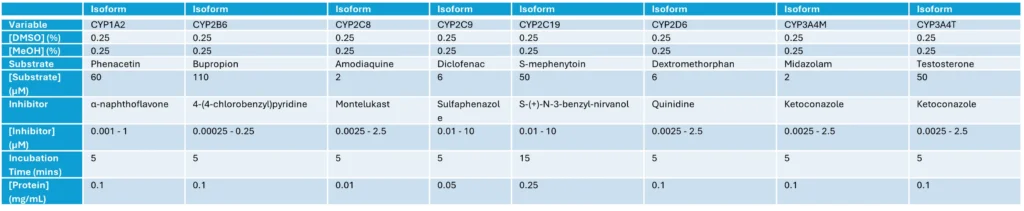
Assay conditions compiled from the validation process are provided in Table 1, including substrates, inhibitors, concentration ranges, and protein levels for each isoform. These parameters reflect optimised conditions established through empirical linearity and kinetic studies. The broad coverage of CYP isoforms, combined with strong reproducibility and alignment with FDA guidance, confirms that the assay is well‑suited for early drug‑discovery workflows requiring CYP inhibition risk assessment.

Peak Proteins, NuChem Sciences, and SB Drug Discovery have now fully integrated with Sygnature Discovery.