


Ressources
-
STORM Therapeutics: From Lead to Pre-Candidate Nomination in 18 Months

STORM Therapeutics: From Lead to Pre-Candidate Nomination in 18 Months
Case study


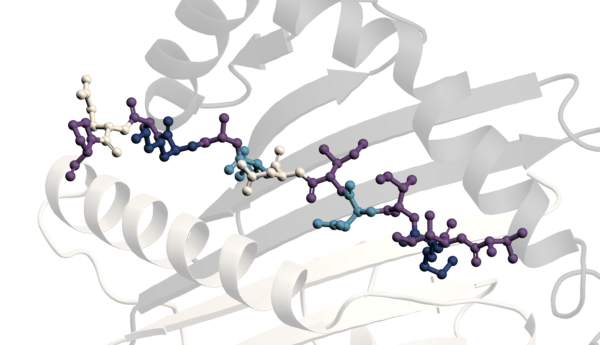


Discover precise insights into brain neurochemistry with Sygnature Discovery's in vivo microdialysis and cOFM services. With over 20 years of expertise, we design bespoke studies that reveal how compounds modulate neurotransmitter systems in health and disease. Using UHPLC/HPLC with electrochemical detection or mass spectrometry, we deliver robust PK/PD data to support confident CNS decision making.


juillet 30, 2015

Inobrodib, an exciting, first-in-class oral anti-cancer drug in clinical development by CellCentric, was collaboratively designed, synthesised and supported on its pre-clinical journey by an integrated project team at Sygnature Discovery. Inobrodib is now showing promising results in Phase I and II trials for multiple myeloma and other cancer types.

In drug discovery, generating targets is no longer the challenge. The real question is how to identify the few worth investing months of research and significant resources to pursue. Hear expert perspectives on how AI, pathway analysis and scientific expertise are shaping modern target identification.
juillet 7, 2026

Tenez‑vous au courant des dernières mises à jour de l’entreprise, des étapes clés et des annonces importantes.
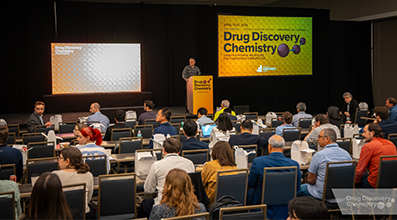
Découvrez les conférences et rencontres scientifiques à venir, où vous pourrez échanger avec notre équipe.

Chez Sygnature Discovery, nous fournissons des solutions de découverte de médicaments de classe mondiale pour accélérer la progression de vos composés, de l’idée jusqu’à la clinique.

Notre équipe de direction rassemble une diversité d’expériences et de ressources, favorisant la collaboration et l’innovation dans l’ensemble du processus de découverte de médicaments.

Explorez les opportunités de carrière chez Sygnature Discovery. Rejoignez une équipe internationale qui obtient des résultats exceptionnels grâce à la collaboration, à l’innovation et à l’intégrité.
Inobrodib, an exciting, first-in-class oral anti-cancer drug in clinical development by CellCentric, was collaboratively designed, synthesised and supported on its pre-clinical journey by an integrated project team at Sygnature Discovery. Inobrodib is now showing promising results in Phase I and II trials for multiple myeloma and other cancer types.
Chez Sygnature Discovery, nous fournissons des solutions de découverte de médicaments de classe mondiale pour accélérer la progression de vos composés, de l’idée jusqu’à la clinique.
Notre équipe de direction rassemble une diversité d’expériences et de ressources, favorisant la collaboration et l’innovation dans l’ensemble du processus de découverte de médicaments.
Explorez les opportunités de carrière chez Sygnature Discovery. Rejoignez une équipe internationale qui obtient des résultats exceptionnels grâce à la collaboration, à l’innovation et à l’intégrité.
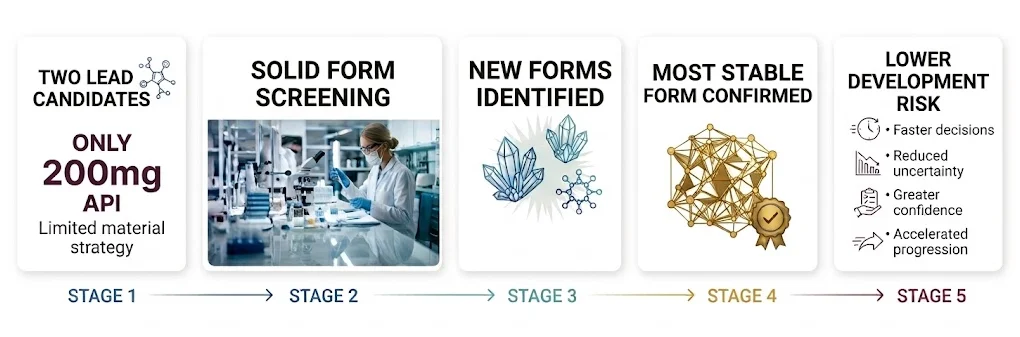
STORM Therapeutics is a clinical-stage biotechnology company focused on developing small molecule therapeutics targeting RNA-modification pathways. As part of its DHX9 inhibitor discovery program, STORM collaborated with Sygnature Discovery’s integrated drug discovery teams to rapidly progress novel chemical matter from lead identification to pre-candidate nomination in just 18 months (Figure 1).
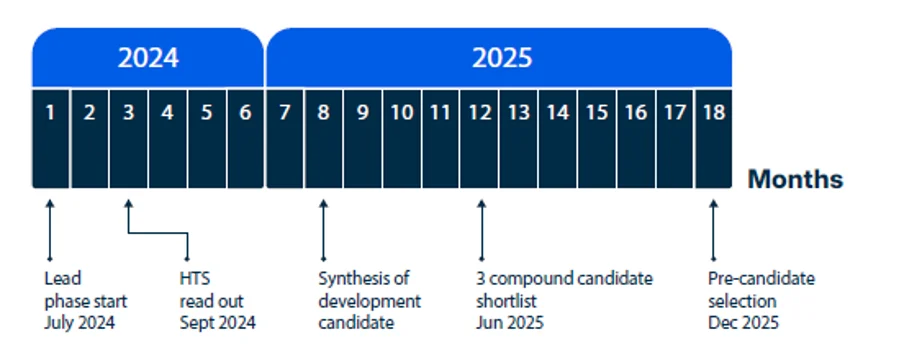
As the program entered late lead optimization, two highly differentiated DHX9 inhibitor candidates remained under consideration. Both compounds demonstrated compelling pharmacology, DMPK properties, and developability characteristics, making candidate selection challenging.
At this critical point,
Understanding the solid-state behavior of each molecule became an important factor in reducing downstream development risk.
Although both compounds were routinely isolated as crystalline solids, little was known about their solid-form landscapes.
The project team needed to answer two key questions:
Answering these questions presented an additional challenge. As is often the case during lead optimization, compound supply was limited and in high demand across multiple disciplines. Any investigation would need to generate meaningful data without consuming large quantities of material.
Rather than waiting until candidate nomination to begin investigating solid-state risk, Sygnature’s Form & Formulation scientists designed an early-stage, fit-for-purpose solid-form screening strategy.
The study was deliberately scoped to use just 200 mg of API per compound, balancing scientific rigor with the realities of a fast-moving discovery program.
Analytical methods included:
Each compound was initially characterized using complementary analytical techniques to establish a baseline understanding of the supplied solid form.
This confirmed that both compounds were being consistently produced in crystalline forms suitable for further investigation.
To maximize the opportunity for discovering alternative crystal forms, the supplied materials were first rendered amorphous to eliminate any residual crystal seeds that might bias subsequent crystallization outcomes.
This approach enabled rapid exploration of each compound’s solid-state landscape while maintaining a minimal material requirement.
Following confirmation of the amorphous state by XRPD, materials were exposed to a focused panel of ICH Class 2 and Class 3 solvents using slurry and thermal cycling methodologies designed to promote crystallization across a range of conditions.
Multiple new solid forms were isolated and characterized.
The screen identified:
A competitive slurry assessment was subsequently performed to determine the thermodynamically preferred form under relevant conditions and to assess the relative stability of the isolated forms.
Despite the limited material available, the study generated significant solid-state intelligence that directly informed program progression.
The assessment demonstrated that:
Importantly, the data demonstrated that solid-state properties should not influence candidate selection, allowing the project team to focus on other critical attributes with confidence.
While the study did not identify a clear « winner » between the two lead candidates, it delivered exactly what the project needed at that stage: risk reduction.
By establishing early confidence in the solid-state behavior of both molecules, Sygnature enabled the project team to:
Crucially, this information was generated using only a fraction of the material typically required for a comprehensive late-stage polymorph assessment.
The success of the DHX9 program relied on seamless collaboration across multiple scientific disciplines, including medicinal chemistry, DMPK, biology, translational oncology, and Form & Formulation. The broader program advanced from lead identification to pre-candidate nomination in just 18 months through Sygnature’s fully integrated discovery platform.
For the Form & Formulation team, this meant delivering development-focused insights precisely when they were needed, helping the project team balance scientific rigor, material constraints, and ambitious timelines.
Whether supporting early candidate selection, preclinical development, or IND-enabling activities, Sygnature’s solid-state scientists provide tailored, fit-for-purpose solutions that help clients move promising molecules forward with confidence.
Sygnature Discovery’s Form & Formulation team delivers integrated solid-state, pre-formulation, and developability assessments that help identify risks early, accelerate decision-making, and support successful progression toward the clinic. Contact us to find out how we can assist in your project.

Test