



Ressources
-
STORM Therapeutics: From Lead to Pre-Candidate Nomination in 18 Months

STORM Therapeutics: From Lead to Pre-Candidate Nomination in 18 Months
Case study




Discover precise insights into brain neurochemistry with Sygnature Discovery's in vivo microdialysis and cOFM services. With over 20 years of expertise, we design bespoke studies that reveal how compounds modulate neurotransmitter systems in health and disease. Using UHPLC/HPLC with electrochemical detection or mass spectrometry, we deliver robust PK/PD data to support confident CNS decision making.


juillet 30, 2015

Inobrodib, an exciting, first-in-class oral anti-cancer drug in clinical development by CellCentric, was collaboratively designed, synthesised and supported on its pre-clinical journey by an integrated project team at Sygnature Discovery. Inobrodib is now showing promising results in Phase I and II trials for multiple myeloma and other cancer types.

In drug discovery, generating targets is no longer the challenge. The real question is how to identify the few worth investing months of research and significant resources to pursue. Hear expert perspectives on how AI, pathway analysis and scientific expertise are shaping modern target identification.
juillet 7, 2026

Tenez‑vous au courant des dernières mises à jour de l’entreprise, des étapes clés et des annonces importantes.
Découvrez les conférences et rencontres scientifiques à venir, où vous pourrez échanger avec notre équipe.

Chez Sygnature Discovery, nous fournissons des solutions de découverte de médicaments de classe mondiale pour accélérer la progression de vos composés, de l’idée jusqu’à la clinique.

Notre équipe de direction rassemble une diversité d’expériences et de ressources, favorisant la collaboration et l’innovation dans l’ensemble du processus de découverte de médicaments.

Explorez les opportunités de carrière chez Sygnature Discovery. Rejoignez une équipe internationale qui obtient des résultats exceptionnels grâce à la collaboration, à l’innovation et à l’intégrité.
Inobrodib, an exciting, first-in-class oral anti-cancer drug in clinical development by CellCentric, was collaboratively designed, synthesised and supported on its pre-clinical journey by an integrated project team at Sygnature Discovery. Inobrodib is now showing promising results in Phase I and II trials for multiple myeloma and other cancer types.
Chez Sygnature Discovery, nous fournissons des solutions de découverte de médicaments de classe mondiale pour accélérer la progression de vos composés, de l’idée jusqu’à la clinique.
Notre équipe de direction rassemble une diversité d’expériences et de ressources, favorisant la collaboration et l’innovation dans l’ensemble du processus de découverte de médicaments.
Explorez les opportunités de carrière chez Sygnature Discovery. Rejoignez une équipe internationale qui obtient des résultats exceptionnels grâce à la collaboration, à l’innovation et à l’intégrité.
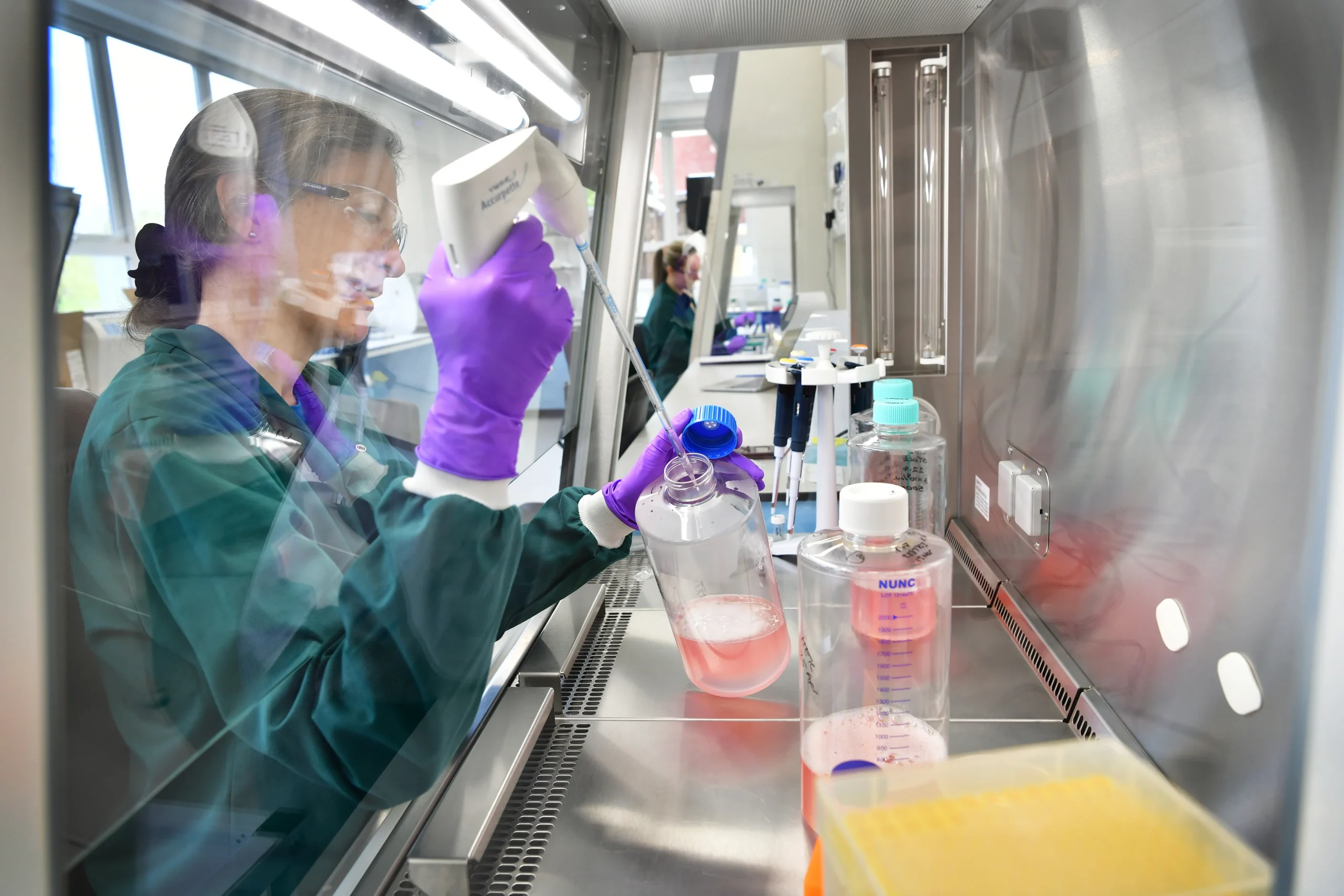
As part of the onboarding process, we compared expression of various test proteins, including 4 antibodies in ExpiCHO‑STM with our well-established CHO-3E7 cell line and we present that data below.
It has always been our philosophy to choose the expression host cell based on the nature of protein target itself and where there are multiple possible options, to perform a comparison screen early in a programme. Different targets respond differently to each system, and selecting the right platform from the outset can:
Within our Cell Science team, we offer a diverse suite of eukaryotic expression systems to support proteins of varying complexity and production needs. Our portfolio now includes:
Mammalian expression platforms are essential for producing proteins that closely replicate their natural human counterparts, making them vital for both research and biotherapeutic development. Unlike bacterial or insect systems, mammalian cells provide the full repertoire of human‑like post‑translational modifications (PTMs)—particularly glycosylation, disulfide bond formation, and complex folding pathways—that many secreted, membrane, and multi‑subunit proteins require to be stable and functional. These systems also offer the appropriate lipid environment, chaperones, and trafficking machinery needed for challenging targets such as GPCRs, cytokines, and antibodies. As a result, mammalian platforms such as CHO and HEK293 have become the industry standard for generating biologically relevant and regulatory‑compliant protein material, underpinning the production of most approved therapeutics and enabling high‑fidelity studies of protein structure and function.
With an increasing demand for high‑yield mammalian expression systems, we evaluated ExpiCHO‑STM to understand where it fits relative to our existing mammalian platforms.
For this comparison we selected a range of test proteins
For each of these proteins we compared:
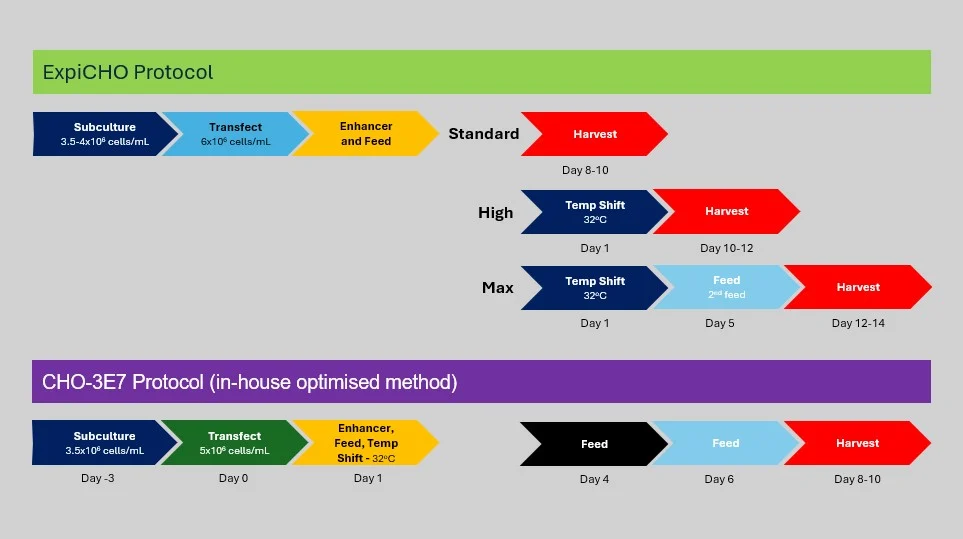
Alongside the cells Thermo Fisher also provides three recommended expression protocols for ExpiCHO‑STM—called STANDARD, HIGH, and MAX—each incorporating different feeding and temperature‑shift strategies to enhance protein yield.
STANDARD protocol:
HIGH protocol:
MAX protocol:
Our evaluation of secreted TIMP2 demonstrated a marked improvement in expression across all three supplied ExpiCHO‑STM protocols (Figure 2, left). Each expression workflow—STANDARD, HIGH and MAX—produced substantially higher titres than our established CHO‑3E7 process for this particular protein, highlighting the robustness of the ExpiCHO‑STM system even without any additional optimisation.
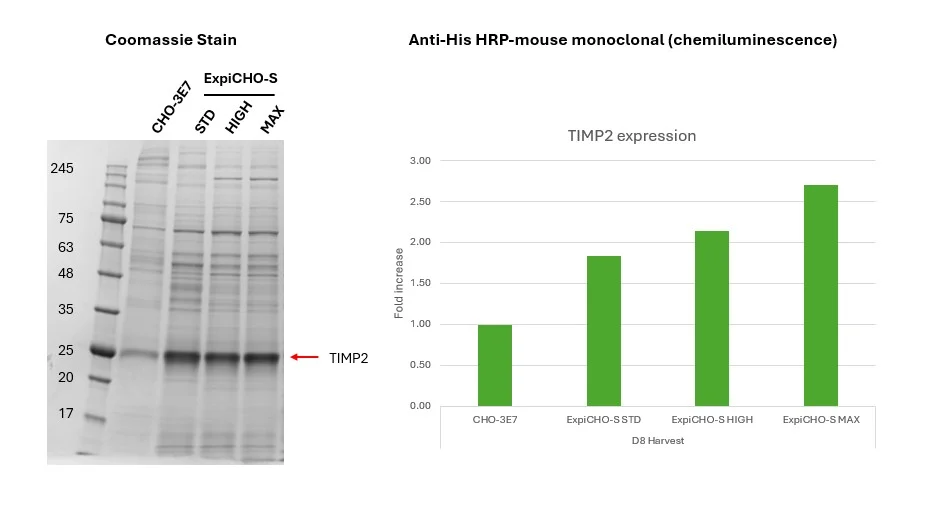
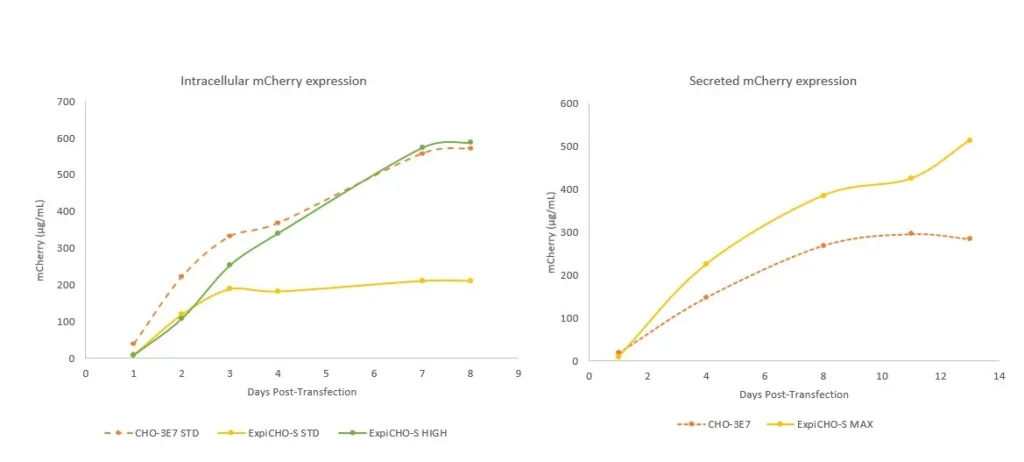
The trend seen with TIMP2 was further supported by our secreted mCherry control construct (Figure 3, right). The parallel increase in expression for both TIMP2 and mCherry indicates that the observed improvements are system‑driven rather than target‑specific.
Together with the TIMP2 data, these results strongly suggest that ExpiCHO‑STM, used in combination with the supplied manufacturer‑recommended protocols, represents an excellent addition to our mammalian expression portfolio for secreted proteins and provides clients with a high‑yield alternative to our existing CHO platform.
Interestingly, the expression of an intracellular mCherry control construct did not show a comparable improvement in ExpiCHO‑STM cells (Figure 3, left). When benchmarked against our in‑house CHO‑3E7 platform, intracellular mCherry levels remained broadly similar, suggesting no clear advantage to switching systems for cytosolic targets. Given the higher media and transfection reagent costs associated with ExpiCHO‑STM, these findings indicate that CHO‑3E7 may remain the more cost‑effective choice for intracellular protein production.
Finally, we evaluated recombinant antibody expression in ExpiCHO‑STM and found that this system can achieve yields approaching 1 g/L, underscoring its suitability for demanding biotherapeutic projects.
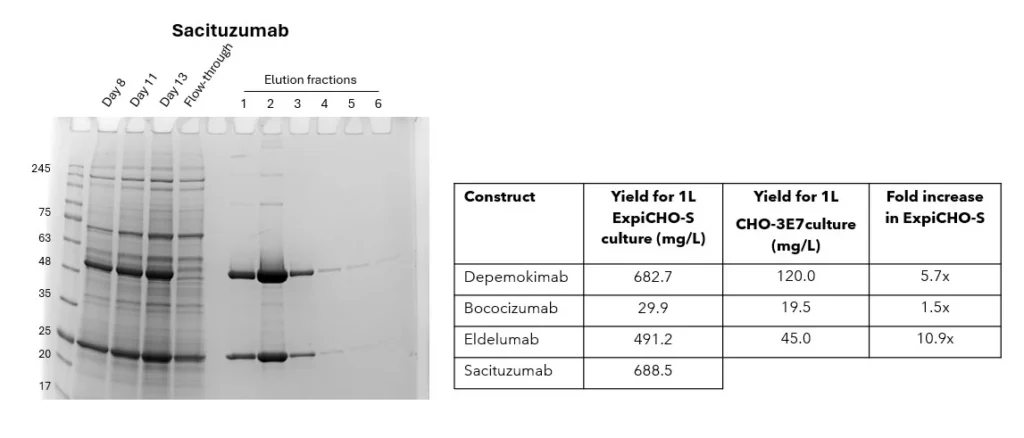
Using the Thermo MAX protocol (described above), we expressed His‑tagged Depemokimab and Eldelumab, followed by nickel‑affinity purification. Both antibodies showed substantially higher yields in ExpiCHO‑STM relative to our in‑house CHO‑3E7 platform—a 6‑fold increase for Depemokimab and an 11‑fold increase for Eldelumab. In contrast, Bococizumab displayed only a modest improvement, with a 1.5‑fold increase in ExpiCHO‑STM (Figure 4, right), reinforcing that performance gains remain target‑specific.
Building on this, we expressed Sacituzumab using the Thermo MAX protocol and purified it under low‑endotoxin conditions via Protein A affinity chromatography. The resulting high‑yield, clean preparation further strengthened our confidence in ExpiCHO‑STM as a robust platform for recombinant antibody production (Figure 4, left).
Our evaluation has shown that the ExpiCHO‑STM cell line can have clear advantages for high yielding expression of secreted protein targets, especially antibodies, and is a valuable addition to our mammalian host cell portfolio that we offer.
At Sygnature Discovery, we work closely with clients to identify the most suitable expression strategy for each target and project, supporting efficient and scalable routes to recombinant protein production.

Peak Proteins, NuChem Sciences et SB Drug Discovery sont désormais pleinement intégrés à Sygnature Discovery.