


Ressources
-
STORM Therapeutics: From Lead to Pre-Candidate Nomination in 18 Months

STORM Therapeutics: From Lead to Pre-Candidate Nomination in 18 Months
Case study




Discover precise insights into brain neurochemistry with Sygnature Discovery's in vivo microdialysis and cOFM services. With over 20 years of expertise, we design bespoke studies that reveal how compounds modulate neurotransmitter systems in health and disease. Using UHPLC/HPLC with electrochemical detection or mass spectrometry, we deliver robust PK/PD data to support confident CNS decision making.


juillet 30, 2015

Inobrodib, an exciting, first-in-class oral anti-cancer drug in clinical development by CellCentric, was collaboratively designed, synthesized and supported on its pre-clinical journey by an integrated project team at Sygnature Discovery. Inobrodib is now showing promising results in Phase I and II trials for multiple myeloma and other cancer types.

In drug discovery, generating targets is no longer the challenge. The real question is how to identify the few worth investing months of research and significant resources to pursue. Hear expert perspectives on how AI, pathway analysis and scientific expertise are shaping modern target identification.
juillet 7, 2026

Tenez‑vous au courant des dernières mises à jour de l’entreprise, des étapes clés et des annonces importantes.
Découvrez les conférences et rencontres scientifiques à venir, où vous pourrez échanger avec notre équipe.

Chez Sygnature Discovery, nous fournissons des solutions de découverte de médicaments de classe mondiale pour accélérer la progression de vos composés, de l’idée jusqu’à la clinique.

Notre équipe de direction rassemble une diversité d’expériences et de ressources, favorisant la collaboration et l’innovation dans l’ensemble du processus de découverte de médicaments.

Explorez les opportunités de carrière chez Sygnature Discovery. Rejoignez une équipe internationale qui obtient des résultats exceptionnels grâce à la collaboration, à l’innovation et à l’intégrité.
Inobrodib, an exciting, first-in-class oral anti-cancer drug in clinical development by CellCentric, was collaboratively designed, synthesized and supported on its pre-clinical journey by an integrated project team at Sygnature Discovery. Inobrodib is now showing promising results in Phase I and II trials for multiple myeloma and other cancer types.
Chez Sygnature Discovery, nous fournissons des solutions de découverte de médicaments de classe mondiale pour accélérer la progression de vos composés, de l’idée jusqu’à la clinique.
Notre équipe de direction rassemble une diversité d’expériences et de ressources, favorisant la collaboration et l’innovation dans l’ensemble du processus de découverte de médicaments.
Explorez les opportunités de carrière chez Sygnature Discovery. Rejoignez une équipe internationale qui obtient des résultats exceptionnels grâce à la collaboration, à l’innovation et à l’intégrité.
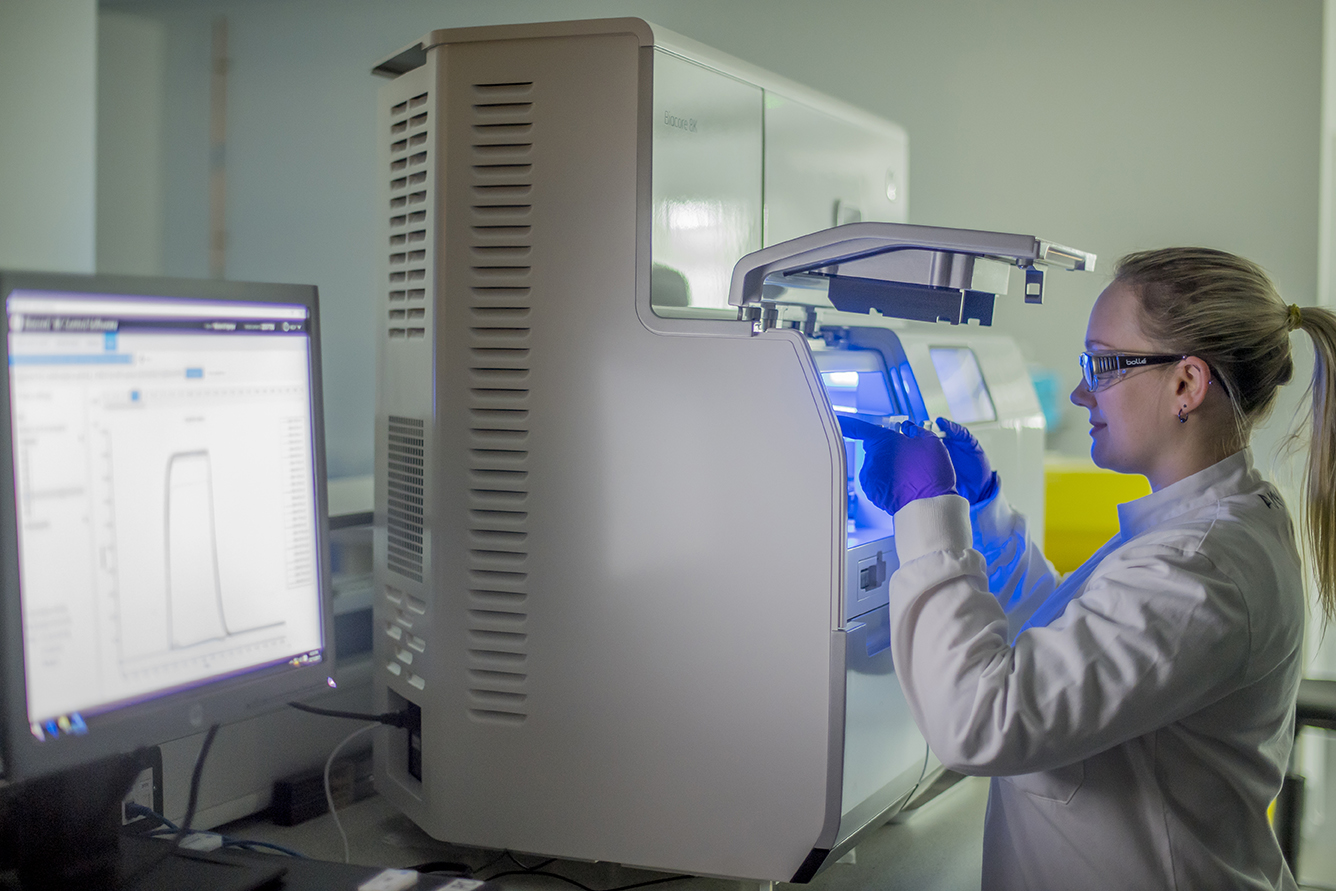
Outside of drug discovery and some academic groups, biophysics is a relative unknown. This branch of science focuses on the analysis and quantitation of biomolecules using physics, often generating data that cannot be produced by other means. In most drug discovery cascades this focuses primarily on the binding of the candidate drug to the target of interest, both to confirm that it does bind, but also to assess the strength and characteristics of that interaction. Questions such as how much of a drug do we need for it to be effective, how long does it stay bound for, and are there any off-target or undesirable effects, can all be answered by biophysical assays. They are also significantly less complex than cellular assays, meaning that an interaction can be assessed without interference from other factors, although this can both be an advantage and a disadvantage. Multiple components can also be used if required, helping to determine mechanisms of action for the potential therapeutics.
Fundamentally, there has to be a drive to generate the right data for a project, rather than generating as much as possible. If the right data isn’t generated, the overall scope of a discovery project can become clouded, leading to a lack of progress, higher costs, and wasted time, which may be better spent elsewhere. This is ever more important as we look to utilize generative Artificial Intelligence (AI) and machine learning tools in drug discovery. These approaches are critically dependent on having the right kind of high-quality data to feed into model design. So, what is the right data? This is always dependent on the target of the drug molecule itself, the modality of the drug (how do you expect it to work), the type of drug molecule (small molecule vs biologic), or the disease indication that is to be treated. It is also dependent on the stage of the project. For example, it is rarely worth trying to gather detailed kinetic information during a hit finding process, where affinities are low, and validation of target binding and behavior is key. In the same way, yes/no target engagement data is often not required at the later stages of the project, where information on residence time, behavior and mechanism of action are much more critical. It is important to continually assess the state of the project and what the key questions are to help move things forward. For example, do you need to identify hits that are binding exclusively to your target site during hit identification? Or do you need to assess residence time to select what may be the most suitable candidate for a novel therapeutic? In our opinion, this constant review of what questions need to be answered is a crucial driver for any discovery project, so having a range of biophysical tools available allows a flexible and dynamic approach, driven by data and project requirements.

So how can biophysics help, and what technologies are available? For the purposes of simplicity, we will focus on the more commonly used biophysical techniques, but there are a plethora of technologies and offerings available that are suited to specific approaches. We are seeing a noticeable shift towards cell based biophysical technologies as new techniques are developed, but many of these are still in their infancy and, barring CETSA® and its related techniques, are yet to be widely adopted throughout the industry.
The most commonly used biophysical techniques include Surface Plasmon Resonance (SPR), Microscale Thermophoresis (MST), Spectral Shift (SpS), Nuclear Magnetic Resonance (NMR), Isothermal Titration Calorimetry (ITC), Fluorescence Thermal Shift assays (FTSA, also called Differential scanning Fluorimetry or DSF) and Cellular thermal shift assays (CETSA, including non-endogenous versions using tagged proteins). These technologies form the core of most biophysical offerings and have various advantages and disadvantages relative to each other. Due to this, they are suited to different applications and can answer different questions depending on the requirements of a project. It is access to this toolbox that helps progress projects and generate the data that a project needs.
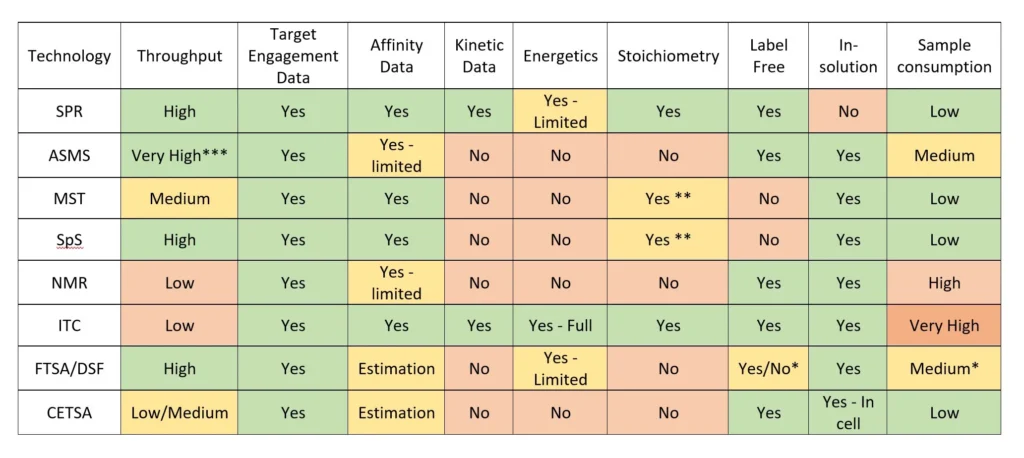
Target engagement is the key strength of biophysical assays, and all these technologies can provide this. They also have their own additional characteristics. SPR, for example, is the gold standard for generating kinetic data and is highly flexible in terms of assay setup. It also has one of the highest throughputs of the techniques listed with current instrumentation, so is well used across the industry. The key drawback for SPR is that it requires at least one component of the assay to be immobilized or captured onto a sensor surface, which is not always feasible. Other technologies, such as MST, SpS, ITC, NMR, and FTSA get around this issue by being in-solution but have drawbacks of their own. MST and SpS, related technologies that use our Monolith and Dianthus instruments, cannot generate kinetic data and require separate assays to determine stoichiometry. Tag placement is also critical to the success of an assay, but there are situations where MST and SpS have proven to work when SPR cannot. SpS, in particular, has the potential to be very high throughput, so under the correct circumstances, this approach can have significant benefits over others. Ligand observed NMR is highly reliable and can serve as a platform for extended structural studies but has limited application for high affinity molecules. ITC is the best way to gather energetic data for a project and produces very reliable data when run well. It is, however, is very low throughput relative to other techniques and requires care when setting up. It also has a very high reagent usage, particularly from a protein perspective, which often rules it out for anything other than the detailed characterization of key examples.
All of these technologies, when used in the right situations, can provide all of the data that could be required by a project, and careful selection of the right approach for a project can be of significant value. There are some situations, however, where some of these options may not be available due to the nature of the project and target. It is here that the scope of these technologies changes. For challenging targets, the most important thing to have is options, and it is here that a multi-technology approach to biophysics shows its strength.
One area that biophysics can excel in is hit finding. This typically comes under two areas: fragment-based screening, often called FBDD, and high throughout screening, HTS. For fragment screens, a range of the technologies identified above can be used, particularly NMR (considered a gold standard), SPR, SpS, MST, and FTSA. Due to the highly sensitive nature of these technologies, they are able to identify weakly bound molecules, and the use of fragment libraries can efficiently and effectively sample a wide range of chemical space. Fragments are low potency, but are typically highly soluble with excellent chemical properties, which can have significant advantages over larger molecular weight starting points, such as those identified from DNA encoded libraries (DEL).
More recently, we have seen a surge in HTS screening using biophysical techniques, particularly using ASMS, and to a lesser extent SPR. The use of pooled libraries in ASMS enables a very fast turnaround time of libraries consisting of several hundreds of thousands of molecules, in a timeframe shorter than many plate based HTS approaches. While ASMS cannot provide functional data, it can rapidly identify binders to a target of interest, in a robust manner with a low rate of false positives, which may be advantageous for some applications, particularly in the induced proximity therapeutics (IPT) area.
As with any hit finding approach, the validation of hits is essential to build confidence in any molecules identified. It is here, again, that the biophysical toolbox can play an important role as we look to confirm and validate hits. Combinations of technologies, such as ASMS high throughput screens followed by SPR confirmation, or SPR fragment screens followed by NMR confirmation, can be particularly powerful in rooting out false hits and identifying the best possible starting point for a discovery project.
Despite all best intentions and selecting a technology that should give the answers that you need, there may be (and often is!) an unforeseen incompatibility between a component of the assay and the equipment that you want to use. Some of these can be managed by optimizing the assay for your target, but sometimes it is more fundamental, particularly with the more challenging targets that are part of many discovery projects. It is here that a biophysicist needs to consider the tools that they have available. Everyone has their favorite as a first port of call, but a clear idea of what is applicable to the science in question can support a project much more effectively than persevering with a single assay technology, even if that means missing out on a particular type of data (e.g., kinetics). This dynamic approach is particularly suited to more difficult target classes, such as membrane proteins, helicases, and intrinsically disordered proteins (IDPs), among others. In these cases, casting the net wide early will often be beneficial in getting a project off the ground. Does this approach always generate the right data? In most cases, yes, as the key parameters that are required in early-stage projects, such as reliable and robust target engagement and affinity determination, can potentially be provided by multiple techniques. Early on, the priority is building confidence in the assays and the project to reassure investors and maintain momentum. Often, as the molecules progress and increase in potency, and the understanding around target biology is improved, we find that other assay options become more viable to gain the required data, such as kinetic, energetic, or detailed mechanism of action (MoA) data. There will always be exceptions to this, but at the very least, aligning the biophysical data generated on a project alongside other assays, such as activity or cellular assays, will help build confidence across the screening cascade, fill in gaps in understanding, and lead to better quality therapeutics as a result.
Peak Proteins, NuChem Sciences et SB Drug Discovery sont désormais pleinement intégrés à Sygnature Discovery.