



Featured Resources
-
STORM Therapeutics: From Lead to Pre-Candidate Nomination in 18 Months

STORM Therapeutics: From Lead to Pre-Candidate Nomination in 18 Months
Case study
📣From lead to pre-candidate nomination in 18 months. Explore the STORM Therapeutics case study




July 30, 2015

Inobrodib, an exciting, first-in-class oral anti-cancer drug in clinical development by CellCentric, was collaboratively designed, synthesised and supported on its pre-clinical journey by an integrated project team at Sygnature Discovery. Inobrodib is now showing promising results in Phase I and II trials for multiple myeloma and other cancer types.

At Sygnature Discovery, we deliver world-leading drug discovery solutions to accelerate your compound from idea to clinic.

Our leadership team brings diverse experience and insight, driving collaboration and innovation across drug discovery.

Explore careers at Sygnature Discovery and join a global team committed to science, collaboration, and integrity.
Inobrodib, an exciting, first-in-class oral anti-cancer drug in clinical development by CellCentric, was collaboratively designed, synthesised and supported on its pre-clinical journey by an integrated project team at Sygnature Discovery. Inobrodib is now showing promising results in Phase I and II trials for multiple myeloma and other cancer types.
At Sygnature Discovery, we deliver world-leading drug discovery solutions to accelerate your compound from idea to clinic.
Our leadership team brings diverse experience and insight, driving collaboration and innovation across drug discovery.
Explore careers at Sygnature Discovery and join a global team committed to science, collaboration, and integrity.
Sygnature Discovery’s plasma stability assay provides a reliable in‑vitro method for assessing the degradation of new chemical entities in plasma. Plasma instability can significantly affect pharmacokinetics, contributing to rapid clearance, short half‑lives and challenges in interpreting in‑vivo data due to continued ex‑vivo degradation after sampling. Plasma stability assessments alert medicinal chemists to structural liabilities, providing an opportunity to modify or remove plasma‑labile features before a series progresses further. Compounds with plasma‑labile functional groups such as amides, esters, lactams, lactones and sulphonamides, tend to be more susceptible to hydrolysis in plasma. It is also valuable for evaluating prodrugs and antedrugs, where rapid plasma degradation is desired.
The validation covered plasma from Mouse, Rat, Human, Dog and Monkey, ensuring broad applicability across discovery programmes. Test compounds were incubated in plasma, and compound disappearance monitored over time using LC–MS/MS. Percent remaining and half‑life values were calculated from depletion kinetics, providing a robust measure of intrinsic plasma stability across species.
By incorporating multiple species and a diverse compound set spanning rapidly degraded compounds such as Propoxycaine to highly stable molecules such as Pepstatin, the assay demonstrates suitability for characterising a broad range of behaviours. Overall, the dataset confirms that the plasma stability platform is an essential early‑stage ADME tool for identifying potential liabilities and guiding medicinal chemistry optimisation.
The plasma stability assay evaluates the degradation profile of compounds by monitoring their disappearance in plasma over time. Test compounds are first prepared from concentrated DMSO stock solutions, then incubated with pooled plasma (pH 7.4). At predetermined time points, aliquots are removed and quenched immediately using organic solvent to prevent further degradation, generating a time course of compound disappearance.
Following centrifugation to remove precipitated proteins, supernatants are pooled for cassette analysis (except if screening for prodrugs) and diluted with water containing internal standard. Samples are analysed via LC–MS/MS to determine the percentage parent compound remaining at each time point. Natural log transformation of compound response–time data enables linear regression to derive the elimination rate constant (k), from which half‑life values are calculated.
This workflow ensures reproducible handling across species and supports early evaluation of structural liabilities during discovery. The use of pooled plasma minimises donor‑specific variability while providing consistent stability profiles suitable for screening, comparative studies, and the identification of candidates for further pharmacokinetic evaluation.
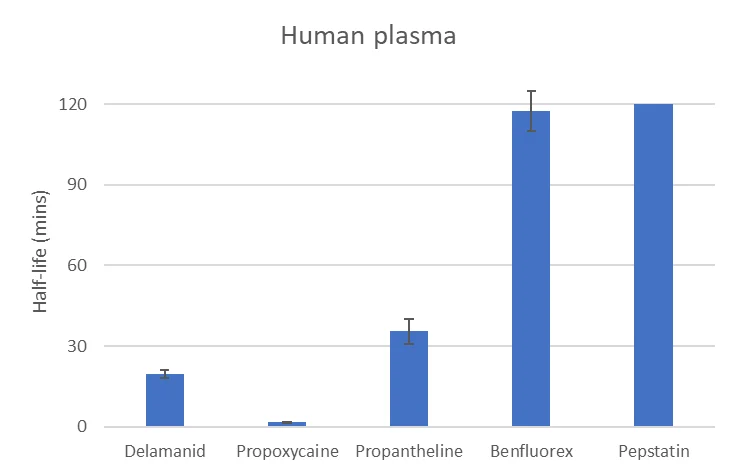
Validation across five plasma species demonstrated consistent, reproducible half‑life measurements spanning a wide range of degradation rates. Across species, the assay showed acceptable reproducibility, with variability maintained below 20% CV. Rapidly degrading compounds, such as Propoxycaine, displayed short half‑lives across multiple species, whereas highly stable compounds, such as Pepstatin, exhibited minimal degradation under the assay conditions.
The graph below presents the validated inter‑assay performance for human plasma:
Peak Proteins, NuChem Sciences, and SB Drug Discovery have now fully integrated with Sygnature Discovery.
