



Featured Resources
-
STORM Therapeutics: From Lead to Pre-Candidate Nomination in 18 Months

STORM Therapeutics: From Lead to Pre-Candidate Nomination in 18 Months
Case study




Discover precise insights into brain neurochemistry with Sygnature Discovery's in vivo microdialysis and cOFM services. With over 20 years of expertise, we design bespoke studies that reveal how compounds modulate neurotransmitter systems in health and disease. Using UHPLC/HPLC with electrochemical detection or mass spectrometry, we deliver robust PK/PD data to support confident CNS decision making.


July 30, 2015

Inobrodib, an exciting, first-in-class oral anti-cancer drug in clinical development by CellCentric, was collaboratively designed, synthesised and supported on its pre-clinical journey by an integrated project team at Sygnature Discovery. Inobrodib is now showing promising results in Phase I and II trials for multiple myeloma and other cancer types.

In drug discovery, generating targets is no longer the challenge. The real question is how to identify the few worth investing months of research and significant resources to pursue. Hear expert perspectives on how AI, pathway analysis and scientific expertise are shaping modern target identification.
July 7, 2026

Stay up to date with the latest company updates, milestones, and announcements.
Explore upcoming conferences and scientific meetings where you can connect with our team.

At Sygnature Discovery, we deliver world-leading drug discovery solutions to accelerate your compound from idea to clinic.

Our leadership team brings diverse experience and insight, driving collaboration and innovation across drug discovery.

Explore careers at Sygnature Discovery and join a global team committed to science, collaboration, and integrity.
Inobrodib, an exciting, first-in-class oral anti-cancer drug in clinical development by CellCentric, was collaboratively designed, synthesised and supported on its pre-clinical journey by an integrated project team at Sygnature Discovery. Inobrodib is now showing promising results in Phase I and II trials for multiple myeloma and other cancer types.
At Sygnature Discovery, we deliver world-leading drug discovery solutions to accelerate your compound from idea to clinic.
Our leadership team brings diverse experience and insight, driving collaboration and innovation across drug discovery.
Explore careers at Sygnature Discovery and join a global team committed to science, collaboration, and integrity.
The MDCKII–MDR1 (Madin–Darby canine kidney II) is a canine epithelial cell line stably transfected with human ATP binding cassette transporter protein (MDR1/ABCB1). MDCKII-MDR1 cells form tight, polarized monolayers suitable for drug transport assays and enable exploration of specific interactions with human MDR1. It has been reported that transfection of wild type MDCKII cells with human transporters results in a knock down of endogenous (canine) transporters including those responsible for efflux.
Drug transport is measured bi-directionally, apical-to-basolateral (AtoB) and basolateral-to-apical (BtoA), which allows for the rate of permeability to be determined and for the identification of MDR1 mediated efflux substrates.
Given lipid bilayers are universally conserved across all species, MDCKII-MDR1cells represent a useful and human relevant system for bidirectional transport studies which enable the identification of passive and active transport processes and can help predict the oral absorption and CNS penetrance of new chemical entities.
Sygnature discovery use pre‑plated MDCKII‑MDR1 cells (MedTech Barcelona) to assess compound permeability and efflux potential in hanging insert format.
|
Well Format |
96 |
|
Incubation Concentration |
5 µM |
|
Number of Replicates |
3 |
|
Incubation Volumes |
75 uL (Apical), 225 uL (Basal) |
|
Incubation Buffer |
Hanks Balanced salt solution (HBSS) with HEPES (pH 7.4) or MES (pH 6.5) |
|
pH |
7.4 / 7.4, 6.5 / 7.4 (Apical / Basal) |
|
Incubation Conditions |
60 min, 150 RPM at 37˚C (5 % CO2) |
|
Assay Controls |
Quinidine (MDR1 substrate), Propranolol (High passive permeability) |
|
Inhibitors |
Elacridar |
|
DMSO% |
0.1% v/v (0.2% v/v with inhibitor) |
|
Integrity Marker |
Lucifer yellow (25 µM) co-incubated with test compound |
|
Quantitation |
LC MS/MS analysis |
|
Data Deliverables |
Apparent permeability coefficient (Papp), Efflux ratio and recovery (%). |
A diverse set of compounds was selected to span a range of intrinsic permeabilities and to include both efflux and non‑efflux substrates.
|
Assay Specific Parameters
|
Compound
|
|---|---|
|
Efflux Substrate |
Quinidine, Prazosin, Verapamil, Loperamide, Risperidone, Vinblastine |
|
Passively Permeable |
Propranolol, Antipyrine, Chlorpromazine, Carbamazepine, Caffeine, Atenolol, Metoprolol |
|
MDR1 Inhibitor |
Elacridar |
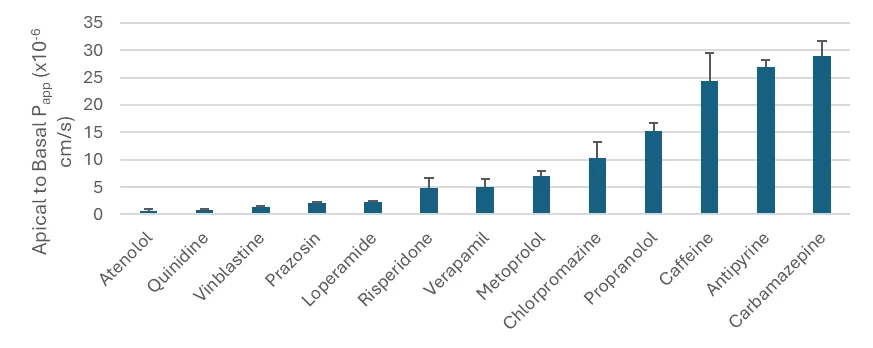
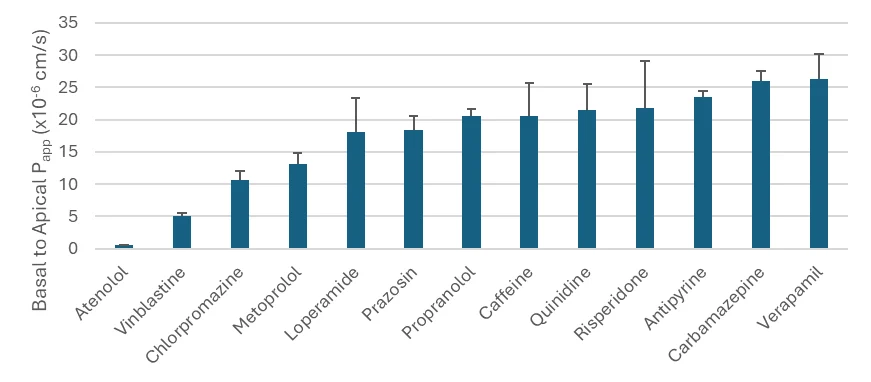
Figure 1 Apparent permeability coefficient (Papp) results for test compounds evaluated in Sygnature Discovery’s MDCKII MDR1 assay with HBSS pH 7.4/7.4 buffer. Each bar represents the mean +/- SD Papp fromindividual experiments, A-B (top) and B-A (bottom), of validation compounds in order from lowest to highest.
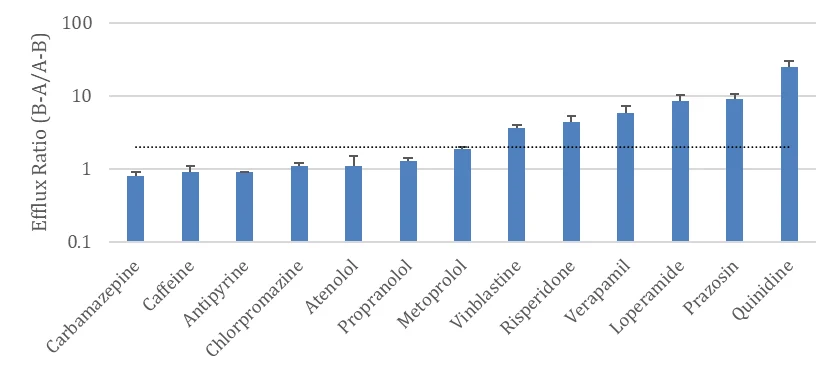
Figure 2. Efflux ratio calculated for test compounds evaluated in Sygnature Discovery’s MDCKII MDR1 assay with HBSS pH 7.4/7.4 buffer. The dotted line indicates the threshold of ER = 2Results are presented as mean +/- SD
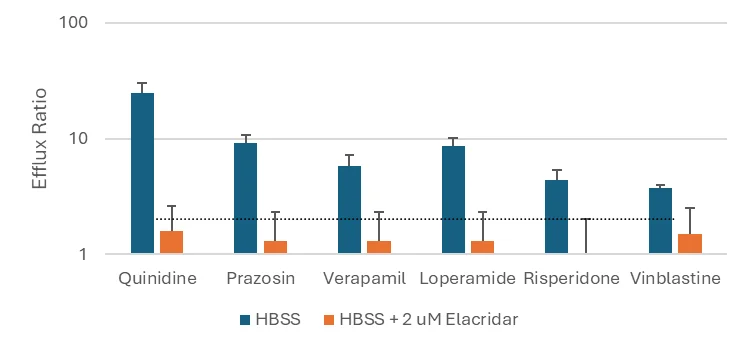
Figure 3. Efflux observed for test compounds evaluated in Sygnature Discovery’s MDCKII MDR1 assay with HBSS pH 7.4/7.4 buffer. The dotted line indicates the threshold of ER = 2. Results are presented as mean +/- SD
Hubatsch, I., Ragnarsson, E. & Artursson, P. Determination of drug permeability and prediction of drug absorption in Caco-2 monolayers. Nat Protoc 2, 2111–2119 (2007).

Peak Proteins, NuChem Sciences, and SB Drug Discovery have now fully integrated with Sygnature Discovery.