



Featured Resources
-
STORM Therapeutics: From Lead to Pre-Candidate Nomination in 18 Months

STORM Therapeutics: From Lead to Pre-Candidate Nomination in 18 Months
Case study
📣From lead to pre-candidate nomination in 18 months. Explore the STORM Therapeutics case study




July 30, 2015

Inobrodib, an exciting, first-in-class oral anti-cancer drug in clinical development by CellCentric, was collaboratively designed, synthesised and supported on its pre-clinical journey by an integrated project team at Sygnature Discovery. Inobrodib is now showing promising results in Phase I and II trials for multiple myeloma and other cancer types.

At Sygnature Discovery, we deliver world-leading drug discovery solutions to accelerate your compound from idea to clinic.

Our leadership team brings diverse experience and insight, driving collaboration and innovation across drug discovery.

Explore careers at Sygnature Discovery and join a global team committed to science, collaboration, and integrity.
Inobrodib, an exciting, first-in-class oral anti-cancer drug in clinical development by CellCentric, was collaboratively designed, synthesised and supported on its pre-clinical journey by an integrated project team at Sygnature Discovery. Inobrodib is now showing promising results in Phase I and II trials for multiple myeloma and other cancer types.
At Sygnature Discovery, we deliver world-leading drug discovery solutions to accelerate your compound from idea to clinic.
Our leadership team brings diverse experience and insight, driving collaboration and innovation across drug discovery.
Explore careers at Sygnature Discovery and join a global team committed to science, collaboration, and integrity.
Sygnature Discovery’s hepatocyte metabolic stability assay provides a comprehensive in vitro system for assessing the intrinsic clearance (CLint) of drug compounds using hepatocytes from multiple preclinical species and human donors. Hepatocytes retain the full complement of phase I and phase II drug metabolising enzymes and their required co-factors, including key cytochrome P450 isoforms, making them a physiologically relevant model for evaluating metabolic turnover. By monitoring parent compound depletion over time, the assay quantifies metabolic stability and supports prediction of in vivo clearance using established scaling factors.
This validation included human, mouse, rat, dog and monkey hepatocytes, each selected to cover a broad spectrum of metabolic capabilities and clearance mechanisms. Human hepatocyte assays were performed using pooled donors to minimise inter‑individual variability, while animal hepatocytes were pooled from multiple donors to ensure representative species performance. A diverse selection of probe substrates spanning CYP1A2, CYP2C9, CYP2C19, CYP2D6, CYP3A4/5 and UGT pathways were included to challenge the system and verify broad metabolic competence.
The study successfully demonstrated that the hepatocyte stability assay provides robust, reproducible metabolic intrinsic clearance data suitable for early‑stage optimisation, compound selection and cross‑species comparison in drug discovery programs.
The hepatocyte metabolic stability assay evaluates compound turnover by incubating test compounds with pooled cryopreserved hepatocytes and quantifies parent depletion over a series of time points. Test compounds are prepared from concentrated DMSO stock solutions and pre‑incubated in assay media before the assay is initiated by the addition of hepatocytes. At predetermined time points aliquots are removed and quenched to terminate metabolic activity, generating a time course of compound disappearance.
Following centrifugation to remove precipitated proteins, supernatants are pooled for cassette analysis and diluted with water containing internal standard. Samples are analysed via LC–MS/MS to determine the percentage of parent compound remaining at each time point. Natural log transformation of compound response–time data enables linear regression to derive the elimination rate constant (k), from which half‑life and intrinsic clearance values are calculated. As hepatocytes contain all major metabolic pathways, including oxidative and conjugative enzymes, the method supports holistic assessment of metabolic competence.
This workflow ensures reproducible handling across species and facilitates evaluation of metabolic liabilities early in discovery. Use of pooled hepatocytes minimises donor ‑specific variability while offering consistent metabolic profiles suitable for screening and comparative studies.
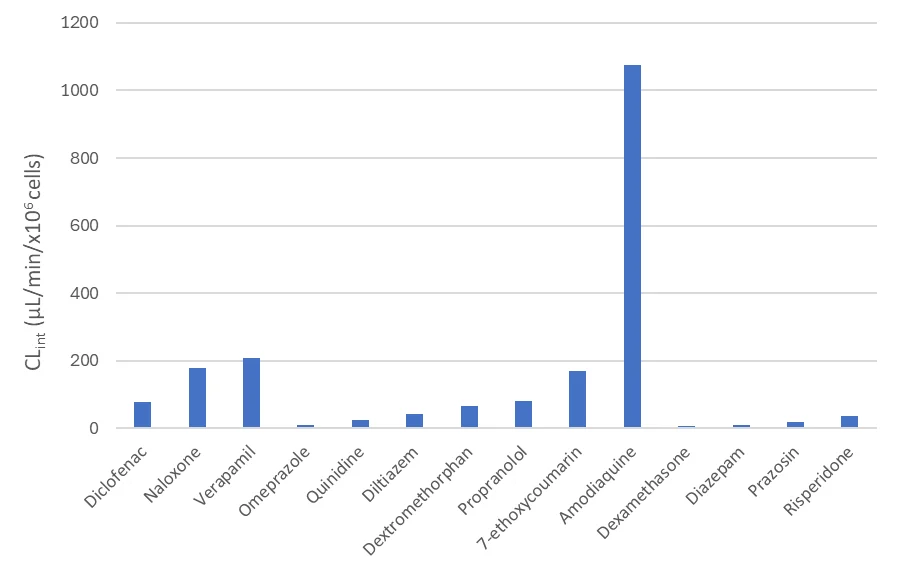
Validation across human and animal hepatocytes demonstrated that the hepatocyte metabolic stability assay generates reliable and reproducible CLint values across species. The human inter‑assay data showed a broad dynamic range of intrinsic clearance values. Across species, the assay demonstrated acceptable reproducibility: human, monkey, and mouse hepatocytes showed consistently low variability; rat hepatocytes performed similarly with only minor compound‑specific exceptions; and dog hepatocytes exhibited slightly higher but still well‑controlled variability.
The graph below presents the validated inter‑assay performance for human hepatocytes following the Percoll clean-up step. Data represent single measurements (n=1) or mean values from duplicate or triplicate assays (n=2-3).


Peak Proteins, NuChem Sciences, and SB Drug Discovery have now fully integrated with Sygnature Discovery.
