



Featured Resources
-
STORM Therapeutics: From Lead to Pre-Candidate Nomination in 18 Months

STORM Therapeutics: From Lead to Pre-Candidate Nomination in 18 Months
Case study
📣From lead to pre-candidate nomination in 18 months. Explore the STORM Therapeutics case study




July 30, 2015

Inobrodib, an exciting, first-in-class oral anti-cancer drug in clinical development by CellCentric, was collaboratively designed, synthesised and supported on its pre-clinical journey by an integrated project team at Sygnature Discovery. Inobrodib is now showing promising results in Phase I and II trials for multiple myeloma and other cancer types.

At Sygnature Discovery, we deliver world-leading drug discovery solutions to accelerate your compound from idea to clinic.

Our leadership team brings diverse experience and insight, driving collaboration and innovation across drug discovery.

Explore careers at Sygnature Discovery and join a global team committed to science, collaboration, and integrity.
Inobrodib, an exciting, first-in-class oral anti-cancer drug in clinical development by CellCentric, was collaboratively designed, synthesised and supported on its pre-clinical journey by an integrated project team at Sygnature Discovery. Inobrodib is now showing promising results in Phase I and II trials for multiple myeloma and other cancer types.
At Sygnature Discovery, we deliver world-leading drug discovery solutions to accelerate your compound from idea to clinic.
Our leadership team brings diverse experience and insight, driving collaboration and innovation across drug discovery.
Explore careers at Sygnature Discovery and join a global team committed to science, collaboration, and integrity.
Sygnature Discovery’s ChromLogD validation demonstrates a fast and reliable chromatographic approach for determining lipophilicity, with excellent reproducibility across inter‑ and intra‑assay experiments. The method offers a practical, high‑throughput alternative to shake‑flask assays, supporting confident ADME decision‑making in early drug discovery.
Sygnature Discovery’s ChromLogD assay is a chromatographic method used to determine the lipophilicity of drug molecules by measuring their distribution behavior between aqueous and organic phases. Lipophilicity, expressed as the Log of the distribution coefficient (LogD), is a key determinant of solubility, distribution, permeability and metabolic stability, making its accurate measurement essential for early‑stage drug discovery. ChromLogD provides a rapid, robust alternative to traditional shake‑flask assays, particularly for highly lipophilic compounds that present quantification challenges due to low solubility in aqueous buffer.
In this assay, compounds are analysed on a reversed‑phase UHPLC system using a gradient of aqueous buffer at physiological pH 7.4 and organic solvent. Retention times are compared against a calibration set of reference compounds with known LogD values. By plotting the logarithm of the chromatographic capacity factor against reference LogD values, a precise calibration line is generated. Test compounds and controls are then assigned ChromLogD values based on their retention characteristics.
The ChromLogD workflow begins with preparation of test compound solutions from 10 mM DMSO stocks, which are diluted into acetonitrile: water to produce standardized working samples. These are transferred to vials or plates for automated UHPLC analysis. Alongside the test articles, calibrants with known LogD values and control compounds are injected to establish system suitability and calibration accuracy.
During the chromatographic run, compounds elute according to their hydrophobicity, with more lipophilic molecules exhibiting longer retention times. A dedicated dead‑volume marker (sodium nitrate) is used to define the void time of the system. Retention times for calibrants are used to calculate the logarithm of the chromatographic capacity factor (logk’), which is plotted against reference LogD values to generate a linear calibration curve. Test and control compound retention times are then fitted to this curve to obtain ChromLogD values.
This streamlined protocol emphasizes efficient data acquisition, reproducibility across runs and consistent calibration. The approach enables rapid lipophilicity determination without reliance on equilibrium partitioning steps, making it a highly practical tool for high‑throughput ADME screening and compound selection workflows.
The ChromLogD assay validation dataset includes calibrants, dead‑volume markers and multiple control compounds to ensure robust performance. The validation demonstrated excellent reproducibility across both inter‑assay (figure 1) and intra‑assay (figure 2) experiments. Six test compounds—Albendazole, Ketoconazole, Loratidine, Verapamil, Propranolol and Terfenadine—were evaluated across multiple independent runs. Inter‑assay mean ChromLogD values were tightly clustered with low coefficients of variation, indicating robust performance across days and experimental batches. Intra‑assay results reflected similarly strong reproducibility, with most compounds showing 0% variability across triplicate injections.
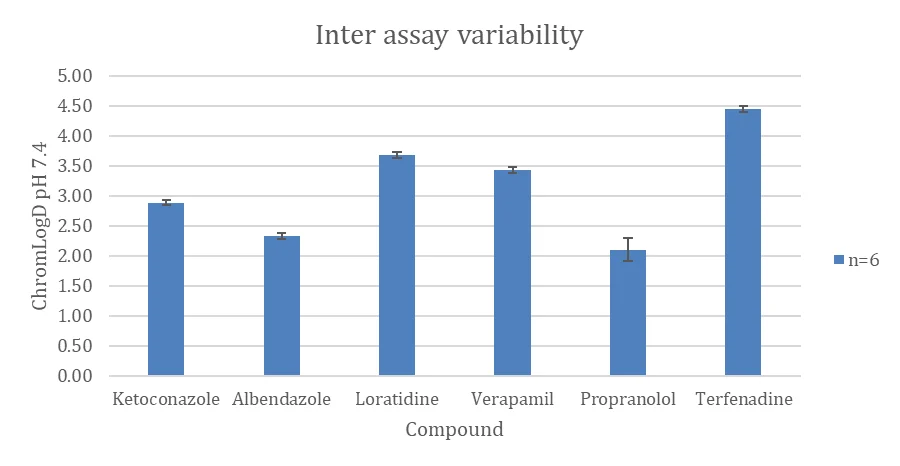
Figure 1. Graph displaying inter-assay ChromLogD data from n=6 assays
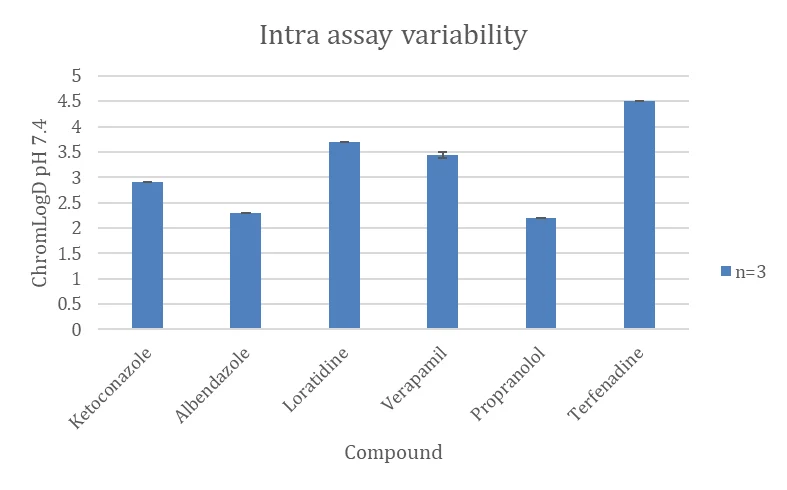
Figure 2. Graph displaying intra-assay ChromLogD data
The data confirms that the ChromLogD platform is reliable, precise and well suited for lipophilicity assessment in discovery programs. It is particularly valuable in early drug discovery for profiling large numbers of compounds and refining medicinal chemistry design strategies.

Peak Proteins, NuChem Sciences, and SB Drug Discovery have now fully integrated with Sygnature Discovery.
