



Ressources
-
STORM Therapeutics: From Lead to Pre-Candidate Nomination in 18 Months

STORM Therapeutics: From Lead to Pre-Candidate Nomination in 18 Months
Case study




juillet 30, 2015

Inobrodib, an exciting, first-in-class oral anti-cancer drug in clinical development by CellCentric, was collaboratively designed, synthesised and supported on its pre-clinical journey by an integrated project team at Sygnature Discovery. Inobrodib is now showing promising results in Phase I and II trials for multiple myeloma and other cancer types.

Tenez‑vous au courant des dernières mises à jour de l’entreprise, des étapes clés et des annonces importantes.
Découvrez les conférences et rencontres scientifiques à venir, où vous pourrez échanger avec notre équipe.

Chez Sygnature Discovery, nous fournissons des solutions de découverte de médicaments de classe mondiale pour accélérer la progression de vos composés, de l’idée jusqu’à la clinique.

Notre équipe de direction rassemble une diversité d’expériences et de ressources, favorisant la collaboration et l’innovation dans l’ensemble du processus de découverte de médicaments.

Explorez les opportunités de carrière chez Sygnature Discovery. Rejoignez une équipe internationale qui obtient des résultats exceptionnels grâce à la collaboration, à l’innovation et à l’intégrité.
Inobrodib, an exciting, first-in-class oral anti-cancer drug in clinical development by CellCentric, was collaboratively designed, synthesised and supported on its pre-clinical journey by an integrated project team at Sygnature Discovery. Inobrodib is now showing promising results in Phase I and II trials for multiple myeloma and other cancer types.
Chez Sygnature Discovery, nous fournissons des solutions de découverte de médicaments de classe mondiale pour accélérer la progression de vos composés, de l’idée jusqu’à la clinique.
Notre équipe de direction rassemble une diversité d’expériences et de ressources, favorisant la collaboration et l’innovation dans l’ensemble du processus de découverte de médicaments.
Explorez les opportunités de carrière chez Sygnature Discovery. Rejoignez une équipe internationale qui obtient des résultats exceptionnels grâce à la collaboration, à l’innovation et à l’intégrité.
Sygnature Discovery’s thermodynamic solubility validation confirms a robust, equilibrium‑based method for generating high‑confidence solubility data across pH 7.4 buffer and biorelevant media including FaSSIF, FeSSIF and FaSSGF. The assay demonstrates strong reproducibility, good agreement with literature values and clear compound‑dependent solubility shifts, supporting absorption prediction, medicinal chemistry optimisation and formulation strategy development.
Sygnature Discovery’s thermodynamic solubility assay determines the equilibrium solubility of drug molecules across physiologically relevant media, providing essential data for understanding absorption, formulation feasibility and developability. Solubility is defined as the amount of compound that dissolves in a solvent under set conditions. Unlike kinetic solubility approaches, the thermodynamic method incorporates excess solid material and allows the system to reach equilibrium, giving a more reliable assessment of intrinsic solubility.
The assay evaluates compound solubility in pH 7.4 phosphate buffer alongside three biorelevant simulated fluids: FaSSIF, FeSSIF and FaSSGF, representing fasted small intestine, fed small intestine and fasted gastric conditions. These environments capture solubility shifts driven by bile salts, fed‑state lipids and pH.
The method supports reproducible measurements across diverse media, facilitating comparison of solubility behavior under physiological conditions. Thermodynamic solubility data are widely used to guide medicinal chemistry optimization, predict oral absorption and inform formulation strategies in early drug discovery.
The thermodynamic solubility workflow begins by adding excess compound to an aqueous medium, allowing the system to reach equilibrium. Samples are incubated in sealed vials with continuous mixing to ensure consistent exposure of solid and dissolved phases throughout the incubation period (24 hours). After equilibrium is achieved, aliquots are removed and filtered to separate dissolved material from any remaining solid.
The filtered samples undergo appropriate dilution to fall within the analytical calibration range and are quantified using LC–MS/MS. Calibration standards prepared from a 10 mM DMSO stock enable accurate quantification across a wide solubility range.
Validation results demonstrated strong reproducibility across all media assessed, with consistent solubility measurements obtained between studies and within assays. Test compounds were selected to cover a broad solubility range, enabling assessment of assay performance across low, moderate and highly soluble substances. Nine test compounds were profiled in pH 7.4 buffer, spanning low‑solubility materials such as Albendazole to highly soluble compounds like Chlorzoxazone and Diclofenac (>1000 µM). Coefficients of variation were generally low, confirming the robustness of the equilibrium solubility determination. The resulting solubility measurements were in good agreement with literature sources (figure 1). Intra‑assay assessments supported similar trends, with Albendazole, Ketoconazole and Haloperidol demonstrating reproducible results across six independent incubations.
To evaluate matrix‑dependent effects, solubility was also measured in FaSSIF, FeSSIF and FaSSGF media. Compounds exhibited solubility enhancements consistent with biorelevant media properties—for example, Ketoconazole (24.8 µM) and Haloperidol (350.2 µM) showed substantial increases in FaSSIF relative to pH 7.4 buffer. The assay reliably quantified solubility increases across all media types while maintaining acceptable variability.
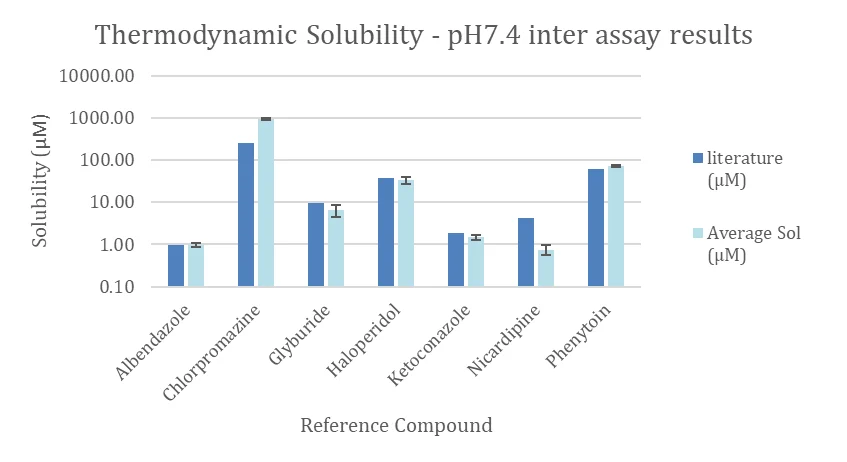
Figure 1. Graph illustrating the mean inter-assay Thermodynamic Solubility results generated in pH7.4 buffer in comparison to literature sources (1,2)
This assay provides a robust, standardized procedure suitable for high‑confidence solubility estimation. The use of multiple biorelevant media allows the assay to capture physiologically meaningful solubility differences, supporting compound triage, formulation selection and mechanistic interpretation of absorption‑related behaviors. Reproducibility across studies ensures that solubility values can be reliably compared across batches and compounds.
Test