
Affiches

Loading…
Preventative effects of dexamethasone in lipopolysaccharide-induced neuroinflammation
The study investigates the preventative effects of dexamethasone on lipopolysaccharide (LPS)-induced neuroinflammation. Neuroinflammation is associated…
Posters
In Vitro Microglia Models as a Screening Platform to Support Neuroinflammation Drug Discovery Programs
Our comprehensive selection of in vitro microglia models, including rat embryonic and adult primary microglia and human monocyte-derived microglia, allows us to provide invaluable tools for screening campaigns aimed at identifying novel drug targets and therapies for neuroinflammatory conditions.
Posters
The implantation site impacts the tumour growth kinetics and tumour immune infiltrate in EO771 and 4T1 syngeneic breast cancer models
Our study delves into the influence of implantation sites on syngeneic breast cancer models. We uncovered that the choice of site significantly impacts tumor growth, viability, and immune cell composition. Notably, the MFP9 site showed the best outcomes in both 4T1 and EO771 models. This research highlights the importance of considering implantation sites when assessing therapeutics with diverse mechanisms of action.
Posters
Combinations of immune checkpoint inhibitors with fractionated radiotherapy or DNA damage response agents leads to improved anti-tumour responses and modulates the tumour immune microenvironment.
Explore our study on the synergy between immune checkpoint inhibitors and radiotherapy in treating colorectal cancer. We found that this combination significantly boosts efficacy, with flow cytometry revealing insightful changes in the tumour microenvironment. Our research opens the door to improved cancer therapies, offering a platform for testing new drugs and novel treatment approaches.
Posters
Dexamethasone and Enalaprilat but not SB525334 exhibit anti-inflammatory properties in precision-cut kidney slices (PCKS) obtained from mice with Adriamycin-induced nephropathy
In a study assessing the effects of dexamethasone, enalaprilat, and SB525334 on kidney slices from adriamycin-exposed mice, it was found that dexamethasone and enalaprilat effectively reduced inflammation and, in dexamethasone’s case, mitigated fibrosis. These findings emphasize the importance of inflammation in adriamycin-induced nephropathy and the value of precision-cut kidney slices as a platform for evaluating anti-inflammatory and anti-fibrotic therapies.
Posters
Development and Validation of [3H]Cimbi-36 Binding in Mouse Frontal Cortex Including Affinity Constant Determination for Classical Psychedelics: Comparison to [3H]MDL100,907 Binding
At Sygnature Discovery, we’re advancing receptor binding assays by utilizing diverse radioligands. Our 5-HT2A receptor screen, employing both agonist and antagonist radioligands, offers insights into receptor pharmacology. Using [3H]Cimbi-36 as an agonist radioligand, we’ve shed light on the differing affinities of psychedelic 5-HT2A agonists. Trust us to optimize your experimental design and enhance the correlation between in vitro data and behavioral models in the drug discovery process
Posters
Evaluation of protein biomarkers in brain homogenate and plasma from different animal models of Alzheimer’s Disease: P301S and APP/PSEN1
Alzheimer’s disease (AD) is a multifactorial disease with unpredictable onset and rate of progression. To address this, Sygnature Discovery utilizes suitable in vivo models, such as APP/PSEN1 and P301S mice, recognized models of AD. We are developing platforms that accurately measure clinically relevant biomarkers like total Tau (tTau), phospho-Tau species (pTau-S396 and pTau-T181), Amyloid β-protein (Aβ), Aβ precursor protein (APP), Neurofilament (NFL), and Presenilin 1 (PSEN1) in brain tissue and biofluid. Our approach combines Jess Western blot, ELISA, and Meso Scale Discovery S-Plex assay (MSD) platforms, providing crucial insights for both medical and R&D translational purposes.
Posters
What is Happening in High Throughput Screening at Sygnature Discovery?
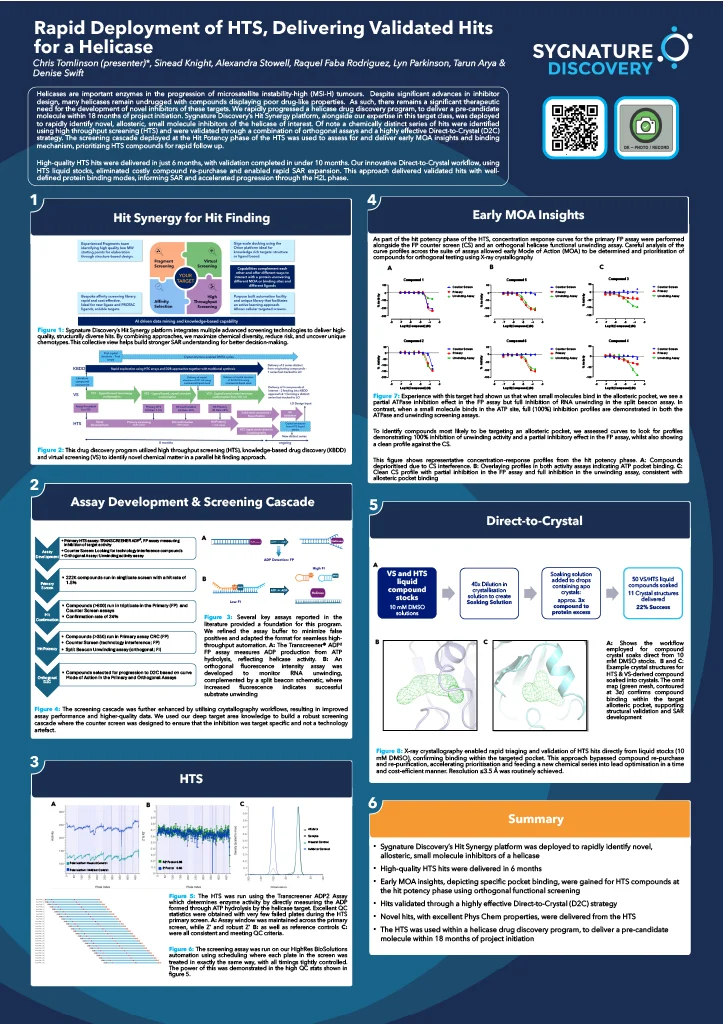
Explore our advanced High Throughput Screening (HTS) capabilities at Sygnature Discovery, integrating automation and informatics for precise chemical library screening. Our poster showcases our diverse target classes, technologies, and therapeutic areas in past HTS campaigns, including complex cell-based assays. Learn about our compound library quality control and see sample screening data.
Posters
Establishing assays to investigate combinations of fractioned radiotherapy with DNA damage response agents in vitro and in vivo to enable investigation of radiosensitisation and improved anti-tumour responses.
Radiotherapy is a cornerstone in treating various cancer types, and enhancing its effectiveness through radiosensitization has gained importance. At Sygnature Discovery, we’ve recently validated innovative in vitro and in vivo methods for screening potential radiosensitizing compounds. Our assays using the MDA-MB-436 human breast cancer cell line, along with inhibitors targeting DNA damage response pathways, provide valuable insights into improving cancer treatment. Discover more about our research in this critical field.
Posters
Chemogenomic screening of the NLRP1 pathway
Dive into our investigation of the NLRP1 inflammasome’s pharmacology through compound screening. We’ve established a cellular screen and unveiled compounds capable of modulating NLRP1 activity, shedding light on its mechanisms and potential targets. Exciting insights await discovery!
Posters
Assessing the effects of four clinically used analgesics in two mechanistic stimuli-evoked acute pain models in mice demonstrates good predictive nature of the phase 2 of formalin pain model.
Explore the significance of acute pain models in predicting the efficacy of novel pain therapeutics and uncover their role in preclinical drug discovery. Download our poster to gain valuable insights into chronic pain prediction through cost-effective and quick screening models.
Posters
Building a Neuroscience Drug Discovery Platform
Neuroscience encompasses a wide range of diseases, from neurodevelopmental to neurological and psychiatric conditions.
Posters
Mitochondrial dysfunction, an in vitro model of neurodegenerative disorders: a focus on multiple endpoints, humanisation, and drug discovery platforms to enable new therapeutic discovery
In our study, we explored various aspects of mitochondrial function using an in vitro model of dysfunction, offering valuable insights into the development of treatments for neurodegenerative disorders. We assessed mitochondrial membrane potential, oxidative stress, Ca2+ homeostasis, oxygen consumption rate, and various metabolic factors, enabling us to enhance the speed and translational value of CNS drug discovery.
Posters
Characterising the response of tumours to fractioned radiotherapy and immune checkpoint inhibitors
In our latest study, we delved into combining radiotherapy and immunotherapy against cancer. Fractionated radiation, given in smaller doses over several days, proved more effective and tolerable than a single high dose. Our work offers insights into this synergy, providing a platform to enhance the therapy’s efficacy and safety.
Posters
Load More