



Ressources
-
STORM Therapeutics: From Lead to Pre-Candidate Nomination in 18 Months

STORM Therapeutics: From Lead to Pre-Candidate Nomination in 18 Months
Case study




juillet 30, 2015

Inobrodib, an exciting, first-in-class oral anti-cancer drug in clinical development by CellCentric, was collaboratively designed, synthesised and supported on its pre-clinical journey by an integrated project team at Sygnature Discovery. Inobrodib is now showing promising results in Phase I and II trials for multiple myeloma and other cancer types.

Tenez‑vous au courant des dernières mises à jour de l’entreprise, des étapes clés et des annonces importantes.
Découvrez les conférences et rencontres scientifiques à venir, où vous pourrez échanger avec notre équipe.

Chez Sygnature Discovery, nous fournissons des solutions de découverte de médicaments de classe mondiale pour accélérer la progression de vos composés, de l’idée jusqu’à la clinique.

Notre équipe de direction rassemble une diversité d’expériences et de ressources, favorisant la collaboration et l’innovation dans l’ensemble du processus de découverte de médicaments.

Explorez les opportunités de carrière chez Sygnature Discovery. Rejoignez une équipe internationale qui obtient des résultats exceptionnels grâce à la collaboration, à l’innovation et à l’intégrité.
Inobrodib, an exciting, first-in-class oral anti-cancer drug in clinical development by CellCentric, was collaboratively designed, synthesised and supported on its pre-clinical journey by an integrated project team at Sygnature Discovery. Inobrodib is now showing promising results in Phase I and II trials for multiple myeloma and other cancer types.
Chez Sygnature Discovery, nous fournissons des solutions de découverte de médicaments de classe mondiale pour accélérer la progression de vos composés, de l’idée jusqu’à la clinique.
Notre équipe de direction rassemble une diversité d’expériences et de ressources, favorisant la collaboration et l’innovation dans l’ensemble du processus de découverte de médicaments.
Explorez les opportunités de carrière chez Sygnature Discovery. Rejoignez une équipe internationale qui obtient des résultats exceptionnels grâce à la collaboration, à l’innovation et à l’intégrité.
Cell-based assays represent an important step in understanding the functional effects of GPCR modulation. Having access to high quality cellular tools is critical in driving forward these studies, providing reproducible data and clear insight when you need it most. One of the major challenges faced when developing robust functional GPCR assays is defining the optimal signalling components to ensure a reliable downstream assay and lead optimization. While some GPCRs signal amicably via endogenous host cell G proteins, other receptros benefit from over-expression of a specific G protein to enable coupling and downstream signalling. Additionally, when developing assay systems for orphan receptors lack of information on the target’s signalling mechanism can present a barrier to assay development and receptor de-orphanization.
This collaboration underscores the multifunctional nature of GDF15-GFRAL-RET, impacting pathways critical for cellular stress response and energy balance. Given its regulatory influence across broad physiological systems, this pathway presents new therapeutic opportunities, particularly in areas such as metabolic disorders and cancer.
|
G Protein
|
Characteristics
|
Assay Readout
|
|---|---|---|
|
SB-Gqα15 |
Wild-type SB-Gqα15 |
Calcium/ IP1 assays |
|
SB-Gq/s |
Gqα15 with c terminus optimized for Gs coupling |
Calcium/ IP1 assays |
|
SB-Gq/i |
Gqα15 with c terminus optimized for Gi coupling |
Calcium/ IP1 assays |
|
SB-Gq/i (short) |
Gqα15 with c terminus optimized for Gi coupling |
Calcium/ IP1 assays |
|
SB-Gqα12 |
Gqα15 with c terminus optimized for Gα12 coupling |
Calcium/ IP1 assays |
|
SB-Gqα13 |
Gqα15 with c terminus optimized for Gα13 coupling |
Calcium/ IP1 assays |
|
SB-Gs |
Wild-type Gs |
cAMP signalling assays |
|
SB-Gs/q |
Gs with c terminus optimized for Gq coupling |
cAMP signalling assays |
|
SB-Gs/i Gs |
Gs with c terminus optimized for Gi coupling |
cAMP signalling assays |
|
SB-Gs/α12 |
Gs with c terminus optimized for G α12 coupling |
cAMP signalling assays |
|
SB-Gs/α13 |
Gs with c terminus optimized for G α13 coupling |
cAMP signalling assays |
Using a comprehensive panel of G protein constructs Sygnature Discovery’s assay development team quickly identifyies optimal G proteins partners for your GPCR target, delivering robust functional assays for downstream drug discovery screening.

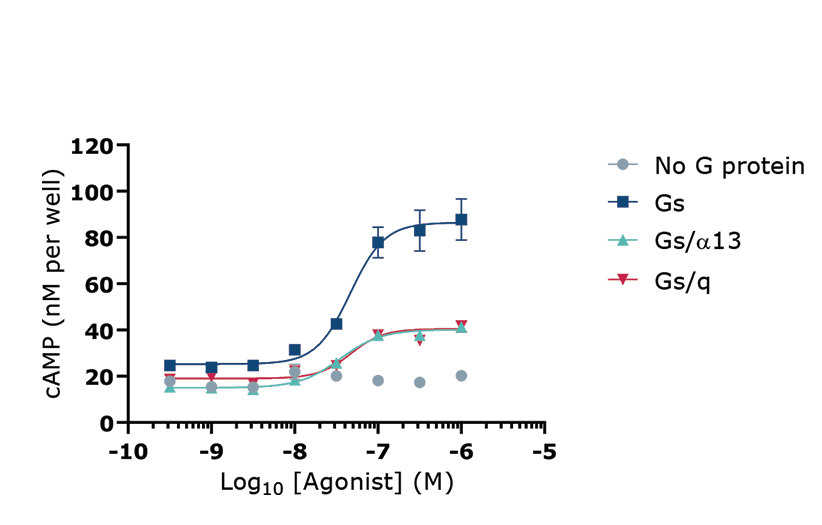
Figure 1. G protein profiling. Identification of optimal G protein coupling partners for detection of robust functional GPCR responses. A range of G-proteins were co-transfected with taregt receptor to dentify optimal partner for downstream cAMP quantitation assay.
GPCRs signal via a variety of pathways which may or may not be amenable of high throughput assay formats. Using chimeric G proteins, Sygnature Discovery’s assay development team can design robust assay to drive GPCR signalling via pathways and endpoint readouts suited to your preferred screening platforms, resulting in reliable, high-quality data for your drug discovery campaigns.
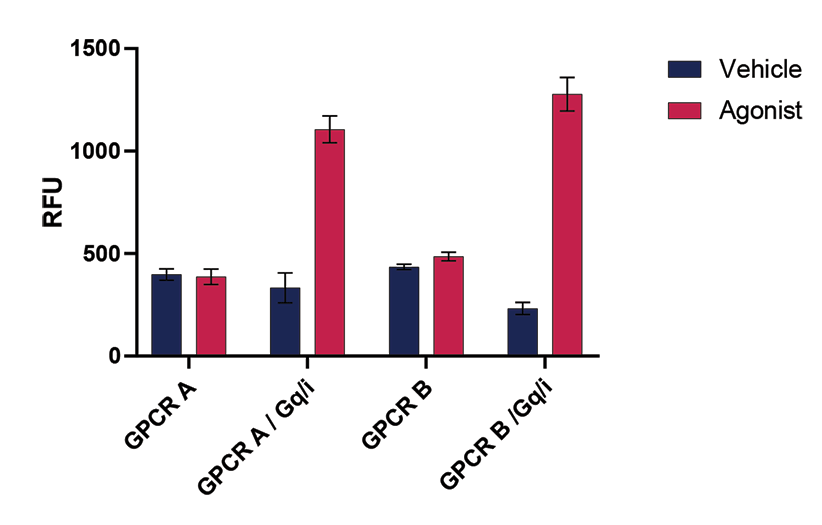
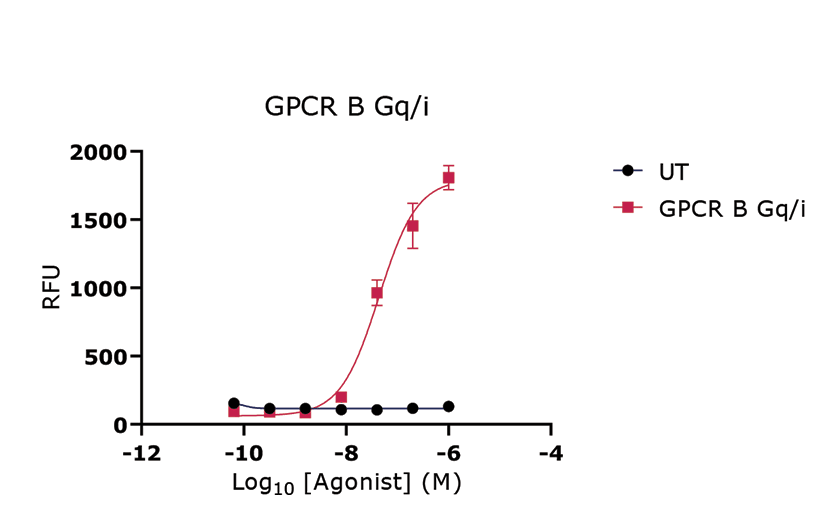
Figure 2. Gi-coupled GPCR targets driven to signal via Gq pathway using chimeric G proteins to enable high-throughput screening using calcium mobilization assays.
CASE STUDY




Test