


Ressources
-
STORM Therapeutics: From Lead to Pre-Candidate Nomination in 18 Months

STORM Therapeutics: From Lead to Pre-Candidate Nomination in 18 Months
Case study




Discover precise insights into brain neurochemistry with Sygnature Discovery's in vivo microdialysis and cOFM services. With over 20 years of expertise, we design bespoke studies that reveal how compounds modulate neurotransmitter systems in health and disease. Using UHPLC/HPLC with electrochemical detection or mass spectrometry, we deliver robust PK/PD data to support confident CNS decision making.


juillet 30, 2015

Inobrodib, an exciting, first-in-class oral anti-cancer drug in clinical development by CellCentric, was collaboratively designed, synthesised and supported on its pre-clinical journey by an integrated project team at Sygnature Discovery. Inobrodib is now showing promising results in Phase I and II trials for multiple myeloma and other cancer types.

In drug discovery, generating targets is no longer the challenge. The real question is how to identify the few worth investing months of research and significant resources to pursue. Hear expert perspectives on how AI, pathway analysis and scientific expertise are shaping modern target identification.
juillet 7, 2026

Tenez‑vous au courant des dernières mises à jour de l’entreprise, des étapes clés et des annonces importantes.
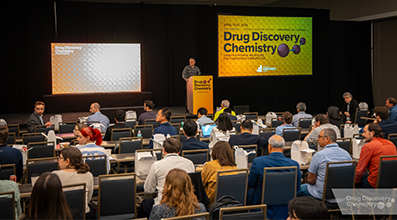
Découvrez les conférences et rencontres scientifiques à venir, où vous pourrez échanger avec notre équipe.

Chez Sygnature Discovery, nous fournissons des solutions de découverte de médicaments de classe mondiale pour accélérer la progression de vos composés, de l’idée jusqu’à la clinique.

Notre équipe de direction rassemble une diversité d’expériences et de ressources, favorisant la collaboration et l’innovation dans l’ensemble du processus de découverte de médicaments.

Explorez les opportunités de carrière chez Sygnature Discovery. Rejoignez une équipe internationale qui obtient des résultats exceptionnels grâce à la collaboration, à l’innovation et à l’intégrité.
Inobrodib, an exciting, first-in-class oral anti-cancer drug in clinical development by CellCentric, was collaboratively designed, synthesised and supported on its pre-clinical journey by an integrated project team at Sygnature Discovery. Inobrodib is now showing promising results in Phase I and II trials for multiple myeloma and other cancer types.
Chez Sygnature Discovery, nous fournissons des solutions de découverte de médicaments de classe mondiale pour accélérer la progression de vos composés, de l’idée jusqu’à la clinique.
Notre équipe de direction rassemble une diversité d’expériences et de ressources, favorisant la collaboration et l’innovation dans l’ensemble du processus de découverte de médicaments.
Explorez les opportunités de carrière chez Sygnature Discovery. Rejoignez une équipe internationale qui obtient des résultats exceptionnels grâce à la collaboration, à l’innovation et à l’intégrité.
Antibody drug conjugates (ADCs) are transforming oncology research by offering the precision of antibody targeting with the potent cell killing power of small‑molecule therapeutics. ADCs consist of three components (Figure 1):
This architecture expands the therapeutic window of the cytotoxic payload, by improving tumour specificity and limiting off‑target toxicity.
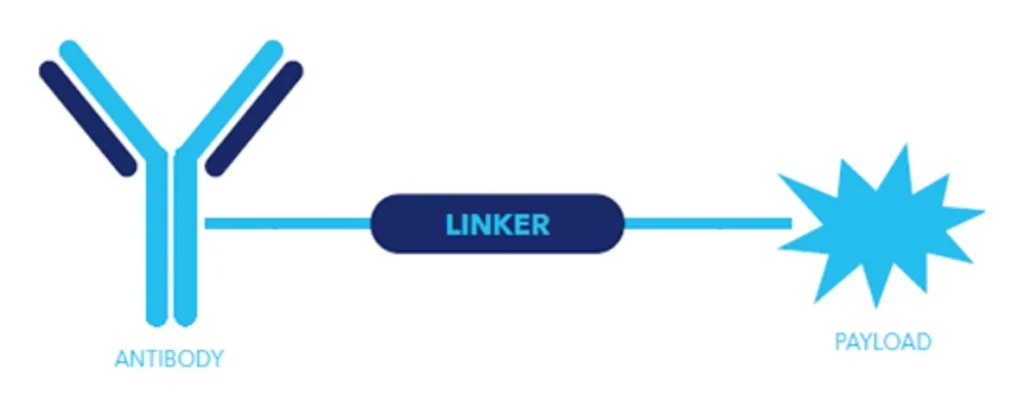
ADCs are comprised of three core components: antibody, linker and cytotoxic payload.
At Sygnature Discovery, we can combine our in-house protein production expertise with specialist conjugation chemistries, and robust analytical characterisation to deliver high quality ADCs for clients. Indeed, one of the most critical attributes of any ADC is the drug‑to‑antibody ratio (DAR), which comprises the average number of payloads attached per antibody (Figure 2). DAR affects potency, stability, pharmacokinetics and safety. Low DAR reduces efficacy, whereas very high DAR can compromise stability or accelerate clearance of the ADC from systemic circulation. Therefore, it is paramount that the analytical techniques available can accurately resolve and quantify the different species. Moreover, the type of conjugation chemistry selected (stochastic vs. site‑specific) plays a major role in defining DAR uniformity.
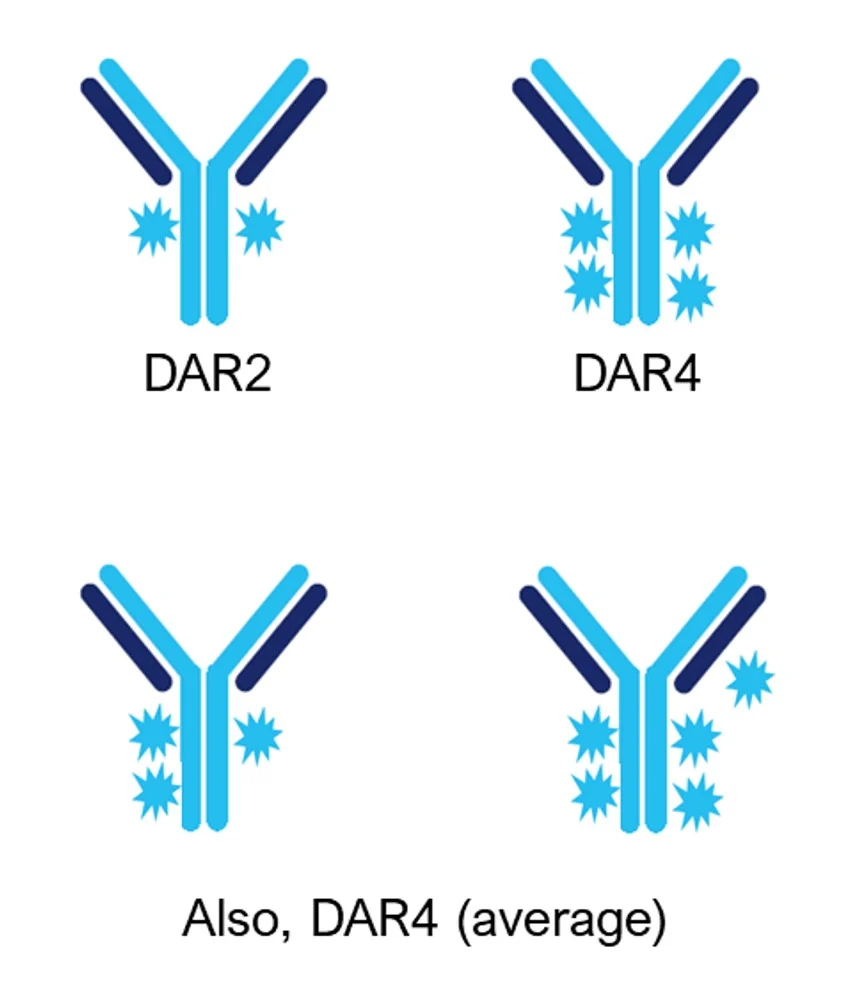
ADCs can form a mixture of species with different numbers of attached payload molecules (DAR0, DAR1, DAR2, DAR3, etc.). The relative abundance of each DAR species is then used to calculate the average DAR, which represents the weighted mean number of payloads per antibody molecule. This average DAR provides a single, interpretable value that reflects the overall conjugation level and is a critical quality attribute influencing potency, pharmacokinetics and stability.
Accurate DAR characterisation is crucial for ADC QC, reproducibility and downstream biological testing. Initial analytical method development was performed using non-cytotoxic maleimide linked payloads (AF488 C5 maleimide and Biotin PEG2 maleimide). Our standard intact mass spectrometry method could detect conjugation events based on the mass increase corresponding to the linker payload addition. However, analysis was complicated by several factors:
These factors introduced heterogeneity, making interpretation more challenging. Ideally, analysis would involve a single reference mass for heavy and light chains and no half body species. However, the incomplete reduction and glycosylation of samples prevented this in the standard MS method.
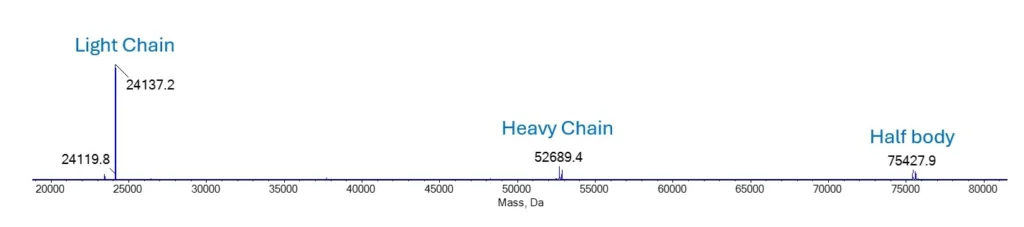
To overcome this heterogeneity, we developed a simple, robust pre‑treatment protocol using:
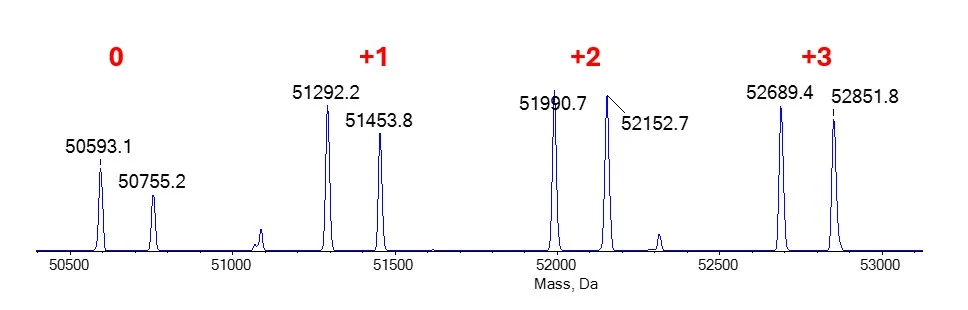
This produced single, well‑resolved peaks (Figure 5) with accurate molecular weights and no glycoform heterogeneity, enabling confident DAR quantification across all ADCs. Although minor deconvolution artefacts remained, the optimised method proved robust and transferrable across highly glycosylated antibodies and diverse biotherapeutic targets. Integration and quantification were performed using SCIEX BPV Flex, delivering highly reproducible results.
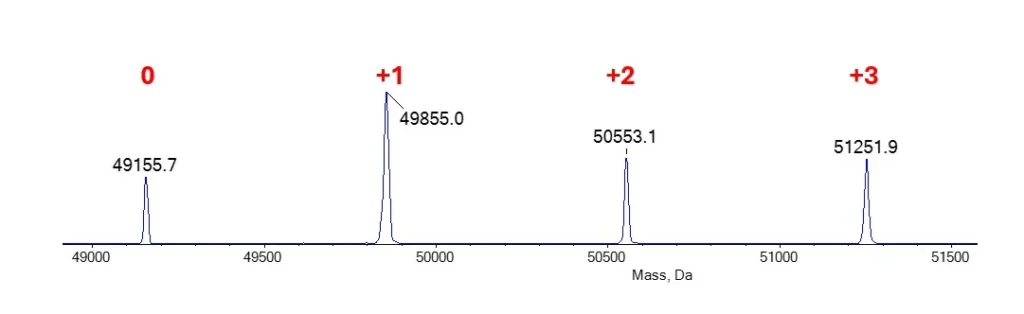
The deconvoluted mass spectrum confirms complete reduction of trastuzumab, as only light and heavy chain species are present, and half body fragments are absent. PNGase F treatment successfully removed N-linked glycans, evidenced by the heavy chain mass matching the theoretical value (49,156 Da). Moreover, the spectrum shows distinct single peaks corresponding to different conjugation states: unconjugated heavy chain (0) and heavy chains with 1, 2, or 3 payloads (+1, +2, +3). As such, the absence of glycosylation related doublet peaks simplifies interpretation. This optimised workflow enables accurate determination of drug-to-antibody ratio (DAR) and confirms homogeneity of glycan removal prior to conjugation analysis.
By optimising our intact mass spectrometry workflow, we have developed an accurate and robust mass spectrometry workflow for robust DAR assignment. This allows us to resolve and quantify DAR species with minimal sample requirements, rapid turnaround times and high reproducibility, enabling confident decision making throughout ADC optimisation projects.
Découvrez plus en détail notre large éventail de capacités pour soutenir les projets ADC.
Test