


Ressources
-
STORM Therapeutics: From Lead to Pre-Candidate Nomination in 18 Months

STORM Therapeutics: From Lead to Pre-Candidate Nomination in 18 Months
Case study


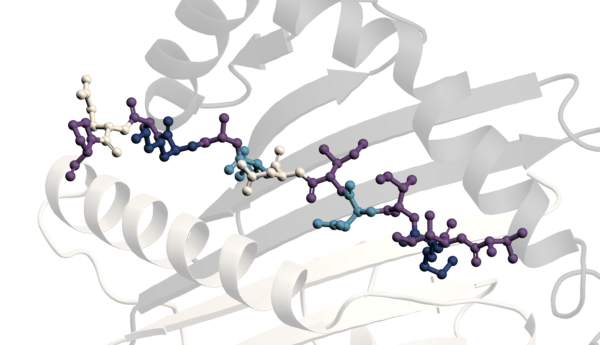


Discover precise insights into brain neurochemistry with Sygnature Discovery's in vivo microdialysis and cOFM services. With over 20 years of expertise, we design bespoke studies that reveal how compounds modulate neurotransmitter systems in health and disease. Using UHPLC/HPLC with electrochemical detection or mass spectrometry, we deliver robust PK/PD data to support confident CNS decision making.


juillet 30, 2015

Inobrodib, an exciting, first-in-class oral anti-cancer drug in clinical development by CellCentric, was collaboratively designed, synthesised and supported on its pre-clinical journey by an integrated project team at Sygnature Discovery. Inobrodib is now showing promising results in Phase I and II trials for multiple myeloma and other cancer types.

In drug discovery, generating targets is no longer the challenge. The real question is how to identify the few worth investing months of research and significant resources to pursue. Hear expert perspectives on how AI, pathway analysis and scientific expertise are shaping modern target identification.
juillet 7, 2026

Tenez‑vous au courant des dernières mises à jour de l’entreprise, des étapes clés et des annonces importantes.
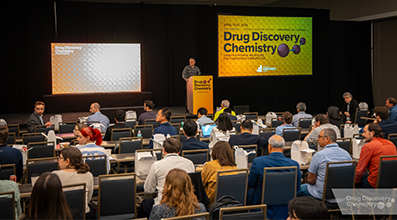
Découvrez les conférences et rencontres scientifiques à venir, où vous pourrez échanger avec notre équipe.

Chez Sygnature Discovery, nous fournissons des solutions de découverte de médicaments de classe mondiale pour accélérer la progression de vos composés, de l’idée jusqu’à la clinique.

Notre équipe de direction rassemble une diversité d’expériences et de ressources, favorisant la collaboration et l’innovation dans l’ensemble du processus de découverte de médicaments.

Explorez les opportunités de carrière chez Sygnature Discovery. Rejoignez une équipe internationale qui obtient des résultats exceptionnels grâce à la collaboration, à l’innovation et à l’intégrité.
Inobrodib, an exciting, first-in-class oral anti-cancer drug in clinical development by CellCentric, was collaboratively designed, synthesised and supported on its pre-clinical journey by an integrated project team at Sygnature Discovery. Inobrodib is now showing promising results in Phase I and II trials for multiple myeloma and other cancer types.
Chez Sygnature Discovery, nous fournissons des solutions de découverte de médicaments de classe mondiale pour accélérer la progression de vos composés, de l’idée jusqu’à la clinique.
Notre équipe de direction rassemble une diversité d’expériences et de ressources, favorisant la collaboration et l’innovation dans l’ensemble du processus de découverte de médicaments.
Explorez les opportunités de carrière chez Sygnature Discovery. Rejoignez une équipe internationale qui obtient des résultats exceptionnels grâce à la collaboration, à l’innovation et à l’intégrité.
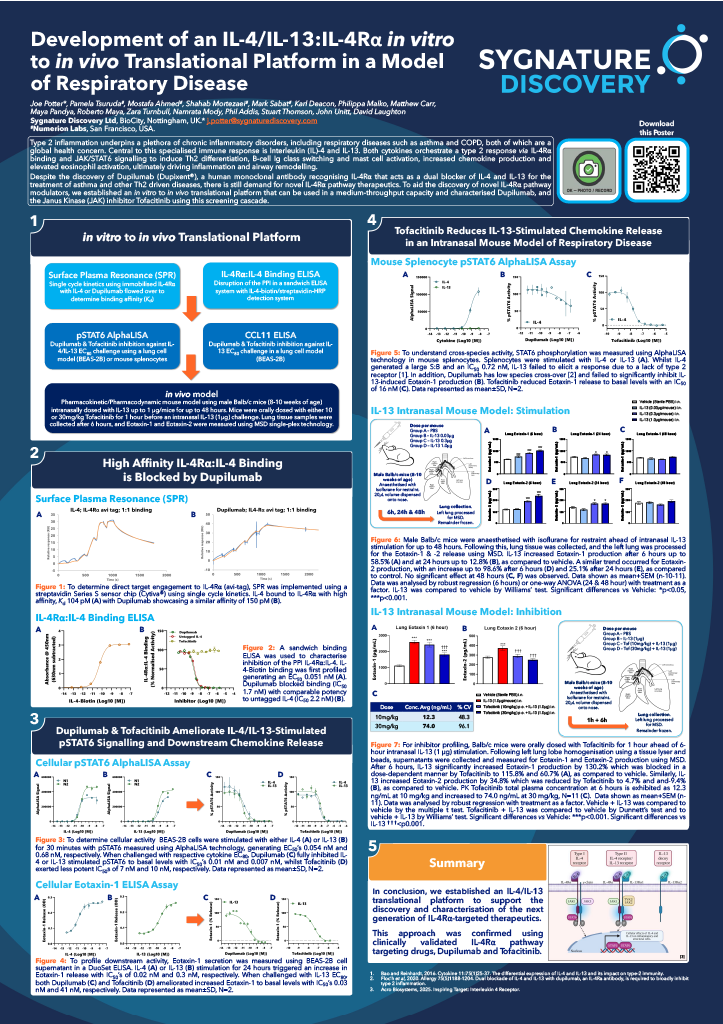
Type 2 inflammation drives many chronic respiratory diseases, include asthma and COPD, with IL-4 and IL-13 signalling through IL-4Rα and JAK/STAT6 as central pathway nodes. While the success of dupilumab clinically validates IL-4Rα as a target, there remains a need for efficient, translational assays to discover and characterize next-generation modulators of this pathway. In collaboration with Numerion, Sygnature Discovery has established an integrated in vitro to in vivo platforms that links IL-4/IL-13:IL-4Rα target engagement and signalling with downstream chemokine readouts in a respiratory disease-relevant mouse model.
Using surface plasmon resonance (SPR), we demonstrated high-affinity binding of IL-4 and dupilumab to IL-4Rα, and confirmed disruption of the IL-4:IL-4Rα protein-protein interactions in a sandwich ELISA format. Cellular assays in BEAS-2B lung epithelial cells and mouse splenocytes then captured pathway activation (pSTAT6) and downstream chemokine release (Eotaxin-1), enabling us to benchmark the clinically validated IL-4Rα antibody dupilumab and the JAK inhibitor tofacitinib. Finally, an intranasal IL-13 Balb/c model provided in vivo confirmation that Tofacitinib reduces lung Eotaxin-1 and Eotaxin-2 in a dose-dependent manner with corresponding plasma exposure, complementing a medium-throughput translational cascade suitable for profiling novel IL-4Rα pathway therapeutics in respiratory and other Th2-driven indications.
Loading form…
Thank you! Your download will begin shortly.

Test