


Featured Resources
-
STORM Therapeutics: From Lead to Pre-Candidate Nomination in 18 Months

STORM Therapeutics: From Lead to Pre-Candidate Nomination in 18 Months
Case study


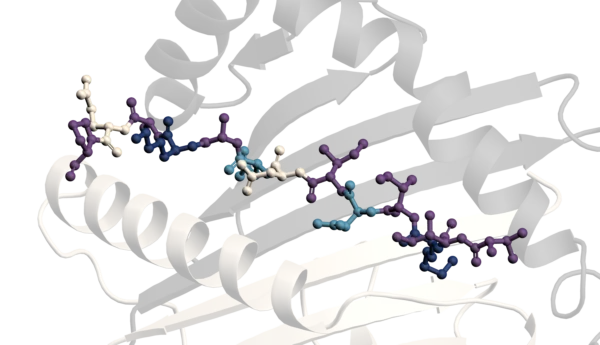

Integrating FIDA™ and Biacore™ SPR for optimal results.


Discover precise insights into brain neurochemistry with Sygnature Discovery's in vivo microdialysis and cOFM services. With over 20 years of expertise, we design bespoke studies that reveal how compounds modulate neurotransmitter systems in health and disease. Using UHPLC/HPLC with electrochemical detection or mass spectrometry, we deliver robust PK/PD data to support confident CNS decision making.


July 30, 2015
Inobrodib, an exciting, first-in-class oral anti-cancer drug in clinical development by CellCentric, was collaboratively designed, synthesized and supported on its pre-clinical journey by an integrated project team at Sygnature Discovery. Inobrodib is now showing promising results in Phase I and II trials for multiple myeloma and other cancer types.

February 3, 2026

Stay up to date with the latest company updates, milestones, and announcements.
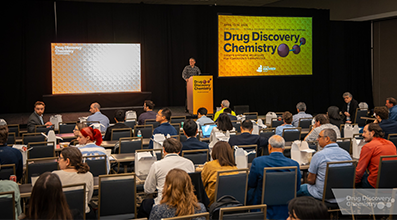
Explore upcoming conferences and scientific meetings where you can connect with our team.

At Sygnature Discovery, we deliver world-leading drug discovery solutions to accelerate your compound from idea to clinic.

Our leadership team brings diverse experience and insight, driving collaboration and innovation across drug discovery.

Explore careers at Sygnature Discovery and join a global team committed to science, collaboration, and integrity.
Inobrodib, an exciting, first-in-class oral anti-cancer drug in clinical development by CellCentric, was collaboratively designed, synthesized and supported on its pre-clinical journey by an integrated project team at Sygnature Discovery. Inobrodib is now showing promising results in Phase I and II trials for multiple myeloma and other cancer types.
At Sygnature Discovery, we deliver world-leading drug discovery solutions to accelerate your compound from idea to clinic.
Our leadership team brings diverse experience and insight, driving collaboration and innovation across drug discovery.
Explore careers at Sygnature Discovery and join a global team committed to science, collaboration, and integrity.
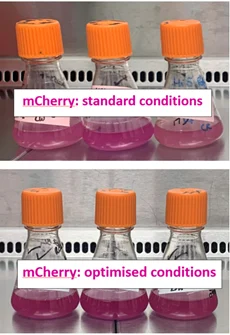
HEK293 6E cells (which we have on license from the National Research Council (NRC) in Canada) are a well-established mammalian expression system used in the protein expression team at Sygnature Discovery for expressing recombinant proteins. In this case study Sarah Beck describes the experiments that Calum Wilson our summer intern student performed under her guidance, that aimed to improve our standard HEK cell culture protocols. Calum carried out a Design of Experiments (DoE) study to investigate transfection conditions and feeding regimes in HEK293 6E cells with the overall aim being to optimize yields of recombinant protein.
Cell density at transfection, DNA concentration, DNA:PEI ratio, and feeding regimes were the variable studied. Two of these were categorical factors so we were unable to use a definitive screening design. Instead, a custom design was created in the JMP software that still allowed us to investigate 2-way factor interactions in two blocks of 12 runs, with each block including a control with our current culture conditions. In total twenty-four different 50ml cultures of HEK293 6E cells were performed with cell viability and mCherry protein expression levels compared as the output for each condition tested. The data obtained was statistically analyzed with the JMP software.
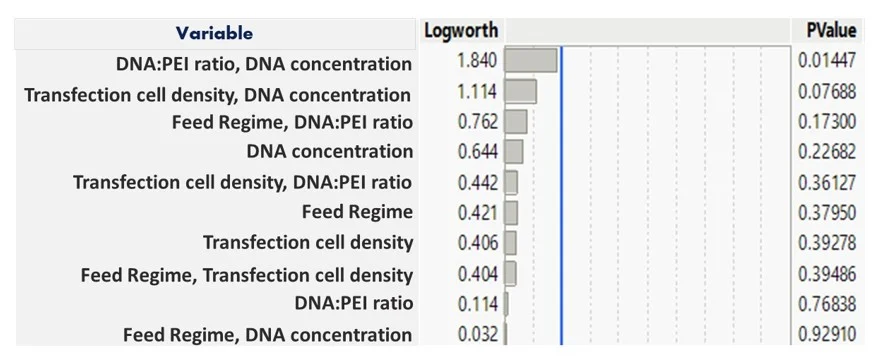
Analysis of DoE data for mCherry yield showed the interaction of DNA:PEI ratio and DNA concentration together had more of a significant effect (P value < 0.05) than individual variables on their own (Figure 1). It was proven to be a good model with R-squared value of 0.91, suggesting that 91% of the observed variation could be explained by the model generated by the software. Using the prediction profiler tool in JMP showed the optimal settings for each of the factors for highest mCherry yield. These conditions were matched by the analysis of the cell viability output (data not shown).
e optimal conditions for highest mCherry yield.
A confirmation run was then performed with the new predicted optimal settings from the DoE for each of the factors. mCherry transfections in HEK cells were tested and compared to standard (original) conditions (Figure 2). It was found that the new optimal conditions produced a higher, 80% improved, mCherry yield and these cells also had a higher percentage cell viability at harvest compared to our standard conditions.
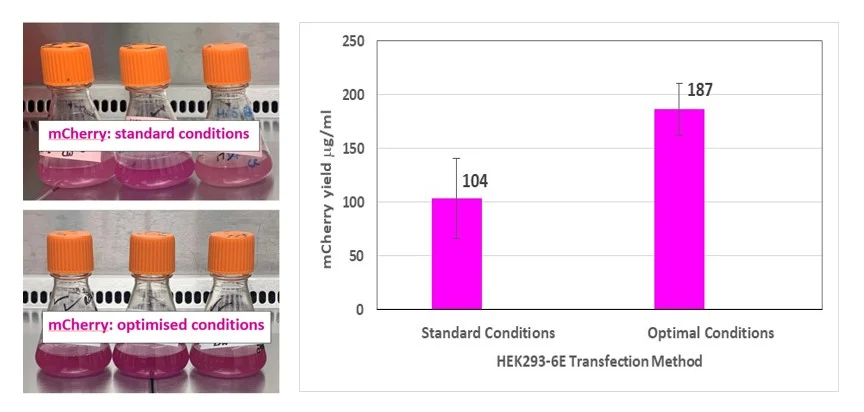
This Design of Experiments (DoE) study was a rapid way to investigate four variables to increase protein yield in our HEK293 6E mammalian expression system. Optimal conditions were identified which successfully improved mCherry yield by 80%. These also included using a lower cell density and DNA concentration at transfection which is advantageous in terms of consumption of materials. Design of experiments is a hugely powerful tool and will be extended to optimize other cell culture protocols in use at Sygnature Discovery.
As discussed, we can apply DoE variable testing to optimise cell growth. We have also use this to optimise a client protein purification protocol. If you have a protein expression and purification project that you think would benefit from a DoE approach, then please don’t hesitate to get in touch with via the link at the bottom of this page.

Peak Proteins, NuChem Sciences, and SB Drug Discovery have now fully integrated with Sygnature Discovery.