


Featured Resources
-
STORM Therapeutics: From Lead to Pre-Candidate Nomination in 18 Months

STORM Therapeutics: From Lead to Pre-Candidate Nomination in 18 Months
Case study
📣From lead to pre-candidate nomination in 18 months. Explore the STORM Therapeutics case study




Discover precise insights into brain neurochemistry with Sygnature Discovery's in vivo microdialysis and cOFM services. With over 20 years of expertise, we design bespoke studies that reveal how compounds modulate neurotransmitter systems in health and disease. Using UHPLC/HPLC with electrochemical detection or mass spectrometry, we deliver robust PK/PD data to support confident CNS decision making.


July 30, 2015

Inobrodib, an exciting, first-in-class oral anti-cancer drug in clinical development by CellCentric, was collaboratively designed, synthesised and supported on its pre-clinical journey by an integrated project team at Sygnature Discovery. Inobrodib is now showing promising results in Phase I and II trials for multiple myeloma and other cancer types.

In drug discovery, generating targets is no longer the challenge. The real question is how to identify the few worth investing months of research and significant resources to pursue. Hear expert perspectives on how AI, pathway analysis and scientific expertise are shaping modern target identification.
July 7, 2026

Stay up to date with the latest company updates, milestones, and announcements.
Explore upcoming conferences and scientific meetings where you can connect with our team.

At Sygnature Discovery, we deliver world-leading drug discovery solutions to accelerate your compound from idea to clinic.

Our leadership team brings diverse experience and insight, driving collaboration and innovation across drug discovery.

Explore careers at Sygnature Discovery and join a global team committed to science, collaboration, and integrity.
Inobrodib, an exciting, first-in-class oral anti-cancer drug in clinical development by CellCentric, was collaboratively designed, synthesised and supported on its pre-clinical journey by an integrated project team at Sygnature Discovery. Inobrodib is now showing promising results in Phase I and II trials for multiple myeloma and other cancer types.
At Sygnature Discovery, we deliver world-leading drug discovery solutions to accelerate your compound from idea to clinic.
Our leadership team brings diverse experience and insight, driving collaboration and innovation across drug discovery.
Explore careers at Sygnature Discovery and join a global team committed to science, collaboration, and integrity.

In 2025 we celebrated 10 years of licencing the HEK293-6E mammalian suspension expression system from the National Research Council (NRC) in Canada. Since then, it has become a reliable expression workhorse for us with the result that the HEK293-6E system has played a key role in delivering mammalian cell grows for the company. This anniversary seems like an ideal moment to look back at what we have achieved with them over the past decade.
HEK293-6E were developed at NRC and are engineered to express a truncated form of Epstein-Barr virus nuclear antigen 1 (EBNA-1), which allows for episomal replication of plasmids with oriP. Transfection of the cells with the pTT5 vector, which has both oriP and a strong hCMV promoter, enables enhanced expression of recombinant proteins, making them ideal for quickly generating useful quantities of transiently expressed protein.
Back in 2015 the HEK293-6E were brought in to complement the E. coli and insect cell lines which had already been established at Peak Proteins (now The Protein Science & Structural Biology department at Sygnature Discovery Ltd). The HEK293-6E were selected based on previous experience of working with this cell line and the enhanced expression characteristics mentioned above. What made it a “no brainer”, in the words of our founder Mark Abbott, was that the commercial terms on the HEK-6E cells were much better than alternatives on the market and the media was a lot cheaper. Being a small start-up company, these were key factors for us at the time.
We tend to choose mammalian host cell lines for extracellular targets, especially when glycosylation is a consideration. With the HEK293-6E system, well, we have produced everything from membrane proteins to proteases, extracellular domains of receptors and some really challenging molecules including the production of some intrinsically disordered proteins and even a protein complex that involved co-transfection of 12 separate plasmids. They have proved excellent for the production of antibodies and antibody derived proteins (e.g. Fabs) which alongside our other mammalian cell lines have become a key component in the support of our ADC workflows.
A few selected examples are presented below:-
One of our early successes was the production of the extracellular domain (ECD) of G6b-B protein, which was used in an X-ray crystallography project. The team successfully determined the structure of the G6b-B ectodomain bound to a recombinant Fab fragment and a crystal structure of the ECD in complex with a 12 saccharide-unit heparin fragment (DP12) that was predicted to be an analogue of the physiological ligand. To date this is still the only structure of G6b-B in the PDB (reference 6R0X).
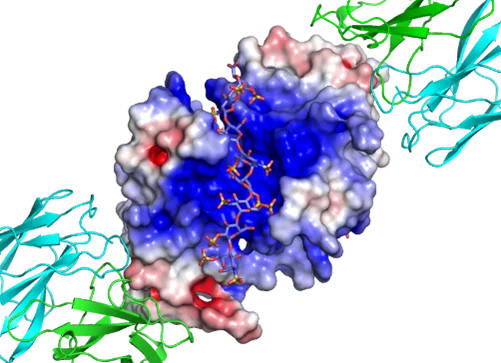
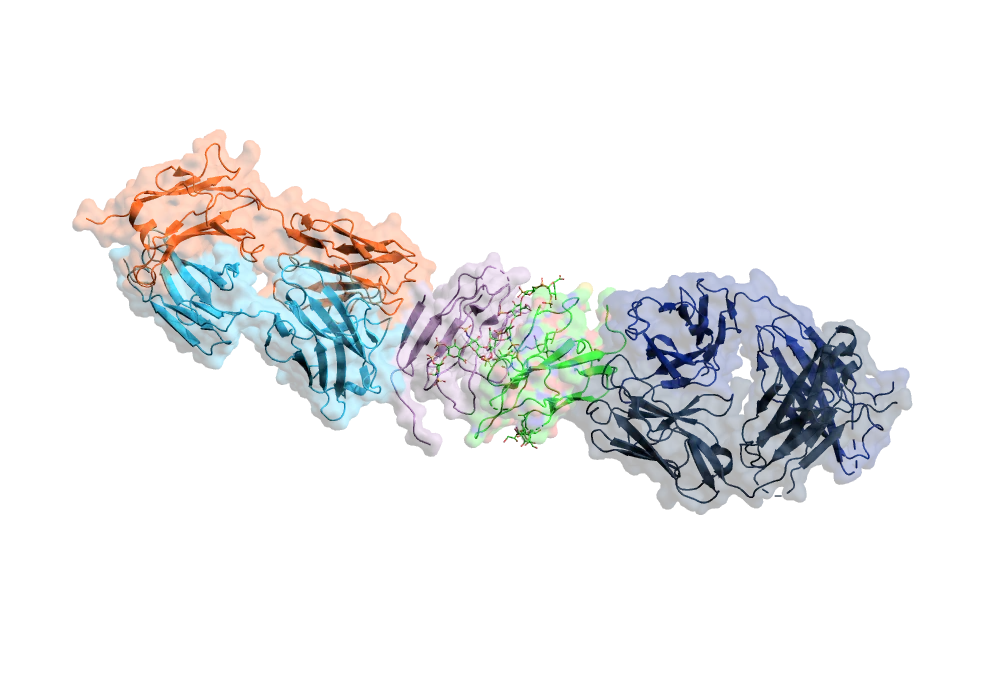
Bivalent single chain Fvs (scFv) expressed in our HEK293-6E cells featured in a publication on a new family of anti-thrombotic biotherapeutics from the lab of Dr. Yotis Senis, Research Director, INSERM, Strasbourg, France. Christened CAPRIs (cis-acting platelet receptor inhibitors), the ScFv act by clustering the platelet inhibitory receptor G6b-B (G6B, MPIG6B) with the platelet stimulatory receptors GPVI-FcR γ-chain or FcγRIIA, thus blocking platelet activation and laying the foundation for a novel class of anti-thrombotics with potential for greater efficacy.
HEK293-6E have also been used for the development of a production process that was suitable for full scale manufacture of the protein component of a biopharmaceutical. The small, secreted <10kDa glycosylated protein featured all of the desired traits for excellent SISPQ and a robust process for manufacture: fully active, amenable to subsequent conjugation, high yielding (~80-100 mg per L culture), low endotoxin (0.1 EU/mL), a single species observed by MS, reproducible, scalable and with a single step purification, relatively inexpensive with respect to Cost of Goods.
Working with HEK293-6E for a long period of time has allowed us to develop additional tools such as an in vivo biotinylation method (well of course it is not strictly in vivo, more during translation by co-expression of BirA) , which provides further options for our clients’ projects.
We are also able to modulate the post-translational glycosylation of proteins which can be especially helpful for X-ray crystallography projects. Oligosaccharides attached to asparagine or N-linked structures are very common and we can remove the N-linked glycans by either mutating the asparagine or more commonly culturing the cells in kifunensine and then treating the protein with endoglycosidase H during purification.
Much less common are oligosaccharides linked to the -OH group of either threonine or serine. Protein characterisation using mass spectrometry has revealed O-glycosylation on proteins from time to time. Since O-glycosylation can have a significant impact on proteins produced for biotherapeutic purposes this highlights the importance of identifying any post translational modifications proteins may possess.
As described in our recent blog ‘More Protein Targets More Cell Cultures’ there has been a dramatic rise in the number of cell expression grows, culture volumes and expressed protein targets during the last five years. We have kept up with this demand by expanding the range of volumes the cells (including the HEK293-6Es) are grown at and can now cover everything from small scale feasibility studies in as little as 4mL in a plate, up to 20L wavebag grows. In addition to this, we have developed an in house ‘toolbox’ of tricks and tweaks we use to coax more difficult proteins to express.
And what might the next decade bring for HEK293-6E? We’re currently developing a method for expressing labelled proteins for NMR so watch this space!


Peak Proteins, NuChem Sciences, and SB Drug Discovery have now fully integrated with Sygnature Discovery.