


Featured Resources
-
STORM Therapeutics: From Lead to Pre-Candidate Nomination in 18 Months

STORM Therapeutics: From Lead to Pre-Candidate Nomination in 18 Months
Case study




Discover precise insights into brain neurochemistry with Sygnature Discovery's in vivo microdialysis and cOFM services. With over 20 years of expertise, we design bespoke studies that reveal how compounds modulate neurotransmitter systems in health and disease. Using UHPLC/HPLC with electrochemical detection or mass spectrometry, we deliver robust PK/PD data to support confident CNS decision making.


July 30, 2015
Inobrodib, an exciting, first-in-class oral anti-cancer drug in clinical development by CellCentric, was collaboratively designed, synthesized and supported on its pre-clinical journey by an integrated project team at Sygnature Discovery. Inobrodib is now showing promising results in Phase I and II trials for multiple myeloma and other cancer types.

In drug discovery, generating targets is no longer the challenge. The real question is how to identify the few worth investing months of research and significant resources to pursue. Hear expert perspectives on how AI, pathway analysis and scientific expertise are shaping modern target identification.
July 7, 2026

Stay up to date with the latest company updates, milestones, and announcements.
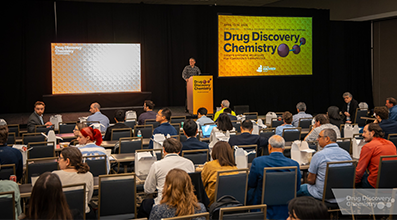
Explore upcoming conferences and scientific meetings where you can connect with our team.

At Sygnature Discovery, we deliver world-leading drug discovery solutions to accelerate your compound from idea to clinic.

Our leadership team brings diverse experience and insight, driving collaboration and innovation across drug discovery.

Explore careers at Sygnature Discovery and join a global team committed to science, collaboration, and integrity.
Inobrodib, an exciting, first-in-class oral anti-cancer drug in clinical development by CellCentric, was collaboratively designed, synthesized and supported on its pre-clinical journey by an integrated project team at Sygnature Discovery. Inobrodib is now showing promising results in Phase I and II trials for multiple myeloma and other cancer types.
At Sygnature Discovery, we deliver world-leading drug discovery solutions to accelerate your compound from idea to clinic.
Our leadership team brings diverse experience and insight, driving collaboration and innovation across drug discovery.
Explore careers at Sygnature Discovery and join a global team committed to science, collaboration, and integrity.
Design of Experiments (DoE or sometimes DoX) is an umbrella term that has been coined to cover a particular statistical design and evaluation approach to performing experiments. In essence it is a hugely powerful and very efficient way to conduct experiments where you have more than one variable that you would like to study.
Phil Kay , who describes himself as an Evangelist for Data Analysis says that “Every scientist and engineer in the world should be able to use DoE: It is THE most important method in statistics and data science for industrial R&D and manufacturing”.
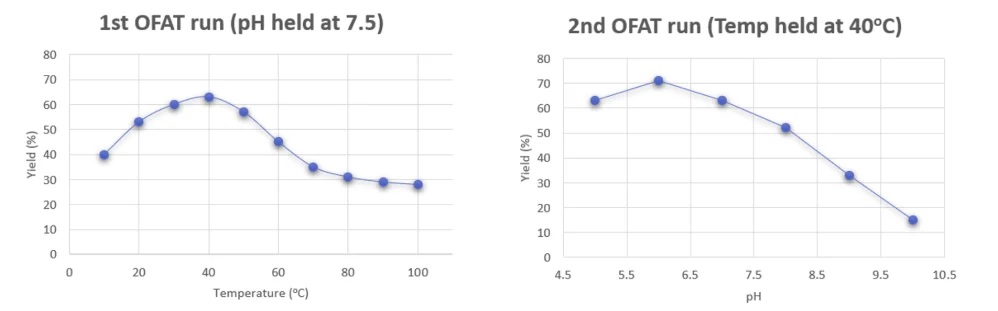
Perhaps the best way to illustrate this is with a relatively simple example. Say you have a system where you have 2 variable factors, temperature and pH, that you are interested in for a reaction and you want to study their impact on the final yield of your product. All the other factors; time, reagent concentrations, etc are held constant as far as is experimentally possible. You might have some historical (random trial) data for the reaction (Figure 2a) and from that you decide to perform a structured study by varying One Factor At a Time (OFAT). In your 1st OFAT set of trials, you fix reaction pH at one level (pH7.5) and then vary the temperature between 10°C and 100°C in 9 separate experiments. From this set of experiments, you discover that the optimum temperature is 40°C and it gives you a yield of 63% (Figure 1a). For your 2nd set of OFAT trials, you then fix the temperature a 40°C and run 6 experiments between pH 5.0 and 10.0 and find that at pH 6.0 you have improved the yield to 71% (Figure 1b). Hoorah…….!……
….BUT…… In reality it transpires that the optimum yield of 83% is obtained at 80°C and pH9.0. You have run 15 experiments (not including the initial random experiments – Figure 2) and although the yield is reasonable, you have missed the sweet spot, because you didn’t experiment in that region. The red point on all of the charts in Figure 2.
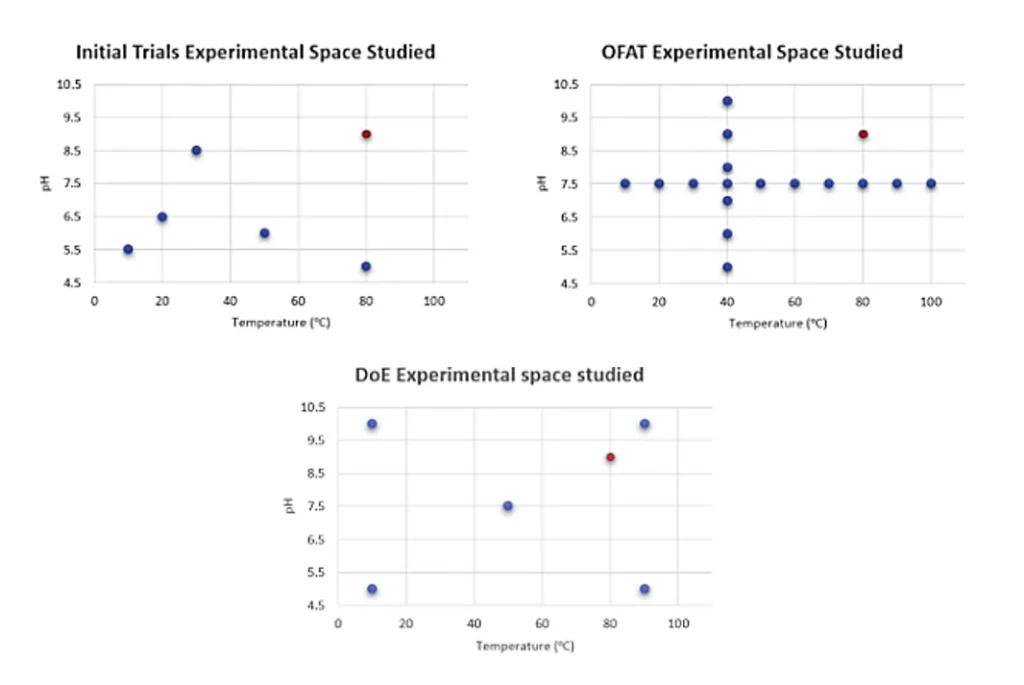
With the DoE approach, doing less, but with more focus gives you more, much more. Kind of the Tai Chi martial art of experimental design. With a DoE trial you vary both factors at the same time, with them set at the corners of the experimental range you wish to study and often include a centre point (Figure 2). In this example, you only run 5 experiments, but are much more likely to have settings that are near to the optimum condition for the system than with the OFAT approach, because you have covered more of the experimental space. Your second set of DoE experiments can then explore the region in more detail if you wish.
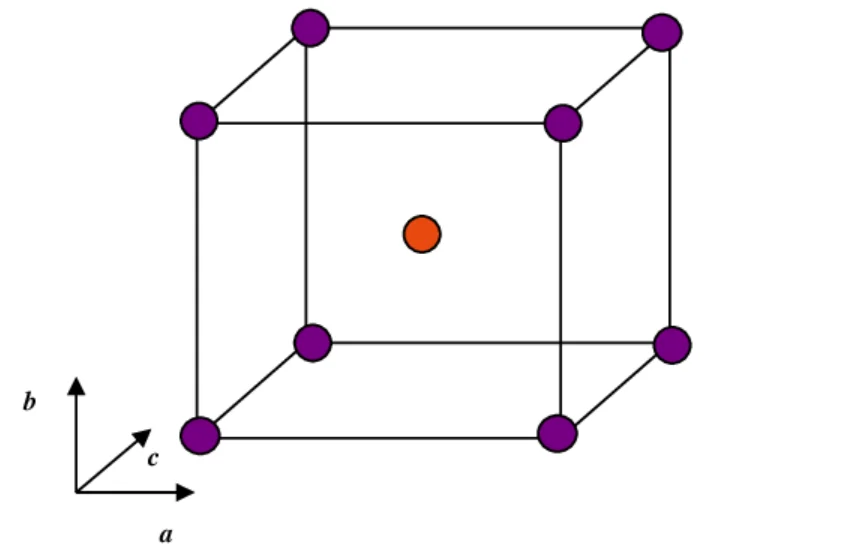
The power comes if you translate this out to a study varying 3, 4, 5 or more factors at once. This is not only possible in a DoE trial, but relatively straightforward to achieve. (Figure 3 shows the design space for 3 factors set at 2 levels with a centre point), If like Doc Brown in Back to the Future you can think forth dimensionally, perhaps you can visualize the experimental ground you can cover with 4 and then even more factors studied at once.
Our previous managing director, Mark Abbott, was one of the early adopters of DoE for recombinant protein production. In this 2002 paper he and his team used a fractional factorial design to optimize the refolding of Cathepsin S from inclusion bodies. In this later study, the aim was to optimize the process to transiently transfect CHO cells. In the early days you needed a card carrying statistician to help both design the experiment and then interpret the data obtained. Fortunately, nowadays, things have moved on and there are software packages that do the heavy statistical lifting for you. This now allows scientists to go a long way with DoE and the statistical interpretation. Mind you, it is still good to have a statistician available to discuss the detail with when you get out of your depth. We use the JMP Software which allows us to design, perform and interpret a range of DoE methodologies such as Full and Fractional Factorial, Definitive Screening, Response Surface and other designs.
In Sygnature Protein and Structure, we have team members who have significant (>10 years) experience using DoE and other statistical methods for biopharmaceutical manufacturing process control and process development (both upstream fermentation and downstream purification). Currently we are aiming to leverage this knowledge and increase our use of DoE. Where appropriate, we are applying DoE to processes we are trying to optimize. This will be projects such as optimizing refolding conditions from inclusion bodies (similar to the Cathepsin S example above), how best to solubilise membrane proteins, optimisation of cell culture protocols, how to obtain the best activity of an enzyme, how to improve the yield from a protein chromatography protocol. As you can see the potential applications are wide and diverse. See our case study in one of the coming month’s newsletter (Mar 2023) for an example where we have used it to optimize an E.coli fermentation process and the subsequent lysis and clarification steps to improve the yield of a target recombinant protein.
There are a few key points to consider when designing a DoE trial and these influence the type of design that you select. To give you an idea, the first thing to decide is how many different factors you are going to study and balance this with how much time and resource you have. This obviously very much depends on the complexity of the experimental set up and protocol. If you have a lot of factors and want to see which are just having an impact on your process, then a screening design is a good place to start. However, often you are not able to get an indication of whether the factors interact and affect each other with these type of designs. If that is important, then factorial designs are needed, however these take more individual runs (more time and resource). Do you need to see if there are quadratic effects (curvature in the response)? Do you need to get data on the inherent experimental variation of the system? If yes, more runs are required. There are solutions to all these considerations, but as you can see time spent thinking through the overall approach and design, is time very well spent.
There are plenty of resources on DoE on the web, especially YouTube. A good place to start though is the free online course provided by JMP “Statistical Thinking for Industrial Problem Solving” that has DoE as one of the modules.

Peak Proteins, NuChem Sciences, and SB Drug Discovery have now fully integrated with Sygnature Discovery.