



Featured Resources
-
STORM Therapeutics: From Lead to Pre-Candidate Nomination in 18 Months

STORM Therapeutics: From Lead to Pre-Candidate Nomination in 18 Months
Case study




Discover precise insights into brain neurochemistry with Sygnature Discovery's in vivo microdialysis and cOFM services. With over 20 years of expertise, we design bespoke studies that reveal how compounds modulate neurotransmitter systems in health and disease. Using UHPLC/HPLC with electrochemical detection or mass spectrometry, we deliver robust PK/PD data to support confident CNS decision making.


July 30, 2015

Inobrodib, an exciting, first-in-class oral anti-cancer drug in clinical development by CellCentric, was collaboratively designed, synthesised and supported on its pre-clinical journey by an integrated project team at Sygnature Discovery. Inobrodib is now showing promising results in Phase I and II trials for multiple myeloma and other cancer types.

In drug discovery, generating targets is no longer the challenge. The real question is how to identify the few worth investing months of research and significant resources to pursue. Hear expert perspectives on how AI, pathway analysis and scientific expertise are shaping modern target identification.
July 7, 2026

Stay up to date with the latest company updates, milestones, and announcements.
Explore upcoming conferences and scientific meetings where you can connect with our team.

At Sygnature Discovery, we deliver world-leading drug discovery solutions to accelerate your compound from idea to clinic.

Our leadership team brings diverse experience and insight, driving collaboration and innovation across drug discovery.

Explore careers at Sygnature Discovery and join a global team committed to science, collaboration, and integrity.
Inobrodib, an exciting, first-in-class oral anti-cancer drug in clinical development by CellCentric, was collaboratively designed, synthesised and supported on its pre-clinical journey by an integrated project team at Sygnature Discovery. Inobrodib is now showing promising results in Phase I and II trials for multiple myeloma and other cancer types.
At Sygnature Discovery, we deliver world-leading drug discovery solutions to accelerate your compound from idea to clinic.
Our leadership team brings diverse experience and insight, driving collaboration and innovation across drug discovery.
Explore careers at Sygnature Discovery and join a global team committed to science, collaboration, and integrity.
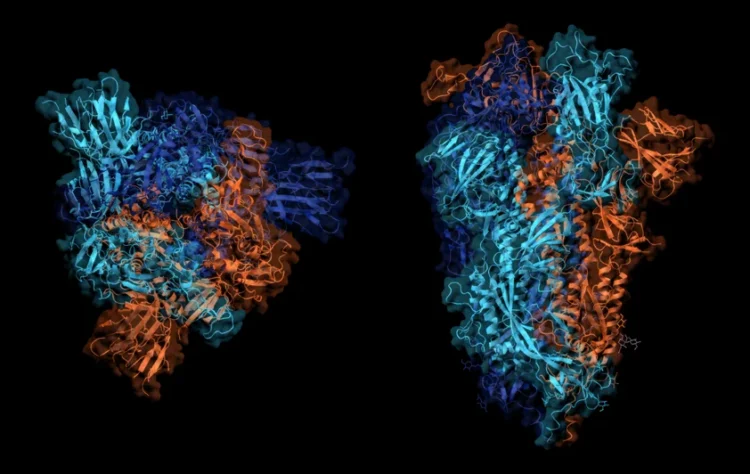
Two projects we have been involved with, required solutions to this in order to produce homotrimeric proteins.
The first was the SARS-CoV-2 spike protein which is active as a homotrimer. To produce the protein recombinantly, teams have replaced the transmembrane region with a bacteriophage T4 fibritin trimerization motif [1] (aka “Foldon b-propeller”) [2 – 5] along with other stabilising mutations. We successfully reproduced these methods in the Sygnature Protein Science laboratories to generate homotrimeric spike in HEK293 cells. This purified with good yields, to produce pure, active spike as demonstrated by its binding kinetics to the ACE2 receptor in Biacore surface plasmon resonance (SPR) experiments.
Furthermore, the spike protein we produced was used by Phelan et al 2021 [6] in their study “Dynamic Assay for Profiling Anti-SARS-CoV-2 Antibodies and Their ACE2/Spike RBD Neutralization Capacity”.
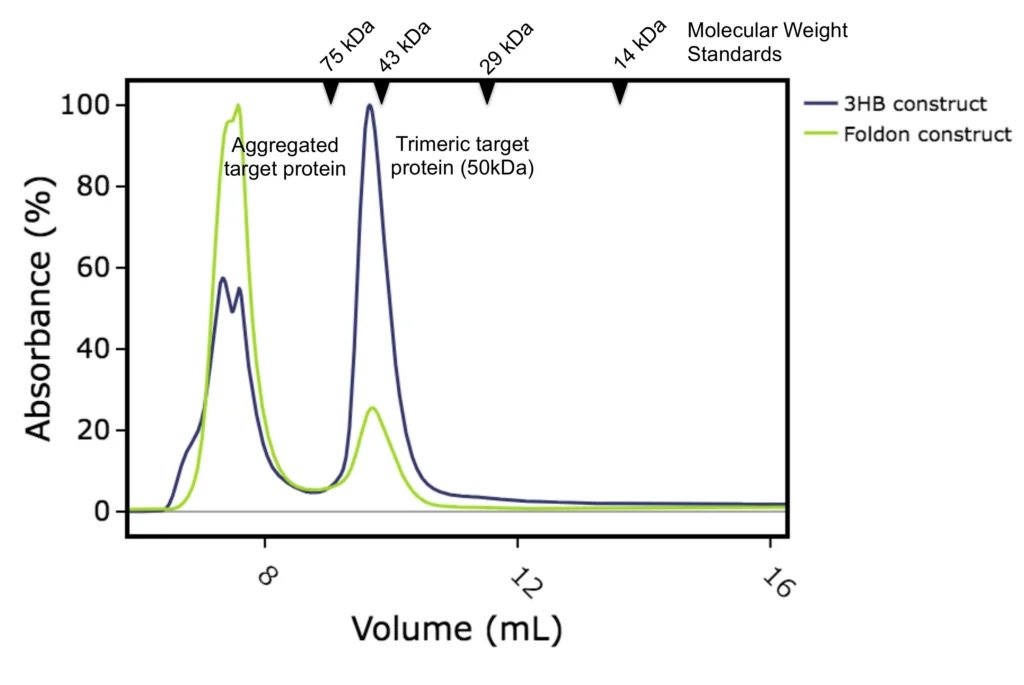
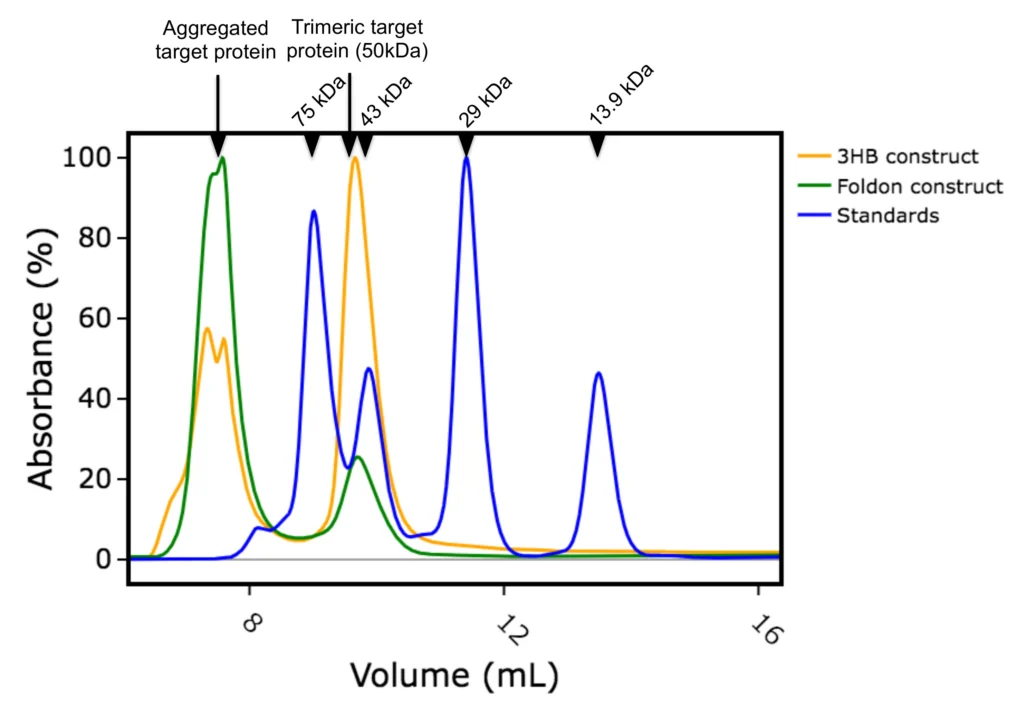
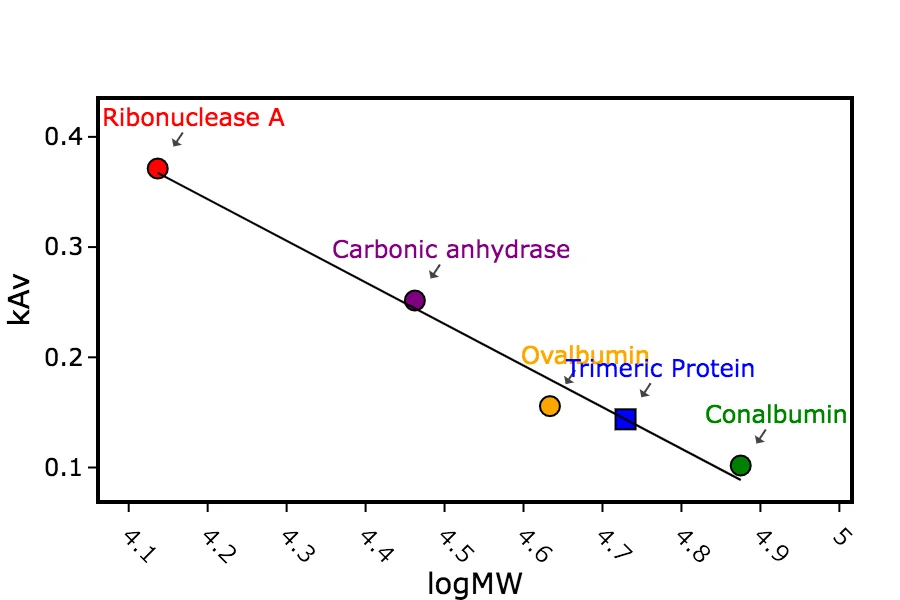
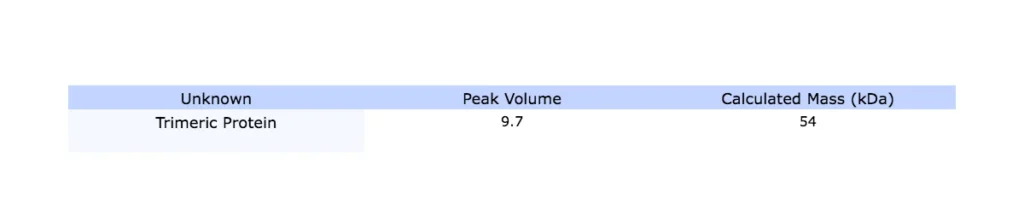
For the second project, we were asked to produce a different protein as a homotrimer. This particular target relies on interactions with other proteins to trimerize in vivo, but for this project the client wanted the target protein on its own, in trimeric form. There are several trimerization motifs that have been used in the literature and we chose to compare two in parallel. The T4 foldon motif, as it had worked so well for spike, and the engineered 3 helix bundle (3HB) developed by Fletcher et al [7]. We expressed both constructs (with 6His tags and either Foldon or 3HB motifs) in E.coli and purified using metal affinity and size exclusion chromatography. Both expressed well with yields between 35 to 55 mg per litre culture. Interestingly, a significant proportion of the construct with the foldon appeared as aggregated peak running at the void volume of a calibrated size exclusion column. Whereas the main peak for the construct with 3HB ran with a calculated apparent mass of 54kDa which is expected for the desired homotrimer (Figures 1a, 1b and 1c). When pooled the homotrimer was found to be stable to both concentration and freeze thaw.
While both constructs produced homotrimeric protein, it was certainly worth comparing different trimerization motifs to find the one that gave the best yield, 3HB in this case.
Fletcher et al [7] described other variations of coiled-coil peptide oligomers to produce dimeric, and tetrameric proteins as well as the trimeric version used in this study.
[1] Y. Tao, S. V Strelkov, V. V Mesyanzhinov, and M. G. Rossmann, ‘Structure of bacteriophage T4 fibritin: a segmented coiled coil and the role of the C-terminal domain’, Structure, vol. 5, no. 6, pp. 789–798, Jun. 1997, doi: 10.1016/S0969-2126(97)00233-5.
[2] D. Wrapp et al., ‘Cryo-EM structure of the 2019-nCoV spike in the prefusion conformation’, Science (80-. )., vol. 367, no. 6483, pp. 1260–1263, Mar. 2020, doi: 10.1126/science.abb2507.
[3] Y. Watanabe, J. D. Allen, D. Wrapp, J. S. McLellan, and M. Crispin, ‘Site-specific glycan analysis of the SARS-CoV-2 spike’, Science (80-. )., vol. 369, no. 6501, pp. 330–333, Jul. 2020, doi: 10.1126/science.abb9983.
[4] J. M. Schaub et al., ‘Expression and characterization of SARS-CoV-2 spike proteins’, Nat. Protoc., vol. 16, no. 11, pp. 5339–5356, Nov. 2021, doi: 10.1038/s41596-021-00623-0.
[5] J. Juraszek et al., ‘Stabilizing the closed SARS-CoV-2 spike trimer’, Nat. Commun., vol. 12, no. 1, p. 244, Dec. 2021, doi: 10.1038/s41467-020-20321-x.
[6] T. Phelan et al., ‘Dynamic Assay for Profiling Anti-SARS-CoV-2 Antibodies and Their ACE2/Spike RBD Neutralization Capacity’, Viruses, vol. 13, no. 7, p. 1371, Jul. 2021, doi: 10.3390/v13071371.
[7] J. M. Fletcher et al., ‘A Basis Set of de Novo Coiled-Coil Peptide Oligomers for Rational Protein Design and Synthetic Biology’, ACS Synth. Biol., vol. 1, no. 6, pp. 240–250, Jun. 2012, doi: 10.1021/sb300028q.
Peak Proteins, NuChem Sciences, and SB Drug Discovery have now fully integrated with Sygnature Discovery.