


Featured Resources
-
STORM Therapeutics: From Lead to Pre-Candidate Nomination in 18 Months

STORM Therapeutics: From Lead to Pre-Candidate Nomination in 18 Months
Case study




Discover precise insights into brain neurochemistry with Sygnature Discovery's in vivo microdialysis and cOFM services. With over 20 years of expertise, we design bespoke studies that reveal how compounds modulate neurotransmitter systems in health and disease. Using UHPLC/HPLC with electrochemical detection or mass spectrometry, we deliver robust PK/PD data to support confident CNS decision making.


July 30, 2015

Inobrodib, an exciting, first-in-class oral anti-cancer drug in clinical development by CellCentric, was collaboratively designed, synthesized and supported on its pre-clinical journey by an integrated project team at Sygnature Discovery. Inobrodib is now showing promising results in Phase I and II trials for multiple myeloma and other cancer types.

In drug discovery, generating targets is no longer the challenge. The real question is how to identify the few worth investing months of research and significant resources to pursue. Hear expert perspectives on how AI, pathway analysis and scientific expertise are shaping modern target identification.
July 7, 2026

Stay up to date with the latest company updates, milestones, and announcements.
Explore upcoming conferences and scientific meetings where you can connect with our team.

At Sygnature Discovery, we deliver world-leading drug discovery solutions to accelerate your compound from idea to clinic.

Our leadership team brings diverse experience and insight, driving collaboration and innovation across drug discovery.

Explore careers at Sygnature Discovery and join a global team committed to science, collaboration, and integrity.
Inobrodib, an exciting, first-in-class oral anti-cancer drug in clinical development by CellCentric, was collaboratively designed, synthesized and supported on its pre-clinical journey by an integrated project team at Sygnature Discovery. Inobrodib is now showing promising results in Phase I and II trials for multiple myeloma and other cancer types.
At Sygnature Discovery, we deliver world-leading drug discovery solutions to accelerate your compound from idea to clinic.
Our leadership team brings diverse experience and insight, driving collaboration and innovation across drug discovery.
Explore careers at Sygnature Discovery and join a global team committed to science, collaboration, and integrity.
A client required both biotinylated and non-biotinylated forms of a heterotrimeric protein complex to support screening and biophysical characterization activities.
The target complex is involved in tumor suppression and was used to support the identification of novel targeted therapeutic approaches. The project required successful co-expression of three proteins, purification of the assembled complex, generation of two different protein formats, and confirmation that the final products met the quality requirements for downstream studies.
Proteins A and B were co-expressed from a pETDuet expression vector, while Protein C was co-expressed from a separate pET28 construct as part of a strategy to produce the target heterotrimeric complex.
The expression strategy incorporated:
Following expression, the complex was purified using nickel affinity chromatography and the 6His tag was removed using TEV protease. Additional purification steps included:
Once the purified complex had been obtained, a portion of the material was biotinylated using biotin ligase and subsequently re-purified.
Producing individual proteins is often only one part of the challenge.
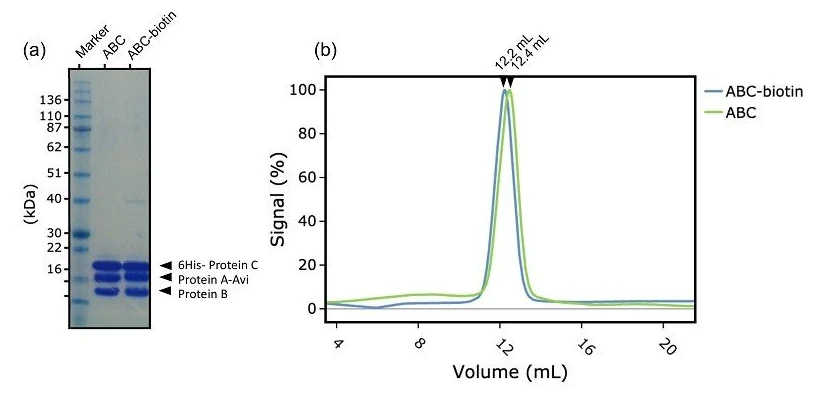
SDS-PAGE analysis showed the presence of all three protein components following purification, supporting successful co-expression and recovery of the heterotrimeric complex.
SDS PAGE and analytical size exclusion data confirmed that we had purified the heterotrimeric complex.
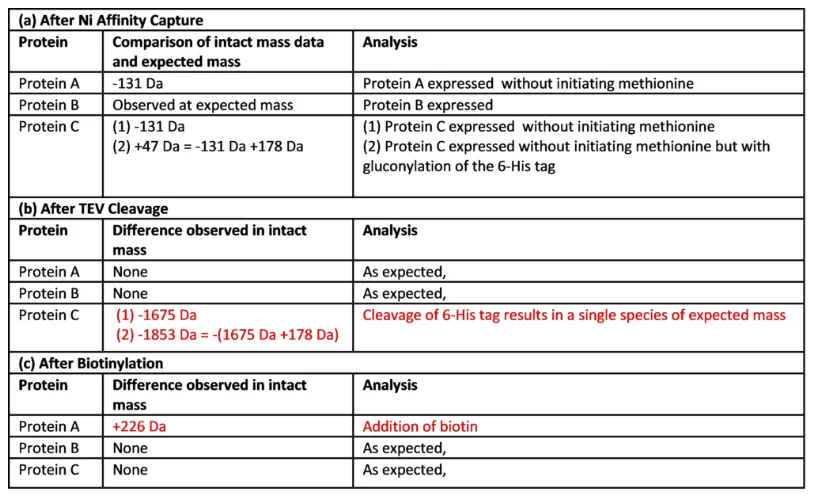
Mass spectrometry was used throughout the workflow to verify the identity and integrity of the proteins at each stage of the process.
Using LC-MS analysis, the team was able to:
Analysis demonstrated a mass increase of approximately 226 Da following biotinylation, consistent with the addition of a single biotin molecule to the AviTag sequence.
Using the optimized workflow, approximately 30 mg/L of purified heterotrimeric complex was produced.
The initial feasibility study successfully generated more than 5 mg of both biotinylated and non-biotinylated protein complex within a short project timeline, providing the client with material suitable for screening and biophysical applications.
Comprehensive analytical characterization confirmed:
This combination of protein production, purification, functionalization, and analytical characterization provides confidence that final protein preparations are suitable for downstream studies.
Many drug discovery programs rely on protein complexes rather than individual proteins. Producing these assemblies can require coordinated expression, careful purification strategies, and robust analytical characterization to confirm that the final material accurately reflects the intended biological system.
This project demonstrates Sygnature Discovery’s ability to support complex protein production programs by combining:
to generate high-quality protein reagents for screening and biophysical research.
✅ Successful co-expression and purification of a heterotrimeric protein complex
✅ Generation of both biotinylated and non-biotinylated protein formats
✅ Approximately 30 mg/L purified complex produced
✅ Greater than 5 mg of each final protein format supplied
✅ Mass spectrometry confirmation of complex integrity, TEV cleavage, and biotinylation
✅ Material delivered to support screening and biophysical studies

Peak Proteins, NuChem Sciences, and SB Drug Discovery have now fully integrated with Sygnature Discovery.