



Featured Resources
-
STORM Therapeutics: From Lead to Pre-Candidate Nomination in 18 Months

STORM Therapeutics: From Lead to Pre-Candidate Nomination in 18 Months
Case study




Discover precise insights into brain neurochemistry with Sygnature Discovery's in vivo microdialysis and cOFM services. With over 20 years of expertise, we design bespoke studies that reveal how compounds modulate neurotransmitter systems in health and disease. Using UHPLC/HPLC with electrochemical detection or mass spectrometry, we deliver robust PK/PD data to support confident CNS decision making.


July 30, 2015

Inobrodib, an exciting, first-in-class oral anti-cancer drug in clinical development by CellCentric, was collaboratively designed, synthesized and supported on its pre-clinical journey by an integrated project team at Sygnature Discovery. Inobrodib is now showing promising results in Phase I and II trials for multiple myeloma and other cancer types.

In drug discovery, generating targets is no longer the challenge. The real question is how to identify the few worth investing months of research and significant resources to pursue. Hear expert perspectives on how AI, pathway analysis and scientific expertise are shaping modern target identification.
July 7, 2026

Stay up to date with the latest company updates, milestones, and announcements.
Explore upcoming conferences and scientific meetings where you can connect with our team.

At Sygnature Discovery, we deliver world-leading drug discovery solutions to accelerate your compound from idea to clinic.

Our leadership team brings diverse experience and insight, driving collaboration and innovation across drug discovery.

Explore careers at Sygnature Discovery and join a global team committed to science, collaboration, and integrity.
Inobrodib, an exciting, first-in-class oral anti-cancer drug in clinical development by CellCentric, was collaboratively designed, synthesized and supported on its pre-clinical journey by an integrated project team at Sygnature Discovery. Inobrodib is now showing promising results in Phase I and II trials for multiple myeloma and other cancer types.
At Sygnature Discovery, we deliver world-leading drug discovery solutions to accelerate your compound from idea to clinic.
Our leadership team brings diverse experience and insight, driving collaboration and innovation across drug discovery.
Explore careers at Sygnature Discovery and join a global team committed to science, collaboration, and integrity.
Baculovirus expression systems are widely used to produce secreted, intracellular, and membrane proteins. These expression systems can be particularly valuable for difficult eukaryotic targets. In many projects, expression levels and purification yields are the primary measures of success.
However, successful expression does not always guarantee that the final protein is suitable for its intended downstream application.
At Sygnature Discovery, protein characterization forms an important part of our protein production workflows, helping to identify issues that are not always apparent from expression levels or standard purification data alone.
Two projects highlighted how additional analytical investigation revealed challenges that would otherwise have been missed.
A secreted protein containing a C-terminal 3C protease-10His-TwinStrep tag was expressed in Hi5 insect cells.
Initial small-scale feasibility studies suggested that expression levels were acceptable, and intact mass analysis confirmed the presence of protein with the expected molecular weight. However, when the process was scaled to 3 L, purification results became highly variable, and the target protein could not be consistently recovered using Strep-Tactin affinity chromatography.
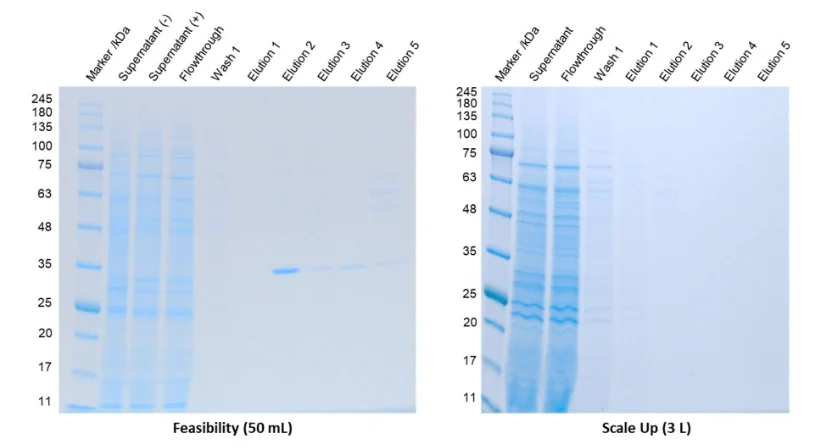
Further investigation revealed an additional protein species approximately 4.8 kDa smaller than expected. Mass analysis suggested that proteolytic cleavage had occurred within the C-terminal tag region.
To better understand the process, an expression time-course study was performed. Proteins harvested after 48 hours could still be purified successfully, whereas proteins harvested after 72 and 96 hours could not.
These results demonstrated that proteolytic degradation was occurring during expression and identified harvest timing as an important factor influencing product quality.
In a second project, two versions of a target protein were produced:
Both proteins expressed well in Sf9 cells and followed comparable purification profiles using nickel affinity chromatography, ion exchange chromatography, and size exclusion chromatography.
At first glance, both proteins appeared highly similar. SDS-PAGE analysis and thermal stability measurements produced results consistent with expectations.
However, the Avi-tagged construct performed poorly during immobilization onto streptavidin surfaces.
Subsequent mass spectrometry analysis showed that the difference in molecular mass between the two constructs was significantly smaller than expected, strongly suggesting that the Avi tag had been removed.
Although expression and purification had been successful, the protein was not suitable for its intended downstream application because the functional tag had been lost during expression.
These projects highlighted two common factors:
This combination can create challenges when expressing secreted proteins containing long affinity or functional tags.
In both projects, protein expression and initial purification appeared successful. Without further characterization, the underlying issues may have remained undetected until much later in the workflow.
These examples demonstrate why protein production involves more than generating a detectable protein band or achieving a target yield. Understanding protein integrity, confirming the presence of functional tags, and assessing suitability for downstream applications is equally important.
By combining protein expression, purification, and detailed characterization, scientists can identify issues early and adapt construct design, harvest strategies, or expression systems before they become significant project bottlenecks.
Through detailed analytical investigation, the source of the observed performance issues was identified in both projects. The findings provided guidance for future construct design and expression strategies, particularly for secreted proteins produced in baculovirus-infected insect cells.
These studies also reinforced the importance of evaluating protein quality alongside expression yield when producing proteins for structural biology, biophysical characterization, and assay development.

Peak Proteins, NuChem Sciences, and SB Drug Discovery have now fully integrated with Sygnature Discovery.