


Featured Resources
-
STORM Therapeutics: From Lead to Pre-Candidate Nomination in 18 Months

STORM Therapeutics: From Lead to Pre-Candidate Nomination in 18 Months
Case study




Discover precise insights into brain neurochemistry with Sygnature Discovery's in vivo microdialysis and cOFM services. With over 20 years of expertise, we design bespoke studies that reveal how compounds modulate neurotransmitter systems in health and disease. Using UHPLC/HPLC with electrochemical detection or mass spectrometry, we deliver robust PK/PD data to support confident CNS decision making.


July 30, 2015

Inobrodib, an exciting, first-in-class oral anti-cancer drug in clinical development by CellCentric, was collaboratively designed, synthesized and supported on its pre-clinical journey by an integrated project team at Sygnature Discovery. Inobrodib is now showing promising results in Phase I and II trials for multiple myeloma and other cancer types.

In drug discovery, generating targets is no longer the challenge. The real question is how to identify the few worth investing months of research and significant resources to pursue. Hear expert perspectives on how AI, pathway analysis and scientific expertise are shaping modern target identification.
July 7, 2026

Stay up to date with the latest company updates, milestones, and announcements.
Explore upcoming conferences and scientific meetings where you can connect with our team.

At Sygnature Discovery, we deliver world-leading drug discovery solutions to accelerate your compound from idea to clinic.

Our leadership team brings diverse experience and insight, driving collaboration and innovation across drug discovery.

Explore careers at Sygnature Discovery and join a global team committed to science, collaboration, and integrity.
Inobrodib, an exciting, first-in-class oral anti-cancer drug in clinical development by CellCentric, was collaboratively designed, synthesized and supported on its pre-clinical journey by an integrated project team at Sygnature Discovery. Inobrodib is now showing promising results in Phase I and II trials for multiple myeloma and other cancer types.
At Sygnature Discovery, we deliver world-leading drug discovery solutions to accelerate your compound from idea to clinic.
Our leadership team brings diverse experience and insight, driving collaboration and innovation across drug discovery.
Explore careers at Sygnature Discovery and join a global team committed to science, collaboration, and integrity.
Metabolic GPCRs play a vital role in how our bodies manage energy. These G protein-coupled receptors act like molecular switches, translating signals from hormones and nutrients into cellular actions that regulate everything from blood sugar to appetite. They’re involved in how we process food, store fat, and maintain energy balance. Due to not only their role in metabolism but also the recent development of blockbuster drugs, the metabolic GPCRs are some of the hottest targets in drug discovery. Moreover, cryo-EM has emerged as a revolutionary tool in structural biology, particularly for membrane proteins such as the metabolic GPCRs. These receptors – once considered structurally elusive due to their dynamic and membrane-bound nature – can now be visualized routinely at high resolution (<2.5Å) 1. Cryo-EM is particularly beneficial for the structural elucidation of agonist-bound active state GPCR complexes, transforming the way ligands are designed to target these receptors.
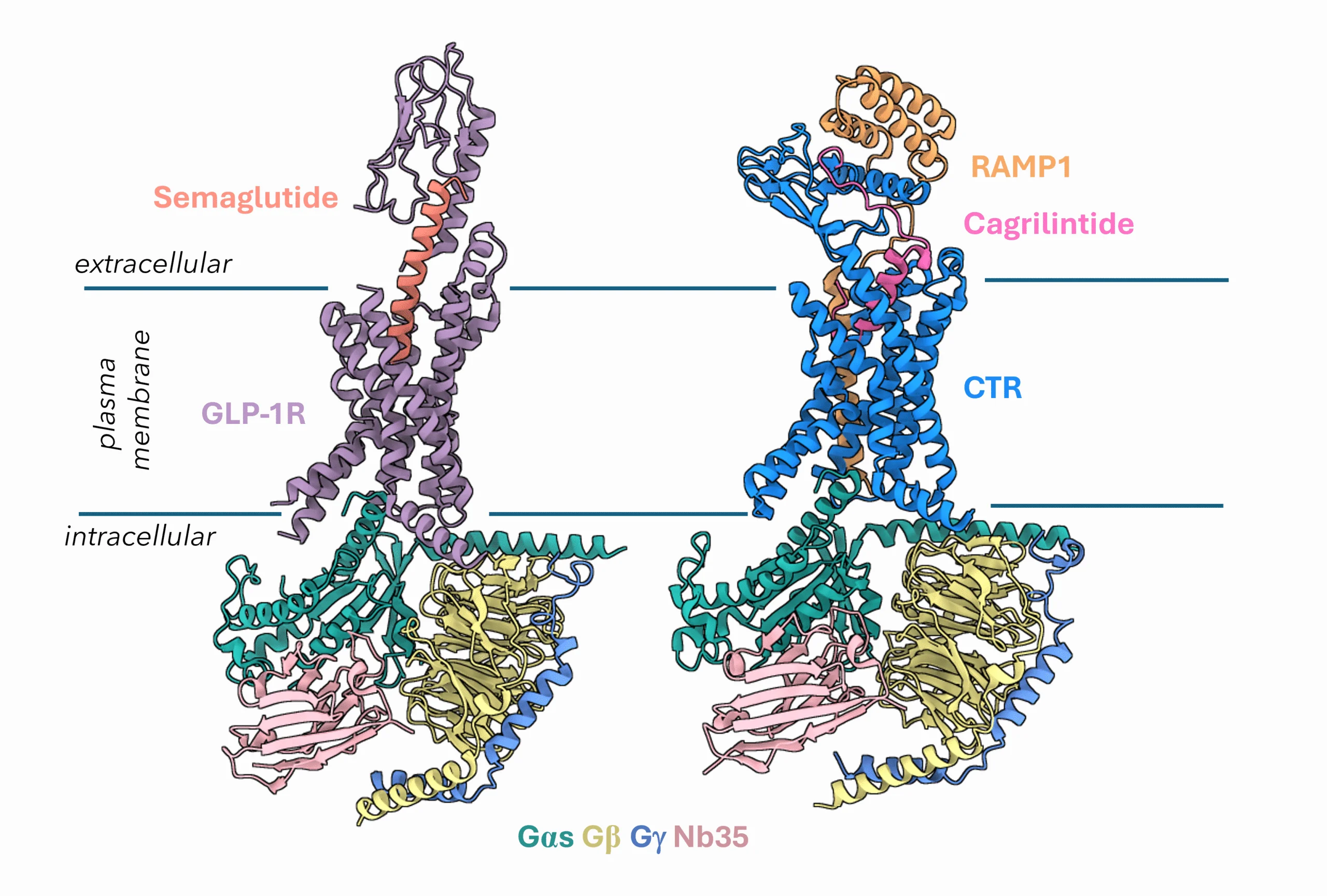
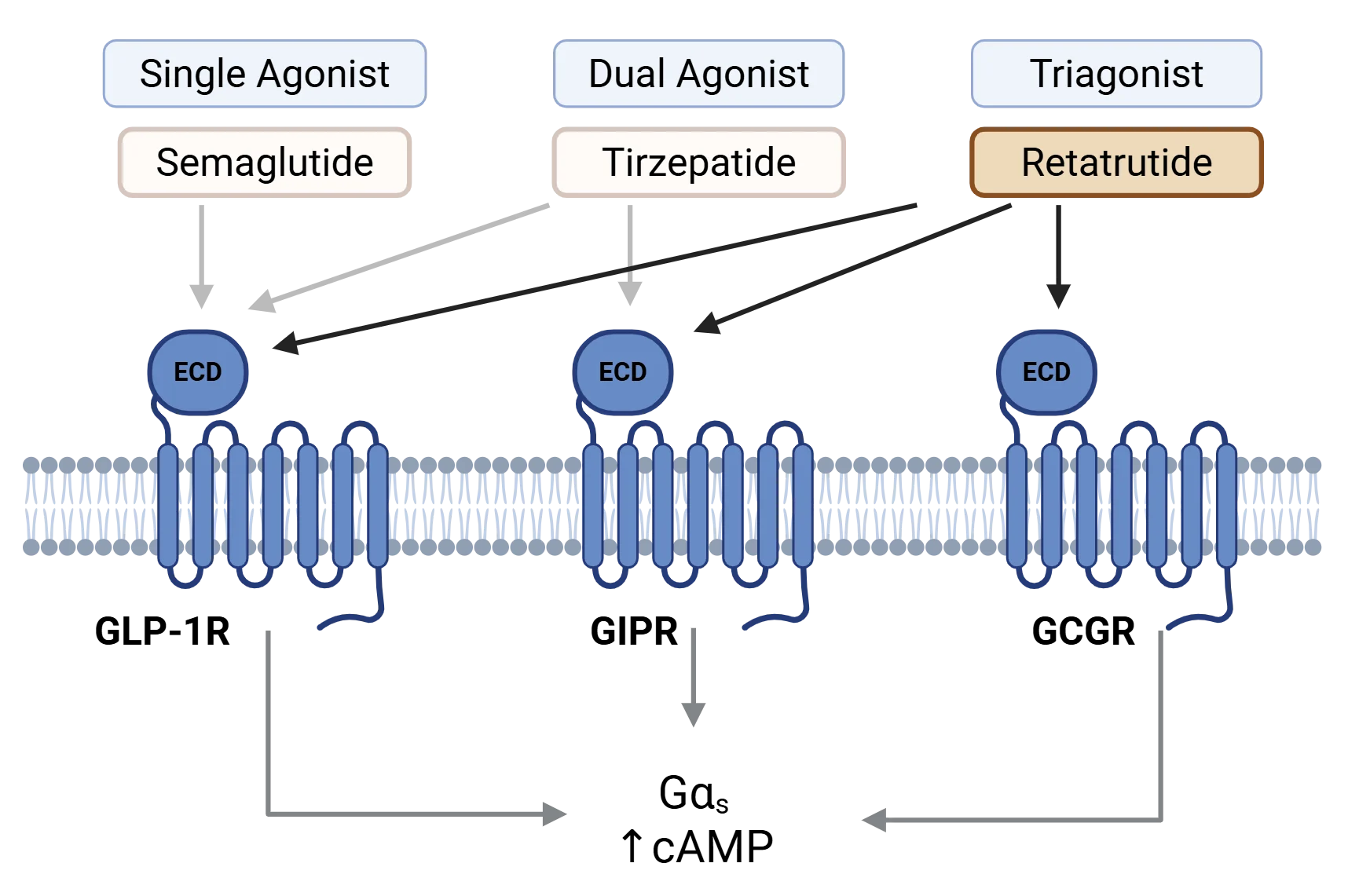
The headline-making weight-loss and diabetes drugs such as Ozempic, Wegovy and Mounjaro all target the Glucagon-like peptide-1 receptor (GLP-1R) which plays a crucial role in helping us to feel fuller for longer after eating. Cryo-EM structures were published in 2021 of Semaglutide, the active ingredient in Ozempic, bound to the GLP-1R receptor 2. The structural insights gained have now transformed the way medicines are designed putting structure-based drug design back at the forefront of drug discovery programs. Pharmaceutical programs are not just targeting the GLP-1R receptor. Researchers are now developing dual and triple agonists that also target the glucagon receptor (GCGR) and the glucose-dependent insulinotropic polypeptide receptor (GIPR), two key regulators of energy balance and glucose homeostasis. Example therapeutics include tirzepatide (approved as Mounjaro) and retatrutide (currently in clinical development) for the treatment of obesity and diabetes (Figure 1).
Another promising target for tackling metabolic diseases is the Amylin receptor. Amylin is a hormone co-secreted with insulin that helps reduce food intake, slow gastric emptying, and suppress glucagon secretion all of which are critical components of metabolic regulation. Pramlintide, used for the treatment of type 1 diabetes, is currently the only approved drug to target the amylin receptors. However, the amylin receptor has emerged as a powerful partner to GLP-1R. By targeting both receptors, researchers aim to achieve more sustained effects on weight loss, appetite control, and glucose regulation. One such combination therapy in development is Novo Nordisk’s CagriSema, which pairs cagrilintide (an amylin analog) with semaglutide (Figure 2). This dual-agonist approach is designed to take advantage of the complementary actions of both hormones, offering a new frontier in the treatment of metabolic diseases.
At Sygnature Discovery, our Protein Science department has extensive expertise in generating high-quality, cryo-EM ready samples of metabolic GPCRs. Our dedicated membrane protein team supports every stage of the workflow, from construct design and purification strategy to grid preparation and structure determination. To date, we’ve successfully produced over 200 samples across at least 20 different GPCR targets, supporting protein production for both high-resolution cryo-EM structural studies and for compound screening or biophysical studies. Among our team, Lead Scientist Dr. Rachel Johnson has published work featuring high resolution cryo-EM structures of key metabolic receptors, including GLP-1R3, 4 and the amylin receptor5, 6, which reflects the depth of expertise behind our approach. Our team is also experienced in generating apo receptor samples, which, through our integrated capabilities, can be applied to both cryo-EM structure determination and for biophysical screens such as SPR, ASMS or assay development.


Peak Proteins, NuChem Sciences, and SB Drug Discovery have now fully integrated with Sygnature Discovery.