



Featured Resources
-
STORM Therapeutics: From Lead to Pre-Candidate Nomination in 18 Months

STORM Therapeutics: From Lead to Pre-Candidate Nomination in 18 Months
Case study




Discover precise insights into brain neurochemistry with Sygnature Discovery's in vivo microdialysis and cOFM services. With over 20 years of expertise, we design bespoke studies that reveal how compounds modulate neurotransmitter systems in health and disease. Using UHPLC/HPLC with electrochemical detection or mass spectrometry, we deliver robust PK/PD data to support confident CNS decision making.


July 30, 2015

Inobrodib, an exciting, first-in-class oral anti-cancer drug in clinical development by CellCentric, was collaboratively designed, synthesised and supported on its pre-clinical journey by an integrated project team at Sygnature Discovery. Inobrodib is now showing promising results in Phase I and II trials for multiple myeloma and other cancer types.

In drug discovery, generating targets is no longer the challenge. The real question is how to identify the few worth investing months of research and significant resources to pursue. Hear expert perspectives on how AI, pathway analysis and scientific expertise are shaping modern target identification.
July 7, 2026

Stay up to date with the latest company updates, milestones, and announcements.
Explore upcoming conferences and scientific meetings where you can connect with our team.

At Sygnature Discovery, we deliver world-leading drug discovery solutions to accelerate your compound from idea to clinic.

Our leadership team brings diverse experience and insight, driving collaboration and innovation across drug discovery.

Explore careers at Sygnature Discovery and join a global team committed to science, collaboration, and integrity.
Inobrodib, an exciting, first-in-class oral anti-cancer drug in clinical development by CellCentric, was collaboratively designed, synthesised and supported on its pre-clinical journey by an integrated project team at Sygnature Discovery. Inobrodib is now showing promising results in Phase I and II trials for multiple myeloma and other cancer types.
At Sygnature Discovery, we deliver world-leading drug discovery solutions to accelerate your compound from idea to clinic.
Our leadership team brings diverse experience and insight, driving collaboration and innovation across drug discovery.
Explore careers at Sygnature Discovery and join a global team committed to science, collaboration, and integrity.
Using our Xstrahl CIX3 cabinet irradiator, we have established robust tumor models that generate high-quality preclinical data to evaluate the effectiveness of combining radiotherapy with immunotherapies.
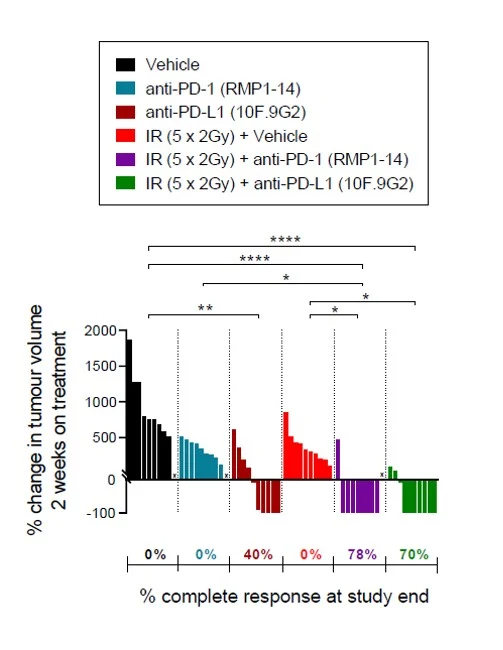
In this article we discuss the subject and refer to a recent example from a study where we investigated using radiotherapy in combination with immune checkpoint inhibitors (ICIs) (Figure 1).
These type of programs are further strengthened by our in-house capabilities for pharmacokinetic (PK), target engagement and pharmacodynamic (PD) analyses, enabling us to generate comprehensive data packages that support oncology drug discovery programs.
Over the past decade, immune checkpoint inhibitors have transformed the cancer treatment landscape [1]. By targeting key immune regulatory pathways on T cells, these antibody-based therapies can activate anti-tumor immune responses, delivering durable clinical benefit—and in some cases long-term remission—to patients across a range of cancer types.
Today, more than 80 FDA approvals exist for immune checkpoint inhibitors used either as monotherapies or in combination regimens. Their success has demonstrated the remarkable therapeutic potential of mobilizing the immune system against cancer.
Despite these advances, significant challenges remain. Both intrinsic and acquired resistance present huge clinical barriers as they limit the effectiveness of immunotherapy, with only around 20% of patients achieving meaningful responses to single-arm therapy with a checkpoint inhibitor [2]. In addition, reliable biomarkers capable of predicting treatment response remain elusive.
As a result, there is strong interest in identifying combination strategies that can expand the proportion of patients who benefit from immunotherapy.
Radiotherapy is well established as a cornerstone of cancer treatment, primarily through its ability to induce tumor cell death. However, accumulating evidence shows that irradiation can also remodel the tumor immune microenvironment [3], [4].
As tumor cells are damaged or ultimately die following irradiation, they release tumor-associated antigens, growth factors, cytokines and chemokines that can stimulate immune activation and promote cytotoxic T-cell infiltration into tumors [3], [4]. This immune-modulating effect provides a compelling rationale for combining radiotherapy with immune checkpoint inhibitors, with the goal of enhancing anti-tumor immunity and overcoming resistance mechanisms [5], [6].
A growing number of clinical trials are evaluating radiotherapy-immunotherapy combinations across multiple cancer indications [4]. Early-phase studies have demonstrated encouraging safety profiles, and attention is now focused on determining which treatment regimens deliver the greatest clinical benefit.
Several critical variables require evaluation and optimization, including:
Preclinical models play a vital role in answering these questions before therapies progress into clinical development.
Within Sygnature Discovery’s Translational Oncology Department, we have developed a range of syngeneic and human xenograft mouse models which are sensitive to radiotherapy, using the Xstrahl CIX3 cabinet irradiator. This platform enables precise delivery of targeted X-ray irradiation directly to tumors, allowing evaluation of radiotherapy both as a standalone treatment and in combination with existing or novel therapeutic agents.
Using these models, we can compare
The latter more closely reflects radiotherapy protocols commonly used in clinical practice.
Our models also enable evaluation of the abscopal response, an important phenomenon in which irradiation of one tumor leads to anti-tumor effects at distant, non-irradiated tumor site. Monitoring these responses provides valuable insight into the systemic immune effects of treatment combinations.
To maximize study value, we complement efficacy assessments with extensive ex vivo analyses of tumor and host tissues.
Our pharmacodynamic capabilities include:
Combined with our PK and target-engagement expertise, these approaches deliver a detailed mechanistic understanding of therapeutic activity.
We have established and characterized murine tumor models to evaluate the effects of radiotherapy in combination with immune checkpoint inhibitors.
For further details, read the full case study here.
Cancer is a highly complex disease driven by interactions between the multiple types of tumor cells and the surrounding microenvironment. To identify effective new treatments, researchers require predictive and informative preclinical models capable of evaluating novel therapeutics both alone and in combination with radiotherapy.
Radiotherapy remains a fundamental component of cancer care, but its value extends beyond direct tumor cell killing. By reshaping the tumor immune microenvironment, radiotherapy has emerged as a powerful partner for immunotherapies and other targeted anti-cancer agents.
Through the use of Xstrahl CIX3 cabinet irradiator, we have established advanced murine models that generate critical preclinical data to support combined radiotherapy and cancer drug development strategies. Furthermore, we are able to augment these studies by performing PK, target engagement and PD analyses, generating comprehensive data packages that accelerate decision-making and de-risk oncology drug discovery programs.
References
[1] P. Sharma et al., “Immune checkpoint therapy—current perspectives and future directions,” Cell, vol. 186, no. 8, pp. 1652–1669, Apr. 2023, doi: 10.1016/j.cell.2023.03.006.
[2] Public Health England, “Chemotherapy, Radiotherapy and Surgical Tumour Resections in England,” https://www.gov.uk/government/statistics/chemotherapy-radiotherapy-and-surgical-tumour-resections-in-england/chemotherapy-radiotherapy-and-surgical-tumour-resections-in-england.
[3] H. E. Barker, J. T. E. Paget, A. A. Khan, and K. J. Harrington, “The tumour microenvironment after radiotherapy: mechanisms of resistance and recurrence,” Nat. Rev. Cancer, vol. 15, no. 7, pp. 409–425, Jul. 2015, doi: 10.1038/nrc3958.
[4] M. McLaughlin et al., “Inflammatory microenvironment remodelling by tumour cells after radiotherapy,” Nat. Rev. Cancer, vol. 20, no. 4, pp. 203–217, Apr. 2020, doi: 10.1038/s41568-020-0246-1.
[5] W. Kim, H. Kim, W. Il Jang, M. S. Kim, and S. H. Bae, “Radiotherapy Combined with Immune Checkpoint Inhibitor on Murine Fibrosarcoma and a Narrative Review of Clinical Studies.,” Curr. Issues Mol. Biol., vol. 48, no. 1, Dec. 2025, doi: 10.3390/cimb48010020.
[6] C. Lynch, S. P. Pitroda, and R. R. Weichselbaum, “Radiotherapy, immunity, and immune checkpoint inhibitors,” Lancet Oncol., vol. 25, no. 8, pp. e352–e362, Aug. 2024, doi: 10.1016/S1470-2045(24)00075-5.



Peak Proteins, NuChem Sciences, and SB Drug Discovery have now fully integrated with Sygnature Discovery.