


Featured Resources
-
STORM Therapeutics: From Lead to Pre-Candidate Nomination in 18 Months

STORM Therapeutics: From Lead to Pre-Candidate Nomination in 18 Months
Case study


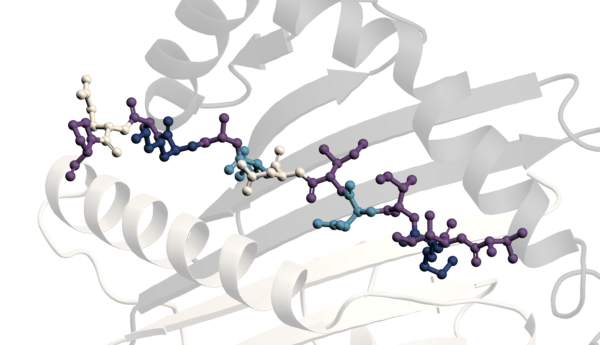


Discover precise insights into brain neurochemistry with Sygnature Discovery's in vivo microdialysis and cOFM services. With over 20 years of expertise, we design bespoke studies that reveal how compounds modulate neurotransmitter systems in health and disease. Using UHPLC/HPLC with electrochemical detection or mass spectrometry, we deliver robust PK/PD data to support confident CNS decision making.


July 30, 2015

Inobrodib, an exciting, first-in-class oral anti-cancer drug in clinical development by CellCentric, was collaboratively designed, synthesised and supported on its pre-clinical journey by an integrated project team at Sygnature Discovery. Inobrodib is now showing promising results in Phase I and II trials for multiple myeloma and other cancer types.

In drug discovery, generating targets is no longer the challenge. The real question is how to identify the few worth investing months of research and significant resources to pursue. Hear expert perspectives on how AI, pathway analysis and scientific expertise are shaping modern target identification.
July 7, 2026

Stay up to date with the latest company updates, milestones, and announcements.
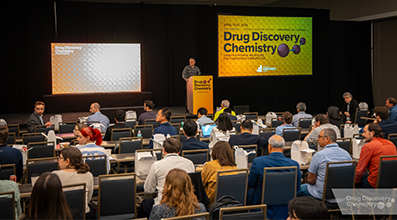
Explore upcoming conferences and scientific meetings where you can connect with our team.

At Sygnature Discovery, we deliver world-leading drug discovery solutions to accelerate your compound from idea to clinic.

Our leadership team brings diverse experience and insight, driving collaboration and innovation across drug discovery.

Explore careers at Sygnature Discovery and join a global team committed to science, collaboration, and integrity.
Inobrodib, an exciting, first-in-class oral anti-cancer drug in clinical development by CellCentric, was collaboratively designed, synthesised and supported on its pre-clinical journey by an integrated project team at Sygnature Discovery. Inobrodib is now showing promising results in Phase I and II trials for multiple myeloma and other cancer types.
At Sygnature Discovery, we deliver world-leading drug discovery solutions to accelerate your compound from idea to clinic.
Our leadership team brings diverse experience and insight, driving collaboration and innovation across drug discovery.
Explore careers at Sygnature Discovery and join a global team committed to science, collaboration, and integrity.
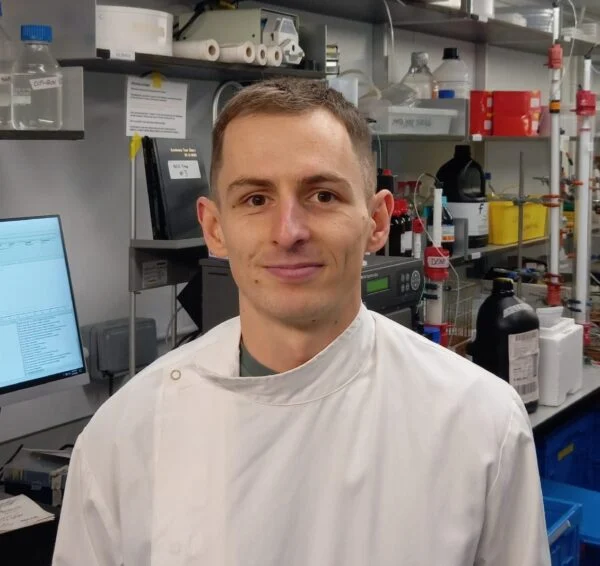
In this article PhD Student Ben Nash discusses his 3-month PIPs placement work at Peak Proteins, which involved the expression and purification optimisation of the G-protein coupled receptor (GPCR) 5-HT2AR. Ultimately, Ben’s work has set us on a path towards cryo-EM structural studies of this target.
Here is Ben’s story:
Hello! I am Ben, a PhD student at the University of East Anglia (Norwich) where my PhD research focuses on understanding the structure and properties of bacterial heme proteins. These proteins allow them to respire without oxygen and interest us for their potential use in biotechnologies like biomining and bioremediation. The Norwich research park PhD program includes a three-month PIPS (Professional Internships for PhD Students) placement period which students like myself must undertake during their second or third years, with the topic of the placement work being left entirely to the student’s choice.
I first heard about Peak Proteins through a colleague who recommended the company to me as a potential host with whom I would be a good fit for my PIPS. After a little investigation I discovered the skills I had been developing throughout my PhD, purifying proteins and determining their structures, were highly valued at Peak where they are two of the most important services offered to their clients.
I got in touch with Dr Steven Harborne about whether they were interested in discussing me undertaking a placement there and soon enough I was packing my bags for Macclesfield. I was both excited and quite apprehensive about moving to a new laboratory, to work in a new team and on a totally new project, and also a little sad to be dropping my existing research project for a while.
I was quickly welcomed into the membrane protein team at peak where we set about aiming to purify the 5-HT2AR GPCR with the eventual goal of determining its structure by cryogenic electron microscopy (cryo-EM) as a benchmark structure. 5-HT2AR made for a great choice as there was good precedent in the literature for determination of its structure both by X-ray crystallography and cryo-EM, and it’s a potentially promising target to treat neuropsychiatric disorders [1–3].
We began by testing the effectiveness of different expression vectors by two techniques that were new additions to my skillset, FSEC (using a fluorescently labelled antibody fragment) and western blotting. Once we identified a promising candidate, we scaled up to a 1 L grow where I was able to get hands on with the growth and transfection of insect cells. Using insect cell expression systems is common for GPCRs but was completely outside of my experiences in cell culture which were limited to bacterial systems. Through affinity chromatography and size-exclusion chromatography we were able to isolate 5-HT2AR in complex with a homotrimeric G-protein complex which was visualised by SDS-PAGE and its identity confirmed by peptide mapping mass spectrometry using Peak Proteins’ in house LCMS facility.
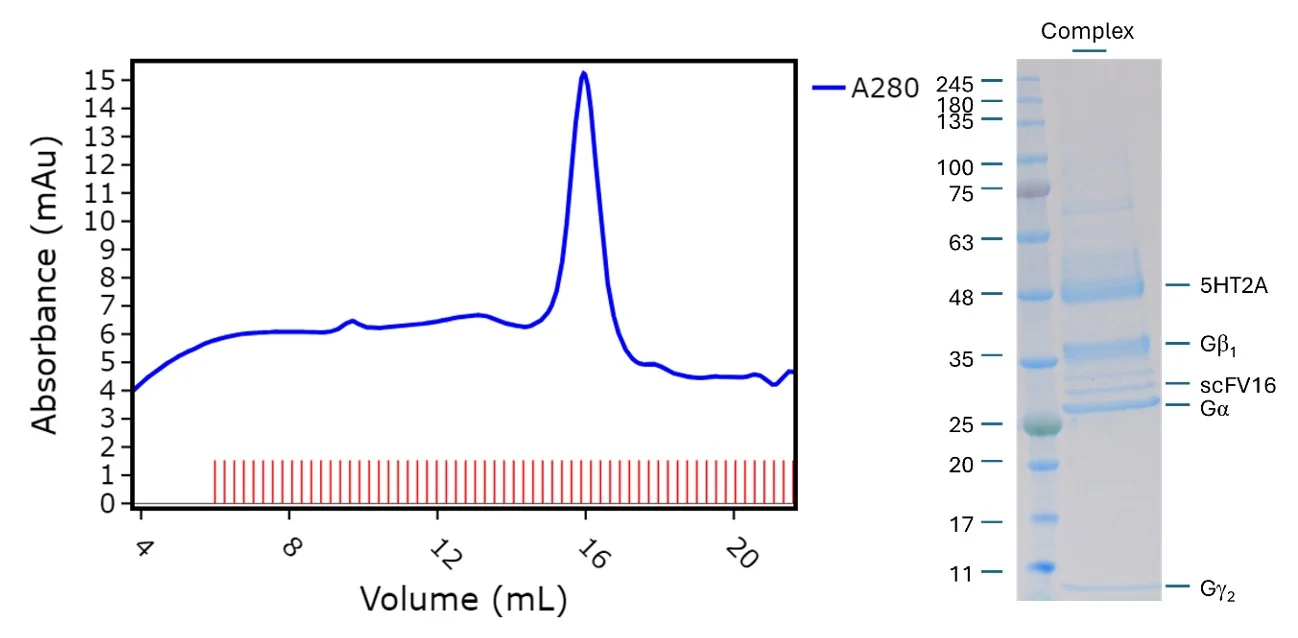
With pure receptor:G-protein complex in hand, we used FSEC to test our sample’s ability to bind the antibody fragment ScFv16 which provides necessary stabilisation and mass for cryo-EM and happily found it capable of doing so. We were also able to confirm its stability upon transfer into the detergents GDN and LMNG which are often popular choices when preparing cryo-EM grids of membrane proteins.
Up to this point, we had been expressing our 5-HT2AR in Spodoptera frugiperda cells, but with there being literature precedent also for expression in High 5 (Trichoplusia ni) insect cells we wanted to test the effect of swapping insect cell lines [2,4,5]. We repeated our purification procedure and were able to produce a product with comparable yield and purity from this cell line too.
Hopefully, these results will provide firm groundwork for the continued goal of determining a cryo-EM 5-HT2AR structure. Importantly for me, my time with Peak Proteins also provided an opportunity to gain completely new skills such as western blotting, and perfect existing ones like use of AKTA purification systems. I made lots of new friends, and I was also exposed to many ways in which industry science differs from academic science, making me feel more informed as to where I go next in my career after my PhD. Having now concluded my PIPS placement, I’m a much more confident scientist than I was starting it and for that reason I am very grateful that the placement scheme is offered by my PhD program and that through it, I found my way to Peak Proteins.

Peak Proteins, NuChem Sciences, and SB Drug Discovery have now fully integrated with Sygnature Discovery.