


Featured Resources
-
STORM Therapeutics: From Lead to Pre-Candidate Nomination in 18 Months

STORM Therapeutics: From Lead to Pre-Candidate Nomination in 18 Months
Case study


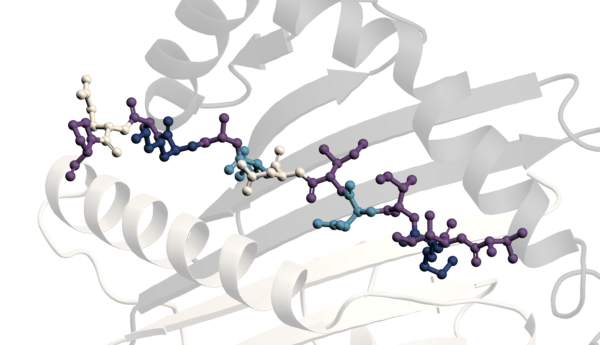


Discover precise insights into brain neurochemistry with Sygnature Discovery's in vivo microdialysis and cOFM services. With over 20 years of expertise, we design bespoke studies that reveal how compounds modulate neurotransmitter systems in health and disease. Using UHPLC/HPLC with electrochemical detection or mass spectrometry, we deliver robust PK/PD data to support confident CNS decision making.


July 30, 2015

Inobrodib, an exciting, first-in-class oral anti-cancer drug in clinical development by CellCentric, was collaboratively designed, synthesised and supported on its pre-clinical journey by an integrated project team at Sygnature Discovery. Inobrodib is now showing promising results in Phase I and II trials for multiple myeloma and other cancer types.

In drug discovery, generating targets is no longer the challenge. The real question is how to identify the few worth investing months of research and significant resources to pursue. Hear expert perspectives on how AI, pathway analysis and scientific expertise are shaping modern target identification.
July 7, 2026

Stay up to date with the latest company updates, milestones, and announcements.
Explore upcoming conferences and scientific meetings where you can connect with our team.

At Sygnature Discovery, we deliver world-leading drug discovery solutions to accelerate your compound from idea to clinic.

Our leadership team brings diverse experience and insight, driving collaboration and innovation across drug discovery.

Explore careers at Sygnature Discovery and join a global team committed to science, collaboration, and integrity.
Inobrodib, an exciting, first-in-class oral anti-cancer drug in clinical development by CellCentric, was collaboratively designed, synthesised and supported on its pre-clinical journey by an integrated project team at Sygnature Discovery. Inobrodib is now showing promising results in Phase I and II trials for multiple myeloma and other cancer types.
At Sygnature Discovery, we deliver world-leading drug discovery solutions to accelerate your compound from idea to clinic.
Our leadership team brings diverse experience and insight, driving collaboration and innovation across drug discovery.
Explore careers at Sygnature Discovery and join a global team committed to science, collaboration, and integrity.
Challenges in drug discovery are common; however, they are rarely rooted within a single scientific discipline.
For example, a compound may fail to demonstrate efficacy because exposure is too low. Exposure may be limited by poor solubility. Poor solubility may be caused by an unsuitable solid form. Alternatively, the problem may stem from a high clearance, poor permeability, or a lack of target engagement.
Without the collaboration between multiple disciplines, determining the root cause of poor performance can be difficult, resulting in unnecessary delays and inefficient development strategies.
At Sygnature Discovery, our DMPK, Form & Formulation and in vivo Pharmacology teams are integrated throughout the discovery process, bringing specialist expertise into programs at the stages where they deliver the greatest value. Housed on the same site, this integrated approach enables exposure, efficacy, and development challenges to be assessed collectively rather than in isolation. By identifying potential barriers early and selecting the most appropriate development strategy, teams can make better-informed decisions, reduce program risk and accelerate candidate progression.
Pharmacology teams are for answering one fundamental question:
Does a compound produce the desired biological effect?
However, meaningful results from efficacy studies are dependent on a compound being sufficiently exposed during in vivo studies.
If drug concentrations never reach therapeutic levels, researchers may be unable to determine whether:
This is where DMPK becomes essential.
in vivo Pharmacology and DMPK together help define the target exposure required to achieve a therapeutic effect. This target exposure then guides formulation strategy and dose design. Exposure also becomes particularly important when compounds progress into preclinical toxicology studies, where sufficient exposure and dose proportionality are required to establish meaningful safety margins.
DMPK identifies the root cause of exposure limitations:
Understanding these mechanisms prevents teams from pursuing inappropriate solutions. Incorrectly diagnosing the cause of poor performance can lead to unnecessary chemistry campaigns, repeated studies and significant delays in program progression.
For example:
Without DMPK, valuable time may be spent solving the wrong problem.
Once exposure limitations are understood, Form & Formulation scientists can design targeted strategies to overcome them.
These may include:
Solid Form Selection
Choosing the most suitable:
Enabling Formulations
Development of:
These approaches can improve dissolution, absorption and systemic exposure without altering the molecule itself. Working together, in vivo Pharmacology, DMPK and Form & Formulation teams use target exposure data to develop the most appropriate strategy for candidate progression.
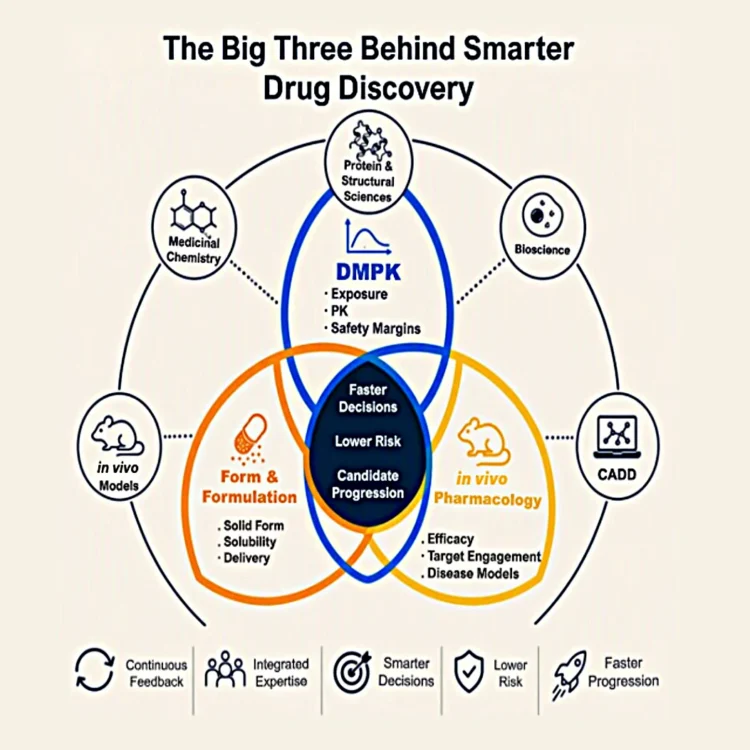
The real value emerges when the Big Three: DMPK, in vivo Pharmacology and Form & Formulation work together. Rather than waiting for studies to be completed sequentially, integrated teams can review emerging PK, efficacy and formulation data in real time, refining strategies before small issues become major development challenges.
However, successful drug discovery rarely depends on three disciplines alone. As programs evolve, expertise from Medicinal Chemistry, Bioscience, Protein & Structural Sciences, CADD and in vivo Models can be integrated as required. This provides additional insight into target biology, molecular design, developability and translational strategy. Together, these disciplines form a continuous feedback network that helps teams identify the right problem, apply the right solution and maintain project momentum.
At the center of this approach sit the Big Three, driving decisions around exposure, efficacy and formulation. Surrounding disciplines provide complementary expertise, ensuring challenges can be addressed from multiple perspectives while maintaining a clear focus on candidate progression.
This approach can:
Historically, Form & Formulation expertise has been introduced only after significant development challenges have emerged. However, lessons from industry examples highlight the importance of understanding solid form, exposure and developability risks much earlier in the discovery process.
For instance, after the launch of Ritonavir a new polymorphic form emerged in the product that was significantly more stable, but substantially less soluble than the marketed form. The appearance of this previously unidentified polymorph reduced drug dissolution and forced the product to be withdrawn and reformulated.
Although extreme, the example highlights how inadequate understanding of solid form can introduce serious development risks. At Sygnature Discovery, Form & Formulation scientists work alongside DMPK and Pharmacology teams from the outset, enabling the early identification of:
This approach can prevent promising compounds from being deprioritized due to limitations that may be resolved through form or formulation strategies. By assessing these factors collectively rather than in isolation, potential barriers can be identified and addressed before they impact program timelines. This allows teams to make critical progression decisions with greater confidence and supports the selection of candidates with the highest likelihood of development success.
Integrated teams are uniquely positioned to determine whether exposure limitations arise from poor solubility, high clearance, poor permeability or insufficient target engagement, ensuring resources are focused on the correct solution.
While DMPK, in vivo Pharmacology and Form & Formulation form the core decision-making engine, they do not operate in isolation. As programs progress, expertise from Medicinal Chemistry, Bioscience, Protein & Structural Sciences, CADD and in vivo Models can be brought into the project wherever they deliver the greatest value. This wider network provides additional insight into target biology, molecular design, protein production, developability and translational relevance. Rather than approaching challenges through a series of disconnected handoffs, Sygnature Discovery’s integrated structure enables information to flow continuously between disciplines, creating a feedback loop that supports smarter and more efficient project progression.
By identifying risks earlier, integrated teams help avoid unnecessary studies, reduce compound consumption, minimize redesign cycles, and improve overall project efficiency. For our clients, this means more confident decision-making, lower development risk and faster progression of promising drug candidates.
Peak Proteins, NuChem Sciences, and SB Drug Discovery have now fully integrated with Sygnature Discovery.