



Featured Resources
-
STORM Therapeutics: From Lead to Pre-Candidate Nomination in 18 Months

STORM Therapeutics: From Lead to Pre-Candidate Nomination in 18 Months
Case study




Discover precise insights into brain neurochemistry with Sygnature Discovery's in vivo microdialysis and cOFM services. With over 20 years of expertise, we design bespoke studies that reveal how compounds modulate neurotransmitter systems in health and disease. Using UHPLC/HPLC with electrochemical detection or mass spectrometry, we deliver robust PK/PD data to support confident CNS decision making.


July 30, 2015

Inobrodib, an exciting, first-in-class oral anti-cancer drug in clinical development by CellCentric, was collaboratively designed, synthesised and supported on its pre-clinical journey by an integrated project team at Sygnature Discovery. Inobrodib is now showing promising results in Phase I and II trials for multiple myeloma and other cancer types.

In drug discovery, generating targets is no longer the challenge. The real question is how to identify the few worth investing months of research and significant resources to pursue. Hear expert perspectives on how AI, pathway analysis and scientific expertise are shaping modern target identification.
July 7, 2026

Stay up to date with the latest company updates, milestones, and announcements.
Explore upcoming conferences and scientific meetings where you can connect with our team.

At Sygnature Discovery, we deliver world-leading drug discovery solutions to accelerate your compound from idea to clinic.

Our leadership team brings diverse experience and insight, driving collaboration and innovation across drug discovery.

Explore careers at Sygnature Discovery and join a global team committed to science, collaboration, and integrity.
Inobrodib, an exciting, first-in-class oral anti-cancer drug in clinical development by CellCentric, was collaboratively designed, synthesised and supported on its pre-clinical journey by an integrated project team at Sygnature Discovery. Inobrodib is now showing promising results in Phase I and II trials for multiple myeloma and other cancer types.
At Sygnature Discovery, we deliver world-leading drug discovery solutions to accelerate your compound from idea to clinic.
Our leadership team brings diverse experience and insight, driving collaboration and innovation across drug discovery.
Explore careers at Sygnature Discovery and join a global team committed to science, collaboration, and integrity.
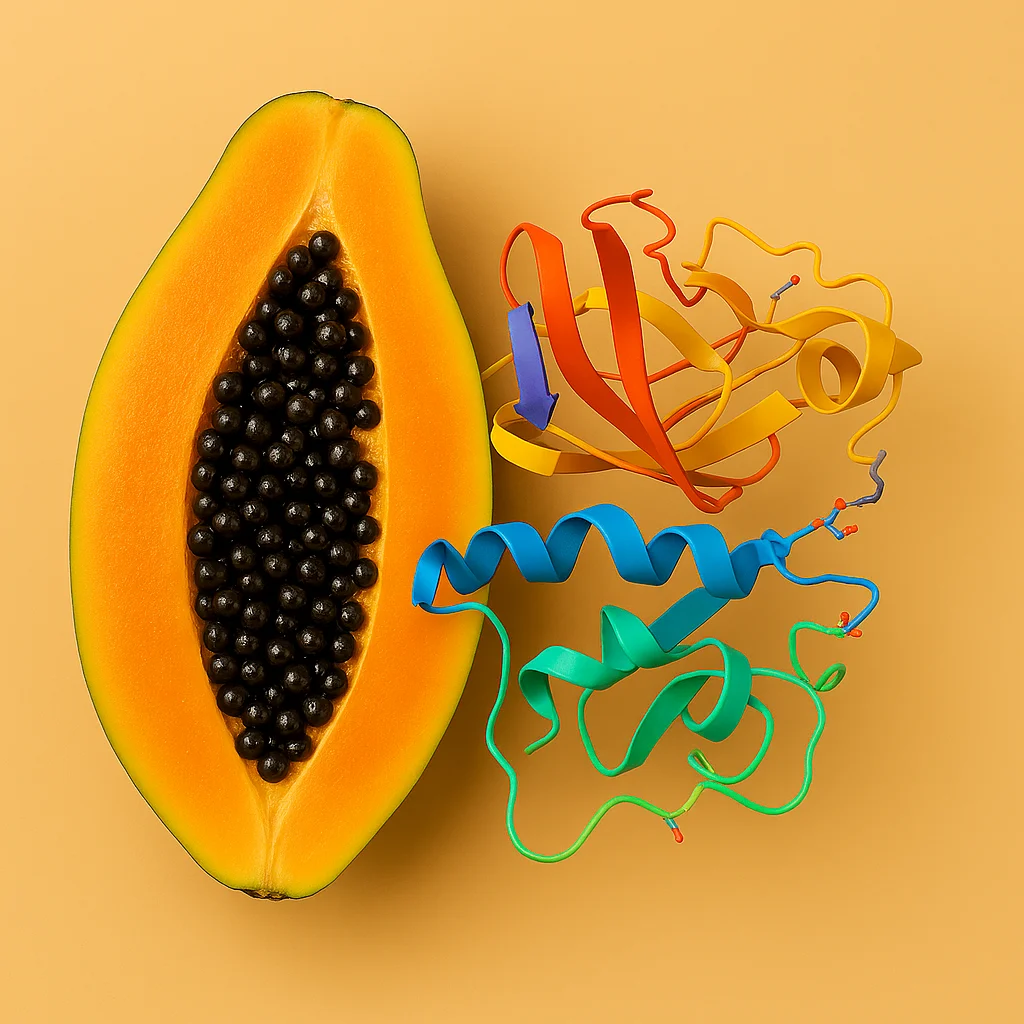
Papain is a cysteine protease (found in Papaya) which can be used to generate Fab and Fc fragments from full-length antibodies. It is, however, a very promiscuous protease and can cleave at many different residues. Our concern was that this can sometimes lead to issues after its use and can make reproducing a protocol difficult for subsequent batches
After papain digestion of the antibody, the Fab and Fc fractions were separated using a protein A column.
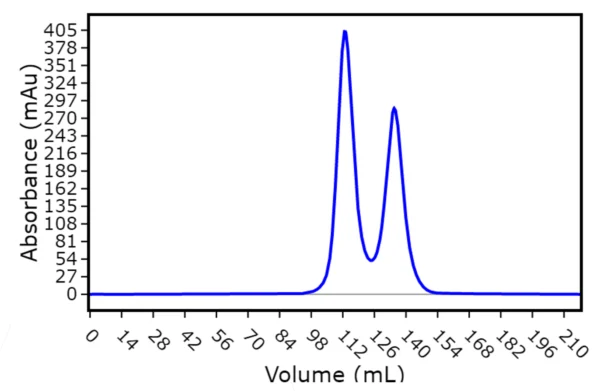
However, a size exclusion run of the isolated Fab fraction showed a very peculiar result: instead of a single Fab peak, there were two elution peaks.
A non-reduced SDS-PAGE gel of the elution peaks gave no further insight.
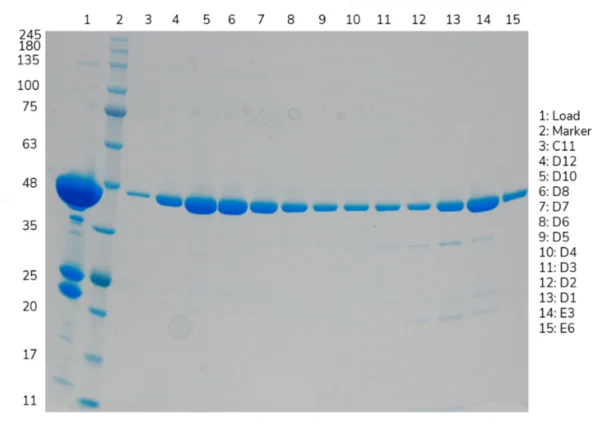
Both peaks were shown to contain the Fab, with minor contaminants seen in the second peak.
However, a reduced SDS-PAGE gel of the elution peaks just raised further questions.
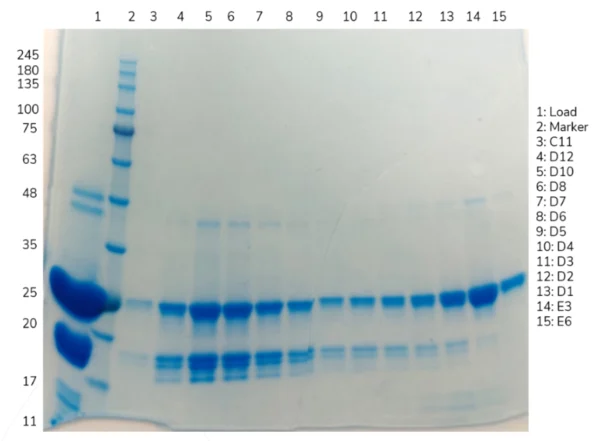
The bands at 25 kDa corresponded to the heavy and light chains of the Fab, separated due to the reduction of the disulfide bonds which held them together. But what were the bands between 17 and 20 kDa?
The two peaks were pooled and concentrated separately. They were then run on intact mass to try to gather further information.
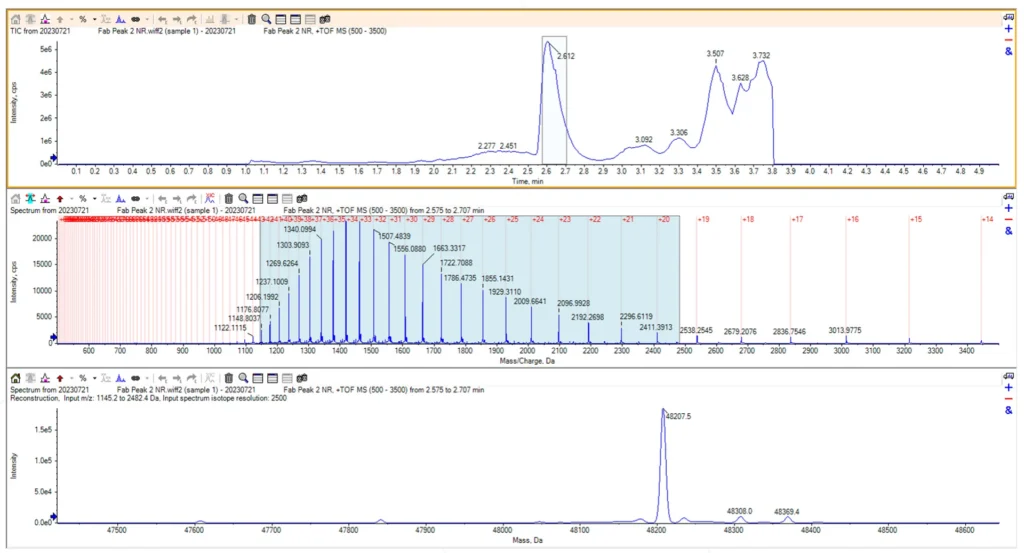
Analysing the chromatogram from the intact mass run of the second peak was quite straightforward; the main peak at 48207.5 Da matched the expected mass of the Fab, minus 10 Da from the five disulfide bonds within the Fab.
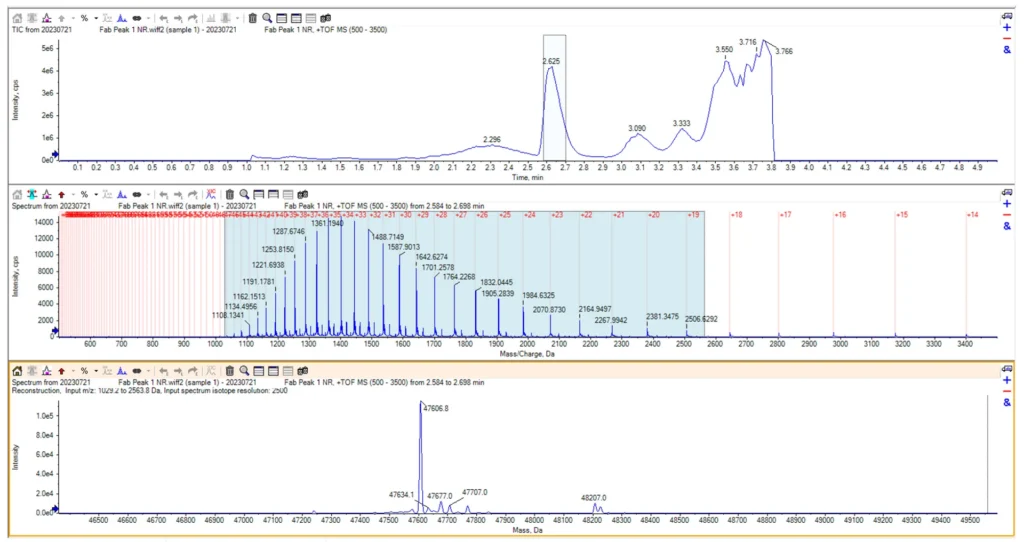
Analysing the chromatogram from the intact mass run of the first peak was more difficult. The main peak shows a mass of 47606.8 Da. This – 600.7 Da difference did not match any expected modifications, nor did it match an N-terminal or C-terminal truncation on either chain. Further investigation needed to be done.
A small sample from the first peak was reduced with DTT and heated at 70 °C for half an hour to see which insights could be gained from separating the light and heavy chains.
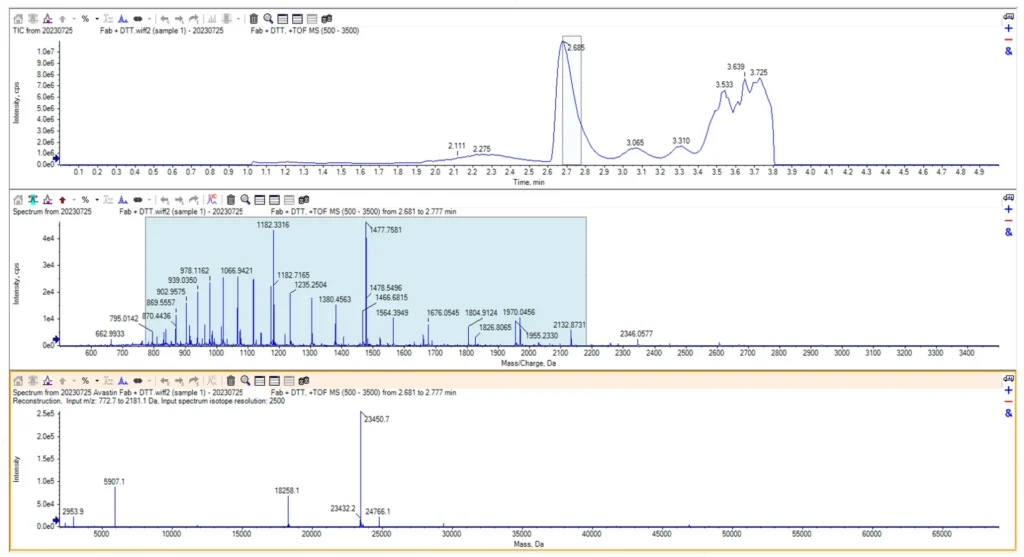
The main peak of 23450.7 Da corresponded to the light chain of the Fab and the much smaller peak of 24766.1 Da corresponded to the heavy chain of the Fab.
The other peaks, 18258.1 Da and 5907.1 Da, were more difficult to assign. Once again, the masses shown did not match either an N-terminal or C-terminal truncation of the heavy chain. Furthermore, adding up the masses of two peaks gives a mass of 24165.2 Da which is too small to be the heavy chain.
After some trial and error, it was discovered that two papain cleavages in the middle of the heavy chain resulted in two fragments of 18.3 kDa and 5.9 kDa being formed, plus a six-amino acid fragment, GEPTYA, which could not be seen in the intact mass chromatogram.
Adding up the 18258 Da fragment, the 5907 Da fragment and the 23450 Da light chain, gives a mass of 47615 Da. This, minus 10 Da from 5 disulfide bonds, matched the main peak in Figure 5, of the non-reduced sample from peak 1.
The 18.3 kDa fragment and 5.9 kDa fragment could not be seen in the non-reduced SDS-PAGE gel (Figure 2) because the intramolecular disulfide bonds between different cystine residues in the heavy chain kept the three fragments together; once the disulfide bonds were reduced, the fragments were no longer kept together and so the fragments could be seen in the reduced SDS-PAGE gel (Figure 3).
This papain over-digestion is a common issue which is difficult to correct. The line between under-digestion and over-digestion when using papain is not so much a fine line as an overlapping, fuzzy area – here, the digestion of the immunoglobulin was not taken to completion, but over-digestion of the Fab fragments still occurred.
One way to circumvent this issue, is to produce the Fab as a recombinant protein using mammalian expression systems and we have several examples where we have done this for our clients. This removes the issue of papain altogether and usually leads to a higher Fab yield. Of course this approach does rely on having the target amino acid sequence of the Fab in question, but assuming that is available, our recommendation is for a recombinant approach to produce Fabs.
Peak Proteins, NuChem Sciences, and SB Drug Discovery have now fully integrated with Sygnature Discovery.