



Featured Resources
-
STORM Therapeutics: From Lead to Pre-Candidate Nomination in 18 Months

STORM Therapeutics: From Lead to Pre-Candidate Nomination in 18 Months
Case study




Discover precise insights into brain neurochemistry with Sygnature Discovery's in vivo microdialysis and cOFM services. With over 20 years of expertise, we design bespoke studies that reveal how compounds modulate neurotransmitter systems in health and disease. Using UHPLC/HPLC with electrochemical detection or mass spectrometry, we deliver robust PK/PD data to support confident CNS decision making.


July 30, 2015

Inobrodib, an exciting, first-in-class oral anti-cancer drug in clinical development by CellCentric, was collaboratively designed, synthesised and supported on its pre-clinical journey by an integrated project team at Sygnature Discovery. Inobrodib is now showing promising results in Phase I and II trials for multiple myeloma and other cancer types.

In drug discovery, generating targets is no longer the challenge. The real question is how to identify the few worth investing months of research and significant resources to pursue. Hear expert perspectives on how AI, pathway analysis and scientific expertise are shaping modern target identification.
July 7, 2026

Stay up to date with the latest company updates, milestones, and announcements.
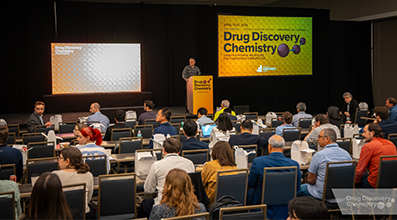
Explore upcoming conferences and scientific meetings where you can connect with our team.

At Sygnature Discovery, we deliver world-leading drug discovery solutions to accelerate your compound from idea to clinic.

Our leadership team brings diverse experience and insight, driving collaboration and innovation across drug discovery.

Explore careers at Sygnature Discovery and join a global team committed to science, collaboration, and integrity.
Inobrodib, an exciting, first-in-class oral anti-cancer drug in clinical development by CellCentric, was collaboratively designed, synthesised and supported on its pre-clinical journey by an integrated project team at Sygnature Discovery. Inobrodib is now showing promising results in Phase I and II trials for multiple myeloma and other cancer types.
At Sygnature Discovery, we deliver world-leading drug discovery solutions to accelerate your compound from idea to clinic.
Our leadership team brings diverse experience and insight, driving collaboration and innovation across drug discovery.
Explore careers at Sygnature Discovery and join a global team committed to science, collaboration, and integrity.
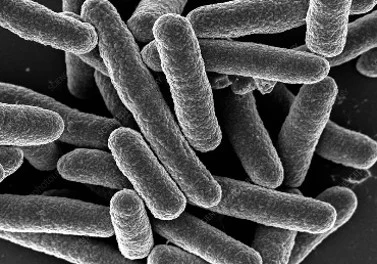
Selecting the right E. coli strain is one of the most important decisions when planning recombinant protein expression. Even subtle differences between host strains – such as expression control, protease activity, chaperone availability, or plasmid compatibility – can dramatically influence both protein yield and quality. The choice of strain can determine whether your expression run results in a clean, high-yield preparation or a challenging, low-quality product.
Within the Protein & Structure department at Sygnature Discovery, our microbial expression team utilizes a broad portfolio of E. coli strains and apply their scientific expertise to match constructs with the most suitable host. By understanding the specific requirements of your protein, such as solubility, toxicity, folding complexity, or need for disulfide bond formation, we can design an expression strategy that maximizes the chance of success and drives a project efficiently toward being able to generate high-quality recombinant protein.
Even the best designed protein expression constructs can behave unpredictably once they reach the bench. Even a well designed expression strategy can quickly run into problems such as:
These challenges often stem from choosing a host strain that isn’t well matched to the protein’s characteristics. That’s why our microbial expression team takes a tailored, data-driven approach. We can review known behavior or sequence features of your construct, and the specific goals of your project and from there select the strain most likely to give robust expression. When needed, we run small-scale comparison screens to identify the “best performer” experimentally. This ensures the expression strategy is built on the strongest foundation possible and maximizes the chances of downstream success.
Many recombinant proteins need more than a “standard” E. coli host strain. Some require tighter promoter control, enhanced folding assistance, improved transformation efficiency, or specialist capabilities such as in vivo biotinylation. To support these diverse needs, our microbial expression team maintains a broad toolbox of E. coli strains and strain–plasmid combinations in the laboratory. With this range, we can troubleshoot issues such as poor transformability, expression toxicity, rare codon usage, plasmid instability, or low yields – choosing strains that give your protein construct the best possible environment to succeed.
Each E. coli strain brings unique features that can dramatically influence expression outcomes. Here are a few examples from our current toolkit:
DE3 Lysogen (DE3)
Contains a chromosomal T7 RNA polymerase gene under the lacUV5 promoter, making it the go-to choice for T7 driven expression systems.
pLysS
Expresses T7 lysozyme, which suppresses background transcription and reduces leaky expression—particularly valuable for toxic or tightly regulated proteins.
One Shot™ Format
Convenient, single use transformation tubes that minimize contamination risks and streamline workflows.
BL21 vs. BL21 Gold
BL21 Gold’s Hte phenotype boosts transformation efficiency (>1×10⁸ cfu/µg), and its endA inactivation reduces plasmid degradation, making it ideal for difficult constructs or low abundance DNA preps.
BirA2
Enables in vivo biotinylation when biotin is added during induction, offering a powerful advantage for affinity purification, assay development or downstream binding studies.
Cloning Strains
For subcloning workflows, we predominantly use DH5α, which consistently delivers strong transformation efficiency and robust plasmid yields across our prep methods.
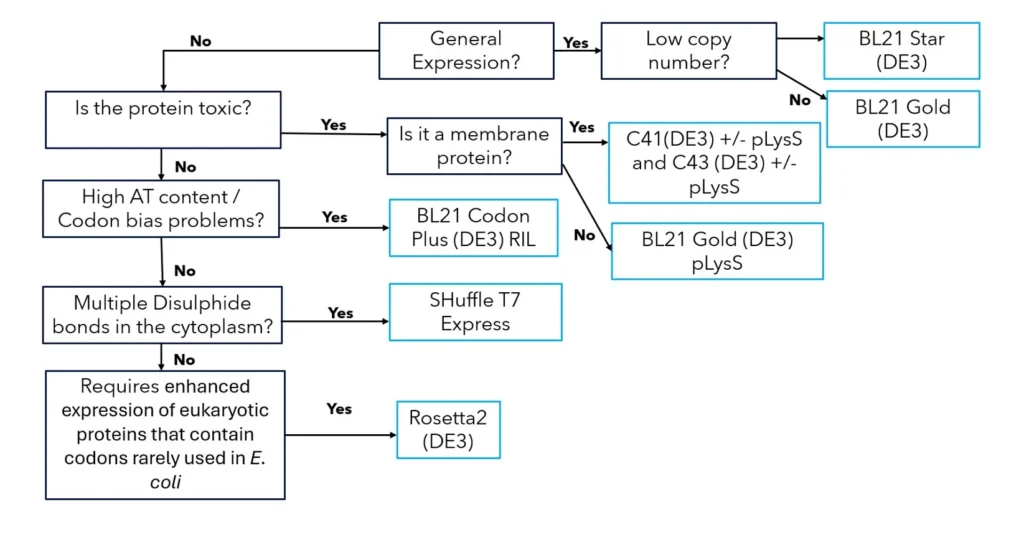
While clients often come to us with a preferred strain type in mind, we can use a structured troubleshooting workflow (see Figure 1) to evaluate each construct’s requirements and predict which host is most likely to deliver strong, reliable protein yields. This approach helps us match the biology of your protein with the strengths of specific cell strains, ensuring the expression system is set up for success from the very start.
We work closely with our clients to identify the expression strategy and cell system that best fits their specific project needs. Whether you’re dealing with challenging constructs, have specialized expression requirements, or complex downstream applications, our expert team is here to guide you toward the most effective and reliable path forward.
We have recently expressed, purified and crystallized Cereblon-Midi, a key protein in the targeted protein degradation system (for more information see our case study ).
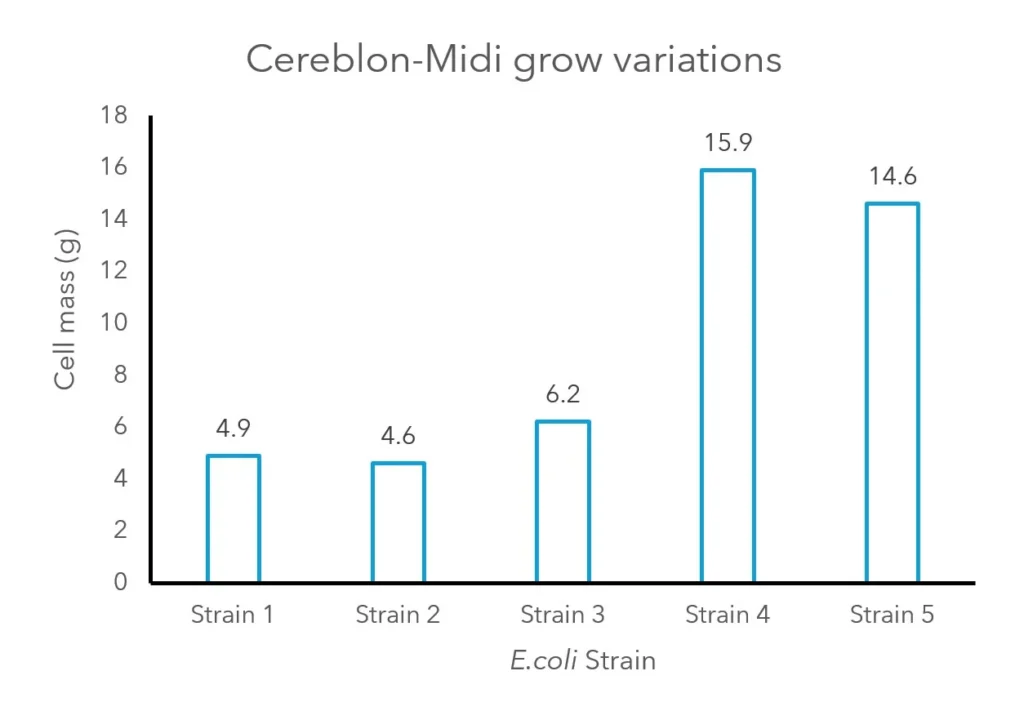
To establish the most optimal conditions for expression of this protein we carried out a panel of small-scale expressions and purifications to compare 5 different E. coli strains. Following the expression grows there were significant differences observed in the harvested pellet size between the cell strains as shown in Figure 2.
A comparable portion of each of the cell pellets was lysed and purified by Nickel IMAC to maintain the ratio differences in cell paste yield. Figure 3 shows the SDS PAGE and protein yields from each cell strain.
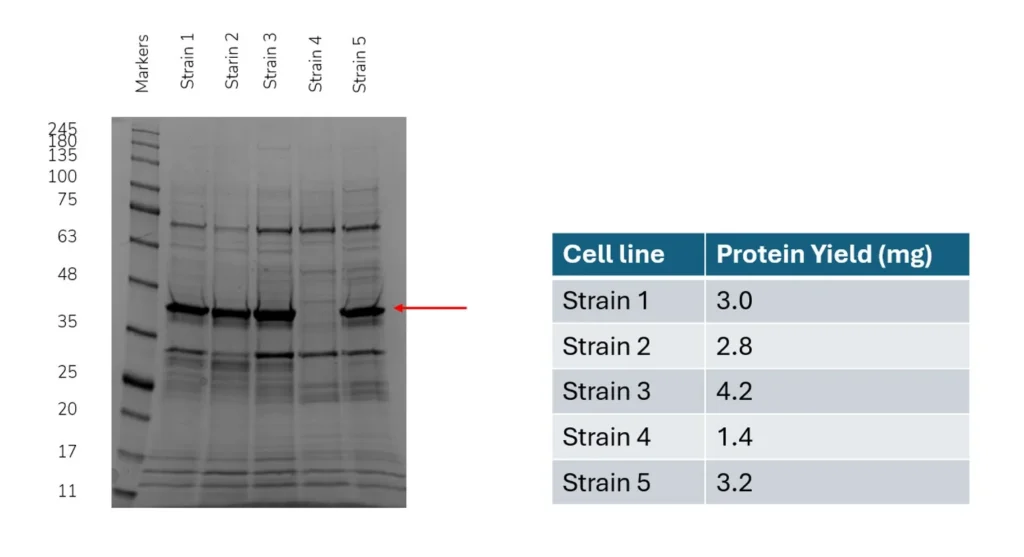
It is clear from the contrast between Figures 2 and 3 that the paste yield is not indicative of the final protein quantities obtained. In this example E. coli cell strain 3 was found to be the “best expressor” of soluble Cereblon-Midi and was taken forwards as the most efficient system for us to produce quality soluble protein at the scale required for crystallography.

Peak Proteins, NuChem Sciences, and SB Drug Discovery have now fully integrated with Sygnature Discovery.