


Featured Resources
-
STORM Therapeutics: From Lead to Pre-Candidate Nomination in 18 Months

STORM Therapeutics: From Lead to Pre-Candidate Nomination in 18 Months
Case study




Discover precise insights into brain neurochemistry with Sygnature Discovery's in vivo microdialysis and cOFM services. With over 20 years of expertise, we design bespoke studies that reveal how compounds modulate neurotransmitter systems in health and disease. Using UHPLC/HPLC with electrochemical detection or mass spectrometry, we deliver robust PK/PD data to support confident CNS decision making.


July 30, 2015

Inobrodib, an exciting, first-in-class oral anti-cancer drug in clinical development by CellCentric, was collaboratively designed, synthesised and supported on its pre-clinical journey by an integrated project team at Sygnature Discovery. Inobrodib is now showing promising results in Phase I and II trials for multiple myeloma and other cancer types.

In drug discovery, generating targets is no longer the challenge. The real question is how to identify the few worth investing months of research and significant resources to pursue. Hear expert perspectives on how AI, pathway analysis and scientific expertise are shaping modern target identification.
July 7, 2026

Stay up to date with the latest company updates, milestones, and announcements.
Explore upcoming conferences and scientific meetings where you can connect with our team.

At Sygnature Discovery, we deliver world-leading drug discovery solutions to accelerate your compound from idea to clinic.

Our leadership team brings diverse experience and insight, driving collaboration and innovation across drug discovery.

Explore careers at Sygnature Discovery and join a global team committed to science, collaboration, and integrity.
Inobrodib, an exciting, first-in-class oral anti-cancer drug in clinical development by CellCentric, was collaboratively designed, synthesised and supported on its pre-clinical journey by an integrated project team at Sygnature Discovery. Inobrodib is now showing promising results in Phase I and II trials for multiple myeloma and other cancer types.
At Sygnature Discovery, we deliver world-leading drug discovery solutions to accelerate your compound from idea to clinic.
Our leadership team brings diverse experience and insight, driving collaboration and innovation across drug discovery.
Explore careers at Sygnature Discovery and join a global team committed to science, collaboration, and integrity.
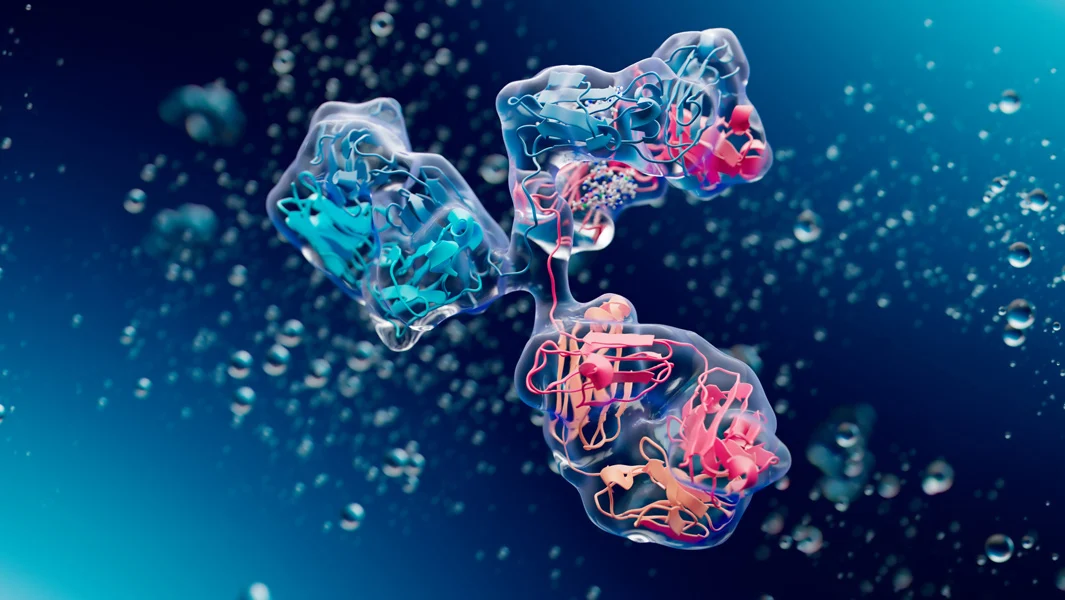
At Sygnature Discovery, we can combine our in-house protein production expertise with specialist conjugation chemistries, and robust analytical characterisation to deliver high quality ADCs for clients.
In a recent project we generated a panel of trastuzumab based ADCs incorporating several novel linker payload constructs. The project delivered five high‑quality ADCs using a combination of site specific and stochastic conjugation chemistries, we established new capabilities, workflows and analytical methods that enhance our ability to provide the entire ADC production workflow in house.
Prior to starting work with cytotoxic payloads, the team implemented a dedicated cytotoxic‑handling system which is an essential requirement for ADC payload chemistry. This includes:
This infrastructure now supports all future ADC projects at Sygnature Discovery.
A common conjugation technique in ADC production, is stochastic (random) conjugation. Stochastic conjugation is widely used because it requires no antibody engineering and can be readily scaled. In this project, payloads were attached via reduced interchain disulfides (Figure 1). A major part of the project involved DAR calibration, varying TCEP concentration, payload excess, temperature and reaction time to achieve the desired ADC DAR species.

Conditions identified in the initial calibration served as a starting point for client specific payloads. By varying TCEP and payload equivalents, we achieved DAR4 and DAR8 ADCs with minimal additional optimisation. The method transferred well, enabling accurate detection of conjugation and rapid progression to scale up within days.
Site‑specific conjugation via microbial transglutaminase (tGase) requires access to a specific glutamine residue (Q295 in trastuzumab). However, the native glycan at N297 sterically blocks the enzyme. To resolve this, we optimised PNGase F deglycosylation of trastuzumab to ensure a single homogeneous species was produced (Figure 2).
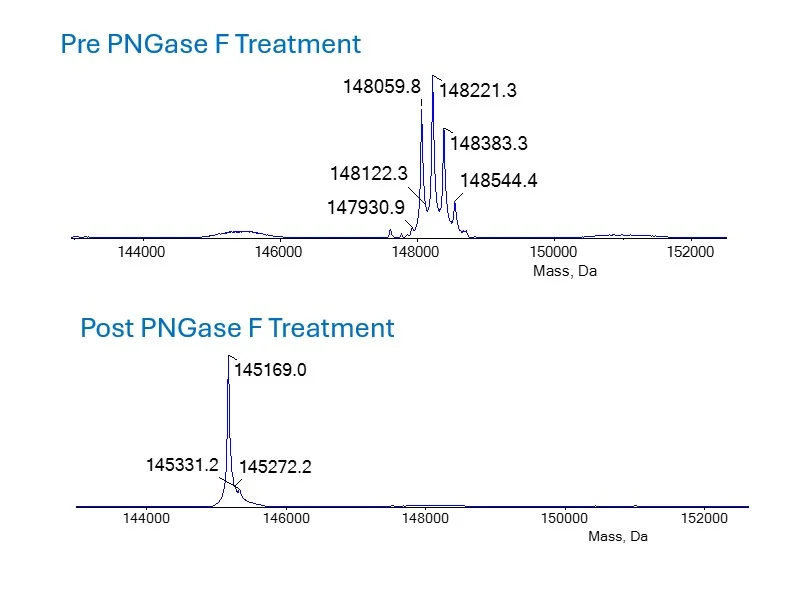
Intact mass analysis of untreated trastuzumab (Pre‑PNGase F treatment, top panel) reveals multiple glycoforms, producing a heterogeneous cluster of peaks between ~147,900 –148,800 Da. Following enzymatic deglycosylation with PNGase F (Post‑PNGase F treatment, bottom panel) the heterogeneous glycoform pattern is reduced into a single species at ~145,169 Da. This shift reflects successful removal of glycans and yields a more homogeneous antibody population with a defined mass, suitable for site specific conjugation.
Using the optimised deglycosylation of trastuzumab protocol, tGase conjugation proceeded efficiently, producing two uniform DAR2 ADCs with excellent analytical profiles. Mass spectrometry confirmed the expected single heavy‑chain modification pattern characteristic of tGase‑mediated site‑specific conjugation (Figure 3).
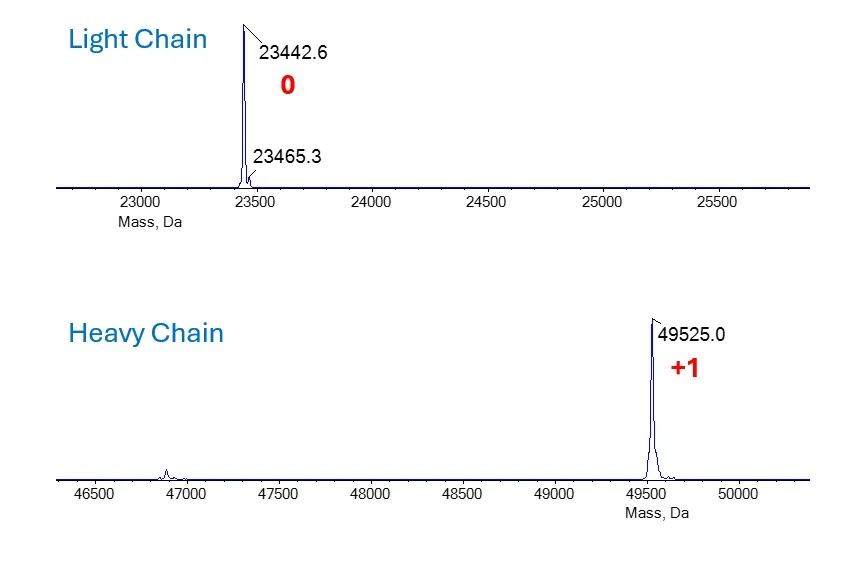
Intact mass analysis of the light chain (top panel) shows a single peak at 23,442.7 Da, corresponding to the unmodified light chain (LC). This confirms that no payload is attached at the LC chain, consistent with the expected tGase mediated site‑specific conjugation chemistry, which targets a glutamine residue located on the heavy chain only.
The heavy chain spectrum (bottom panel) displays one species at 49,525.1 Da, representing a +1 payload addition. This demonstrates efficient, site‑specific incorporation of a single linker payload molecule per heavy chain (HC), giving the characteristic DAR2 ADC (one payload on each of the two HC subunits). Together, these spectra confirm successful site‑specific conjugation, high reaction fidelity, and the expected uniform DAR2 species for the engineered ADC.
To confirm ADC integrity, QC for all ADCs (Figure 4) produced includes:
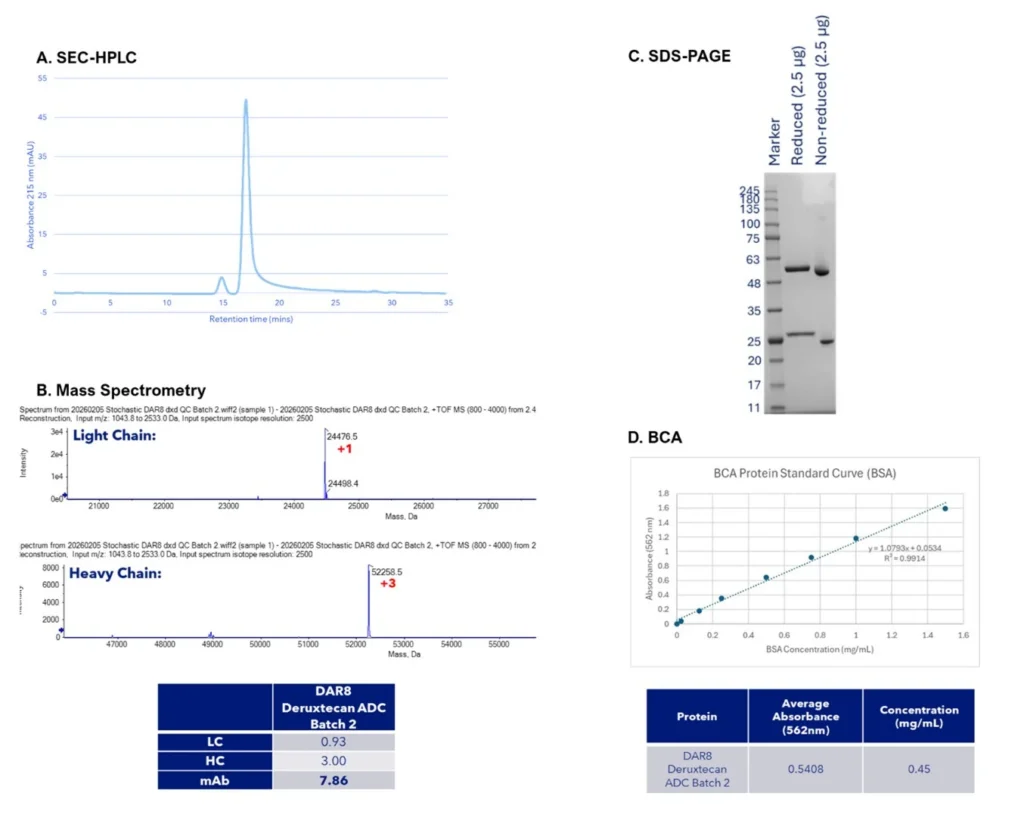
A. SEC‑HPLC chromatograms confirm monodisperse ADCs with minimal aggregation.
B. Intact MS outputs verify expected LC/HC masses and correct DAR assignment.
C. SDS‑PAGE shows the ADC under both reduced and non‑reduced conditions.
D. BCA measurements provide accurate concentration assessment. Collectively, these QC data confirm the identity, purity and suitability of ADCs for downstream biological studies.
Across all five ADCs generated in this project, our team delivered high purity ADCs suitable for downstream biological assays, supported by comprehensive analytical characterisation including accurate DAR determination, SEC‑HPLC, mass spectrometry, SDS‑PAGE, and A280/BCA concentration measurements. These ADCs were produced at milligram scale quantities, enabling clients to progress confidently into early discovery studies.
This work also demonstrated several core strengths within Sygnature’s Protein Science team:
Together, these capabilities now complement and enhance our established strengths in protein expression, purification, chemical biology and bioassay support, creating a comprehensive platform to accelerate client ADC programmes. In addition, through Sygnature Discovery’s fully integrated discovery model, spanning medicinal chemistry for linker and payload design, bioscience, DMPK and in vivo pharmacology, we can deliver the entire ADC workflow in house, enabling seamless, cross disciplinary project execution and supporting complex, multi‑component ADC programmes from concept to candidate.
ADCs represent some of the most complex biologics in development today, sitting at the interface of protein science, synthetic chemistry and analytical characterisation. This project showcased the breadth of Sygnature Discovery’s integrated capabilities, taking a therapeutic antibody from in house production through two conjugation strategies, multiple novel payloads, and full QC.
Through this work, Sygnature Discovery is now able to offer a complete, end‑to‑end ADC workflow, fully customised to each client’s payload chemistry, conjugation strategy and target DAR species. By optimising our intact mass spectrometry workflow, we can now resolve and quantify DAR species with minimal sample requirements, rapid turnaround times and high reproducibility, enabling confident decision making throughout ADC optimisation. Moreover, we can achieve a broad range of DAR species via both stochastic and site-specific conjugation, applying diverse linker payload systems to meet programme specific needs.
Whether clients require early proof‑of‑concept ADCs, high DAR exploration, method development or tailored conjugation strategies, our multidisciplinary team is equipped to accelerate discovery programmes and support the development of next‑generation ADC therapeutics.
Discover more about our wide range capabilities to support ADC projects.
Peak Proteins, NuChem Sciences, and SB Drug Discovery have now fully integrated with Sygnature Discovery.