


Featured Resources
-
STORM Therapeutics: From Lead to Pre-Candidate Nomination in 18 Months

STORM Therapeutics: From Lead to Pre-Candidate Nomination in 18 Months
Case study
📣From lead to pre-candidate nomination in 18 months. Explore the STORM Therapeutics case study


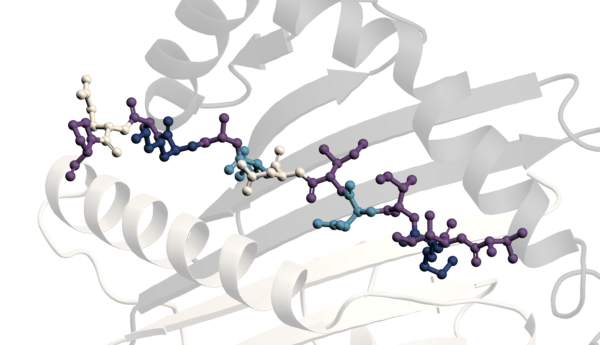


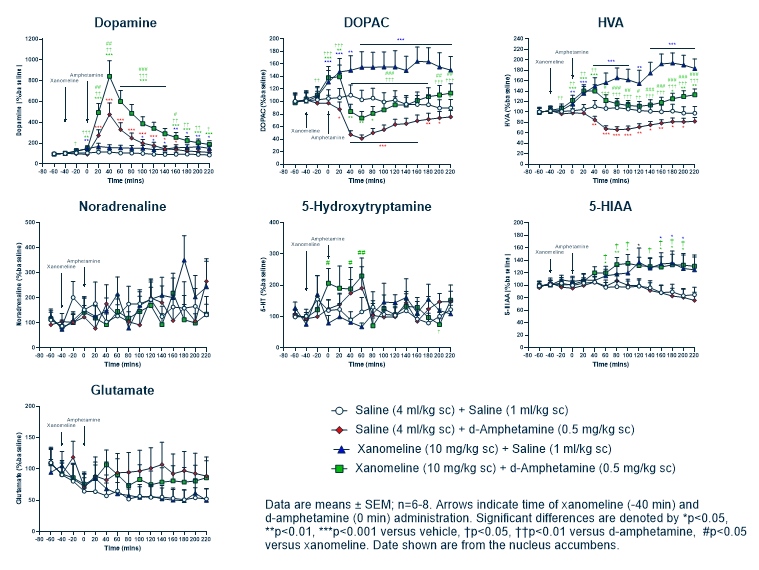
Discover precise insights into brain neurochemistry with Sygnature Discovery's in vivo microdialysis and cOFM services. With over 20 years of expertise, we design bespoke studies that reveal how compounds modulate neurotransmitter systems in health and disease. Using UHPLC/HPLC with electrochemical detection or mass spectrometry, we deliver robust PK/PD data to support confident CNS decision making.


July 30, 2015

Inobrodib, an exciting, first-in-class oral anti-cancer drug in clinical development by CellCentric, was collaboratively designed, synthesised and supported on its pre-clinical journey by an integrated project team at Sygnature Discovery. Inobrodib is now showing promising results in Phase I and II trials for multiple myeloma and other cancer types.

At Sygnature Discovery, we deliver world-leading drug discovery solutions to accelerate your compound from idea to clinic.

Our leadership team brings diverse experience and insight, driving collaboration and innovation across drug discovery.

Explore careers at Sygnature Discovery and join a global team committed to science, collaboration, and integrity.
Inobrodib, an exciting, first-in-class oral anti-cancer drug in clinical development by CellCentric, was collaboratively designed, synthesised and supported on its pre-clinical journey by an integrated project team at Sygnature Discovery. Inobrodib is now showing promising results in Phase I and II trials for multiple myeloma and other cancer types.
At Sygnature Discovery, we deliver world-leading drug discovery solutions to accelerate your compound from idea to clinic.
Our leadership team brings diverse experience and insight, driving collaboration and innovation across drug discovery.
Explore careers at Sygnature Discovery and join a global team committed to science, collaboration, and integrity.
Sygnature Discovery’s LogD7.4 validation confirms the assay’s accuracy and reproducibility across a wide range of compound lipophilicities. Using a classical shake‑flask approach with LC–MS/MS quantification, the method shows strong alignment with literature values and low variability across repeat assays, providing high‑quality lipophilicity data to support confident early‑stage ADME decision‑making.
Sygnature Discovery’s LogD7.4 assay quantifies compound lipophilicity using a classical shake‑flask partitioning approach between 1‑octanol and pH 7.4 phosphate buffer. Lipophilicity expressed as the Log of the distribution coefficient (LogD), is a key determinant of solubility, distribution, permeability and metabolic stability, making its accurate measurement essential for early‑stage drug discovery. The assay is designed to provide reliable LogD measurements across a broad chemical diversity, from hydrophilic to highly lipophilic compounds.
The LogD7.4 workflow involves partitioning of test compounds between 1-octanol and pH 7.4 buffer to quantify the relative distribution between polar and non‑polar environments. Test compound solutions utilizing 10 mM DMSO stocks are prepared in 1-octanol, equilibrated to ensure complete dissolution, and mixed with buffer in a defined phase ratio. Mechanical shaking ensures efficient mixing and enables the compound to distribute between the two phases.
Once equilibrium is reached, the two phases are separated by centrifugation, and aliquots are taken from each layer. Samples undergo appropriate dilution to fall within the analytical calibration range, and quantification is performed using LC–MS/MS. Measurements from multiple dilutions of buffer samples and nominal octanol standards are combined to generate a set of LogD ratios, from which accepted values are averaged to provide a final reported LogD7.4.
This structured workflow emphasizes reproducibility, minimizes handling variability and supports consistent data across compound classes. The standardised dilution and calibration strategy ensures robust quantification, enabling confident assessment of compounds spanning a wide range of lipophilicities.
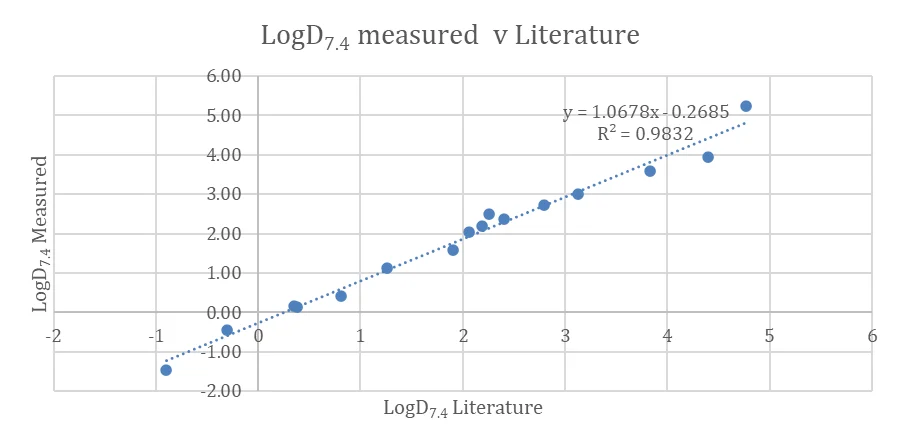
Figure 1. Graph illustrating the mean measured LogD values for reference compounds vs literature data (1,2,3) in pH7.4 phosphate buffer:1-octanol
A subset of five compounds was further assessed in a dedicated intra‑assay evaluation (n = 6 incubations). The results demonstrated outstanding consistency, with coefficients of variation ranging from 0.9% to 8.7%, confirming reproducible performance within a single experimental run.
The assay delivers robust and reproducible partitioning across two immiscible phases following controlled equilibration, enabling accurate determination of concentration ratios. LC–MS/MS quantification ensures high sensitivity and broad dynamic range, supporting measurement of both polar and lipophilic molecules. The method supports high confidence in LogD7.4 characterization, facilitating medicinal chemistry optimization and enabling reliable structure‑property relationship interpretation.
Overall, the shake‑flask LogD7.4 assay provides high‑quality lipophilicity data aligned with industry standards and literature values, making it a powerful tool within early‑stage ADME screening workflows.

Peak Proteins, NuChem Sciences, and SB Drug Discovery have now fully integrated with Sygnature Discovery.
