


Ressources
-
STORM Therapeutics: From Lead to Pre-Candidate Nomination in 18 Months

STORM Therapeutics: From Lead to Pre-Candidate Nomination in 18 Months
Case study




Discover precise insights into brain neurochemistry with Sygnature Discovery's in vivo microdialysis and cOFM services. With over 20 years of expertise, we design bespoke studies that reveal how compounds modulate neurotransmitter systems in health and disease. Using UHPLC/HPLC with electrochemical detection or mass spectrometry, we deliver robust PK/PD data to support confident CNS decision making.


juillet 30, 2015

Inobrodib, an exciting, first-in-class oral anti-cancer drug in clinical development by CellCentric, was collaboratively designed, synthesised and supported on its pre-clinical journey by an integrated project team at Sygnature Discovery. Inobrodib is now showing promising results in Phase I and II trials for multiple myeloma and other cancer types.

In drug discovery, generating targets is no longer the challenge. The real question is how to identify the few worth investing months of research and significant resources to pursue. Hear expert perspectives on how AI, pathway analysis and scientific expertise are shaping modern target identification.
juillet 7, 2026

Tenez‑vous au courant des dernières mises à jour de l’entreprise, des étapes clés et des annonces importantes.
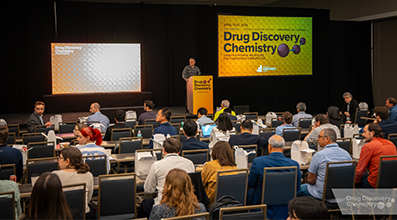
Découvrez les conférences et rencontres scientifiques à venir, où vous pourrez échanger avec notre équipe.

Chez Sygnature Discovery, nous fournissons des solutions de découverte de médicaments de classe mondiale pour accélérer la progression de vos composés, de l’idée jusqu’à la clinique.

Notre équipe de direction rassemble une diversité d’expériences et de ressources, favorisant la collaboration et l’innovation dans l’ensemble du processus de découverte de médicaments.

Explorez les opportunités de carrière chez Sygnature Discovery. Rejoignez une équipe internationale qui obtient des résultats exceptionnels grâce à la collaboration, à l’innovation et à l’intégrité.
Inobrodib, an exciting, first-in-class oral anti-cancer drug in clinical development by CellCentric, was collaboratively designed, synthesised and supported on its pre-clinical journey by an integrated project team at Sygnature Discovery. Inobrodib is now showing promising results in Phase I and II trials for multiple myeloma and other cancer types.
Chez Sygnature Discovery, nous fournissons des solutions de découverte de médicaments de classe mondiale pour accélérer la progression de vos composés, de l’idée jusqu’à la clinique.
Notre équipe de direction rassemble une diversité d’expériences et de ressources, favorisant la collaboration et l’innovation dans l’ensemble du processus de découverte de médicaments.
Explorez les opportunités de carrière chez Sygnature Discovery. Rejoignez une équipe internationale qui obtient des résultats exceptionnels grâce à la collaboration, à l’innovation et à l’intégrité.
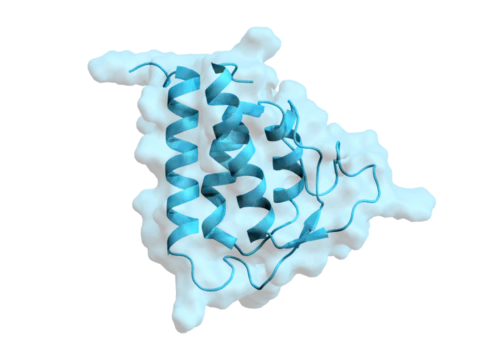
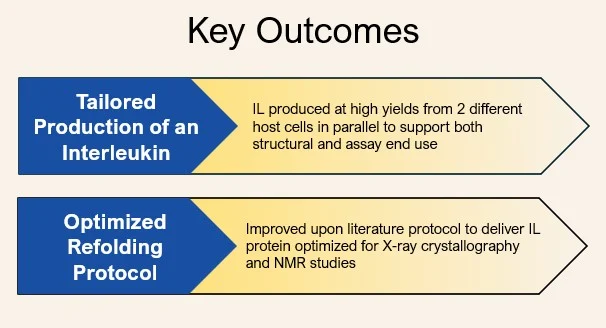
Interleukins (ILs) are a family of cytokines that play an important role in immunology and are the focus of many Oncology research programs. However, to support their work researchers often require a purified IL protein construct with specific characteristics to support the desired end use, be it structural biology, assay development or functional studies. In this case study we present how Sygnature Discovery’s in‑house protein science team developed a parallel‑track production strategy using E. coli and mammalian HEK293 expression systems to produce an Interleukin (IL-X) for a client who needed the protein in different forms for both structure and assay development.
To generate structural-grade protein, Sygnature Discovery optimized a literature refolding and purification protocol from bacterial inclusion bodies. The result was a dramatic increase in final protein yield while producing homogeneous PTM-free protein suitable for crystallography and NMR studies. In parallel, we used HEK293 cells to produce fully functional glycosylated IL-X to support biochemical assay experiments.
This case study demonstrates Sygnature Discovery’s ability to develop tailored expression and purification strategies for challenging proteins, enabling the delivery of fit-for-purpose protein for downstream research applications.
Overcoming Inclusion Body Impurities
While mammalian expression and purification of IL-X was relatively straightforward via standard protocols, procuring IL-X from E. coli inclusion bodies required additional optimization. The first improvement to literature protocol focused on protein expression. rather than relying on standard expression conditions, Sygnature Discovery extended the post-induction incubation and refined the temperature conditions.
Removing Impurities that would Compromise Refolding
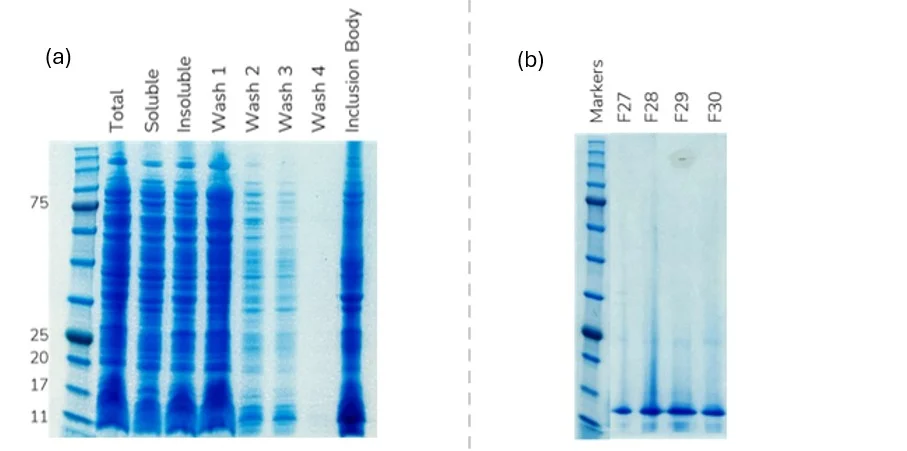
An initial evaluation of the isolated inclusion bodies (IB) revealed substantial impurities were still present despite a series of IB wash steps (Figure 1a). Following inclusion body (IB) solubilization, a denatured Immobilized Metal Affinity Chromatography (IMAC) step was introduced, with urea retained in the buffer, to remove the majority of impurities prior to refolding (Figure 1b). This enabled selective isolation of interleukin from host-cell contaminants and therefore a much purer starting point for the refolding of the IL-X.
Improving the Refolding Protocol
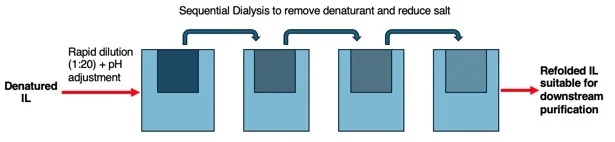
The IMAC purified, denatured interleukin underwent a tailored refolding process, based on our in-house knowledge of working with other interleukins and cytokines, generating a soluble fully folded form that was then suitable for further chromatographic capture and purification (Figure 2).
Optimizing Protein Yield on IEX
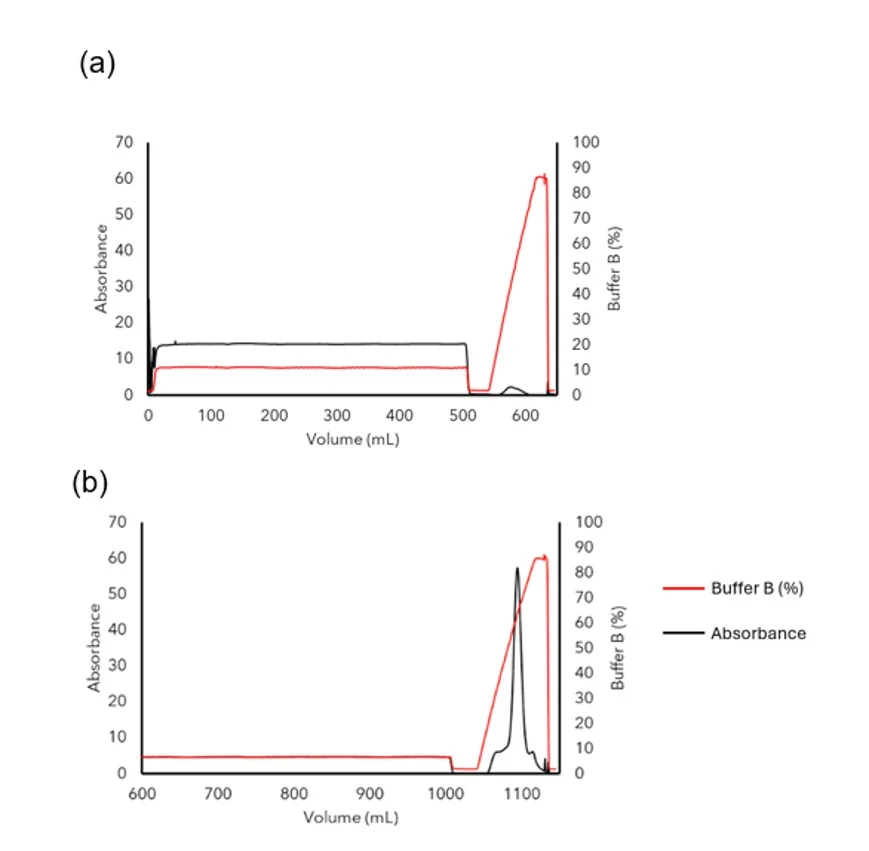
High sample conductivity initially prevented good interleukin capture via ion exchange chromatography (IEX). To overcome this incompatibility, we diluted the load sample with a low-salt buffer which then improved column binding and increased the IEX elution yield by 12-fold (Figure 3).
As a final polishing step, the pool was subjected to size exclusion chromatography, isolating pure interleukin and completing the production pathway.
What Sygnature Delivered
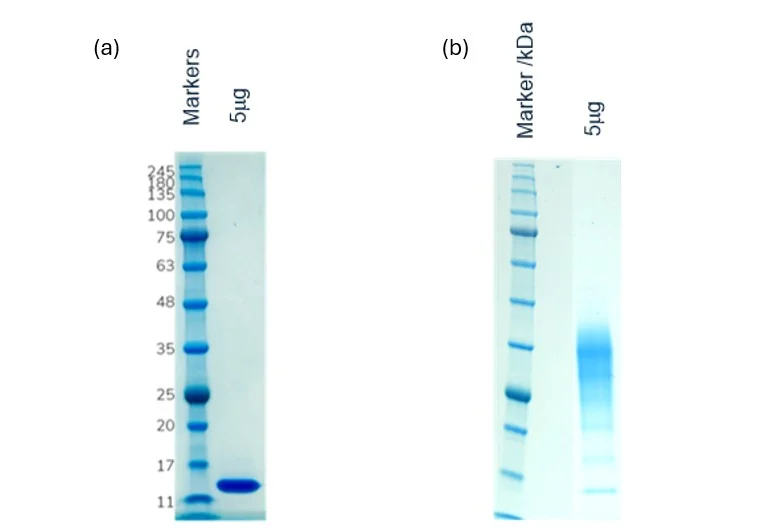
Together, these optimizations enabled the delivery of both structural-grade and assay-ready protein within a single coordinated program. This demonstrates Sygnature Discovery’s ability to tailor protein production strategies to diverse downstream applications.
Parallel-Expression Strategy
Specialized Expertise in Refolding Challenging Cytokines
Cross-Functional Collaboration
Test