


Featured Resources
-
STORM Therapeutics: From Lead to Pre-Candidate Nomination in 18 Months

STORM Therapeutics: From Lead to Pre-Candidate Nomination in 18 Months
Case study




Discover precise insights into brain neurochemistry with Sygnature Discovery's in vivo microdialysis and cOFM services. With over 20 years of expertise, we design bespoke studies that reveal how compounds modulate neurotransmitter systems in health and disease. Using UHPLC/HPLC with electrochemical detection or mass spectrometry, we deliver robust PK/PD data to support confident CNS decision making.


July 30, 2015

Inobrodib, an exciting, first-in-class oral anti-cancer drug in clinical development by CellCentric, was collaboratively designed, synthesized and supported on its pre-clinical journey by an integrated project team at Sygnature Discovery. Inobrodib is now showing promising results in Phase I and II trials for multiple myeloma and other cancer types.

In drug discovery, generating targets is no longer the challenge. The real question is how to identify the few worth investing months of research and significant resources to pursue. Hear expert perspectives on how AI, pathway analysis and scientific expertise are shaping modern target identification.
July 7, 2026

Stay up to date with the latest company updates, milestones, and announcements.

Explore upcoming conferences and scientific meetings where you can connect with our team.

At Sygnature Discovery, we deliver world-leading drug discovery solutions to accelerate your compound from idea to clinic.

Our leadership team brings diverse experience and insight, driving collaboration and innovation across drug discovery.

Explore careers at Sygnature Discovery and join a global team committed to science, collaboration, and integrity.
Inobrodib, an exciting, first-in-class oral anti-cancer drug in clinical development by CellCentric, was collaboratively designed, synthesized and supported on its pre-clinical journey by an integrated project team at Sygnature Discovery. Inobrodib is now showing promising results in Phase I and II trials for multiple myeloma and other cancer types.
At Sygnature Discovery, we deliver world-leading drug discovery solutions to accelerate your compound from idea to clinic.
Our leadership team brings diverse experience and insight, driving collaboration and innovation across drug discovery.
Explore careers at Sygnature Discovery and join a global team committed to science, collaboration, and integrity.
The search for next-generation therapies for obesity, type 2 diabetes, and metabolic dysfunction-associated steatohepatitis (MASH/NASH) continues to drive interest in novel metabolic targets. While incretin-based therapies have transformed the treatment landscape, researchers are also exploring complementary pathways that regulate energy balance, glucose homeostasis, lipid metabolism, and inflammation.
One receptor attracting increasing interest is GPR120, also known as free fatty acid receptor 4 (FFAR4). As understanding of metabolic disease becomes more nuanced, GPR120 has recently emerged as promising therapeutic target with implications for therapies targeted at neurodegeneration, metabolic disorders, cancer, inflammation and cardiovascular diseases. However, the context dependent signaling and the tissue-specific expression of GPR120 has further complicated the drug development efforts.
Consequently, future pharmacological efforts must focus on deciphering these intricate downstream pathways to successfully harness the receptor’s broad therapeutic potential and translate GPR120 vast biological promise into effective clinical treatments.
GPR120 is a Class A G protein-coupled receptor (GPCR) that is activated by medium-to-long-chain free fatty acids, particularly omega-3 fatty acids such as α-linolenic acid (ALA), docosahexaenoic acid (DHA) and eicosapentaenoic acid (EPA). Activation of the receptor has been linked to the regulation of lipid and energy metabolism, glucose homeostasis by promoting insulin sensitization, and ameliorating inflammation, positioning GPR120 at the intersection of several pathways implicated in metabolic disease.
GPR120 exhibits remarkably broad tissue distribution that underlies its pleiotropic physiological roles and expands therapeutic opportunities across multiple disease indications. The highest expression levels are observed in intestinal enteroendocrine L-cells and K-cells (incretin hormone release and appetite regulation), pancreatic islets (enhancement of glucose-stimulated insulin secretion and somatostatin release), adipose tissue (regulation of adipogenesis, lipolysis, thermogenesis, and adipokine secretion), macrophages and microglia (mediation of anti-inflammatory polarization and phagocytic function), central nervous system (energy balance and neurodegeneration) (Figure 1).
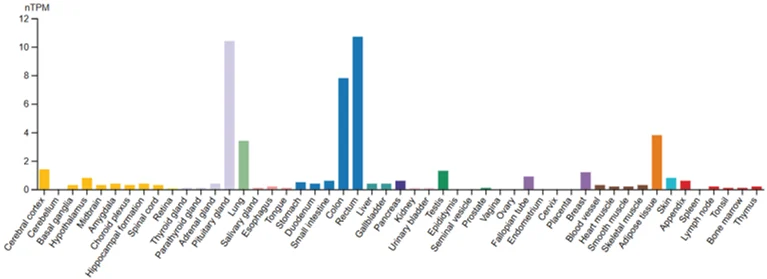
This distribution is consistent with the receptor’s emerging role as a regulator of multiple physiological processes, including glucose homeostasis, lipid metabolism, hormone secretion, inflammatory signalling and neurodegeneration.
One reason GPR120 has generated significant scientific interest is its complex signaling biology. Rather than acting within a single metabolic pathway, GPR120 appears to function as part of a wider network that integrates nutritional status with downstream cellular responses. This has made it an attractive target for researchers investigating obesity, type 2 diabetes, and steatotic liver diseases, where dysregulation occurs across multiple interconnected systems.
In humans, two gene products arise upon alternative splicing of exon 3, that can form longer form of GPR120, commonly referred to as FFA4-’Long’ (FFA4-L), as well as a shorter transcript, referred to as FFA4-’Short’ (FFA4-S). FFA4-L contains an additional 16 amino acid sequence within intracellular loop 3 (ICL3), a GPCR domain typically involved in protein interactions, downstream signaling, and desensitization.
The receptor is known to signal through both Gαq/11-mediated pathways and β-arrestin 2 recruitment pathways, each contributing to different downstream cellular responses. These pathways influence a range of biological outcomes, including hormone secretion, glucose uptake, cell survival, and inflammatory regulation.
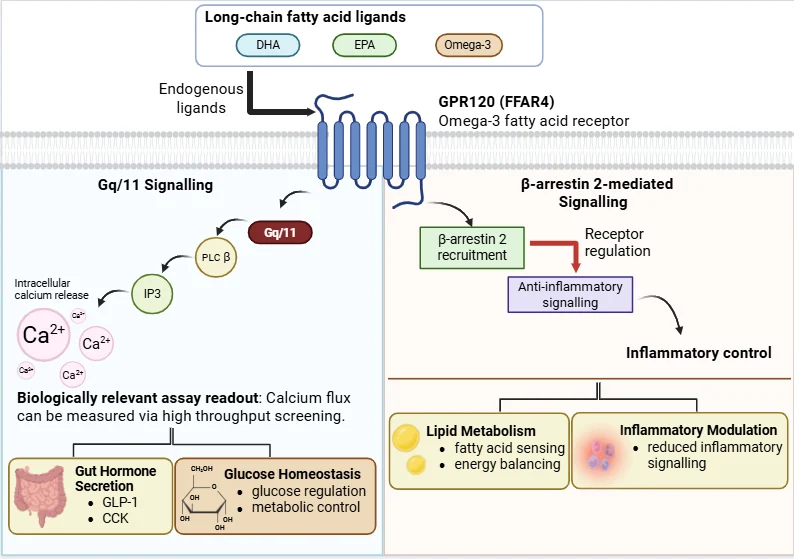
Following identification of different isoforms, it was reported that in response to agonism with the long-chain unsaturated fatty acid oleic acid, native FFA4-L is indeed unable to elicit Ca2+ responses, while FFA4-S produced robust Ca2+ mobilization, suggesting that the short variant of the receptor couples to Ca2+ signaling via Gαq/11. Both FFA4-L and FFA4-S elicited similar responses toward recruitment of β-arrestin2, and subsequently, both demonstrate robust internalization and are targeted to lysosomal compartments for degradation. This highlights the signaling differences between the two transcript variants and suggests that the insertion of the 16 amino acids into ICL3 of FFA4-L facilitates intrinsic bias toward β-arrestin signaling.
Scientists studying GPR120 are therefore faced with an important challenge:
The answer depends on the therapeutic objective. Understanding the biological relevance of each signaling route is essential when selecting assay formats and designing screening strategies, especially for a complex target like GPR120.
In GPCR drug discovery, measuring receptor activation is only part of the challenge. Equally important is ensuring that the chosen assay reflects the biology most relevant to the disease being studied. Poor target validation remains a significant contributor to late-stage attrition in drug development. At Sygnature Discovery, we view the whole discovery pipeline as one integrated feedback loop in order to de-risk progression. Therefore, we use our experience and expertise to ensure that target validation is carried out to the highest accuracy using in-house functional assay development to study our targets.
For GPR120, the Gαq/11 signaling pathway plays an important role in mediating metabolic effects. As a result, calcium mobilization provides a practical and biologically relevant functional readout for screening programs focused on metabolic applications.
Fluorescence-based calcium flux assays offer several advantages:
As interest in GPR120 grows, robust functional assays will be increasingly important for identifying and characterizing novel agonists, antagonists, and allosteric modulators.
To ensure that screening platforms yield predictive, high-confidence results, target biology must dictate assay design from the ground up. At Sygnature Discovery, building a screening-ready GPR120 platform reflects this philosophy, progressing systematically from construct validation and stable clone selection to rigorous pharmacological characterization.
Indeed, to achieve a reliable screening assay, the full process begins with construct validation via (q)PCR or Western Blot to assess that the target is correctly expressed in cells and it is detectable, followed by the generation and evaluation of stable cell lines capable of delivering strong signal windows, low background activity, and reproducible pharmacological responses.
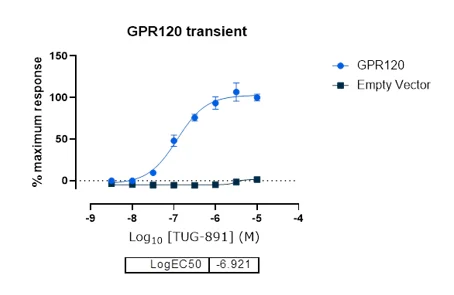
In Sygnature Discovery’s internally developed GPR120 platform, initial validation was performed using transiently transfected HEK 293 cells, demonstrating functional responses to the selective GPR120 agonist TUG-891(Figure 3).
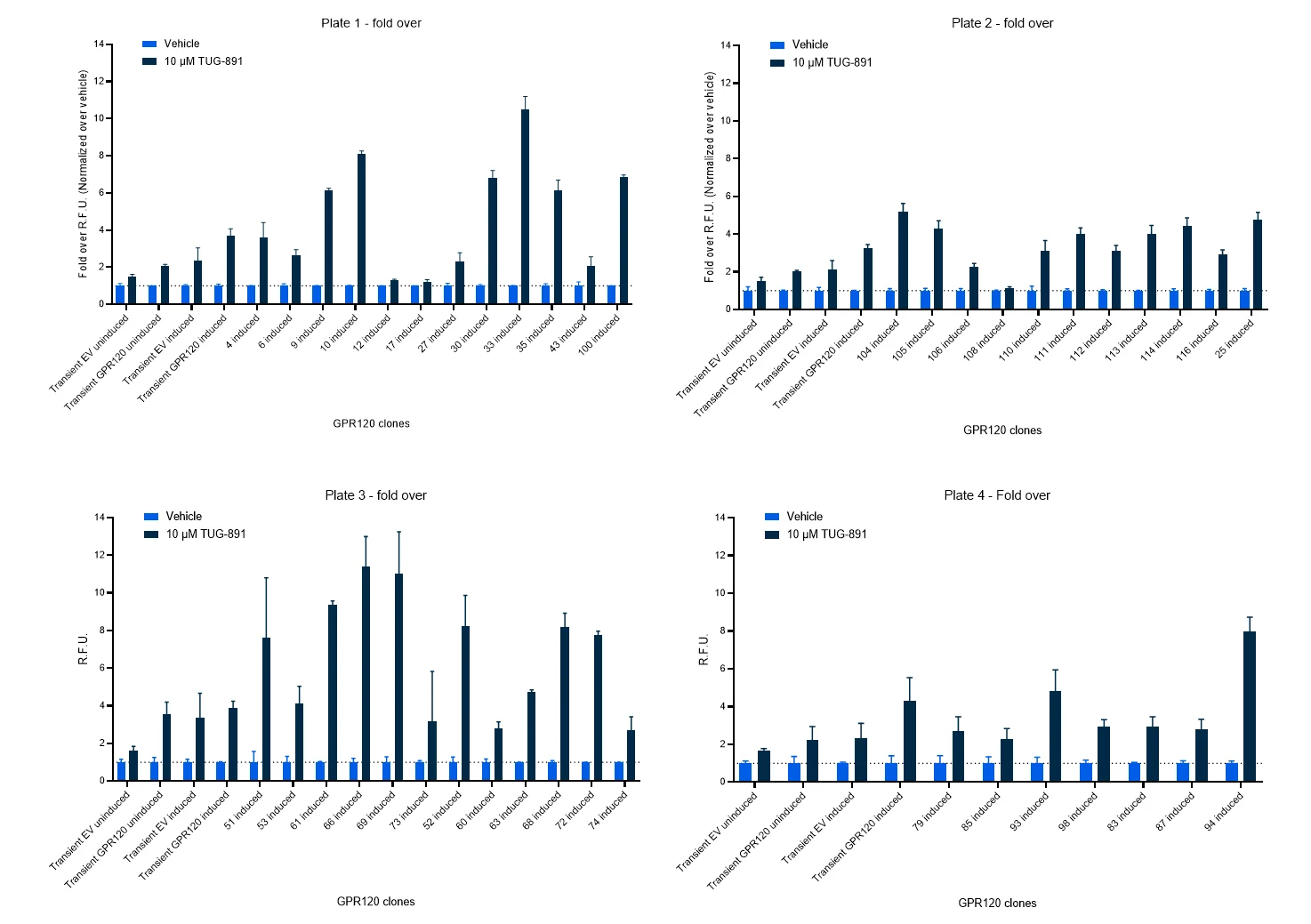
Stable transfectants were then generated and screened to identify clones capable of supporting robust calcium flux measurements. Several single cell-derived clones expressing GPR120 were evaluated to select those with the strongest assay performance (Figure 4). Once the best clone has been selected, assay optimization and further studies are carried out to pharmacologically characterize the selected clones, and a further stock generation of the selected clones is carried out. This ensures homogeneous receptor expression across stocks and their long-term availability.
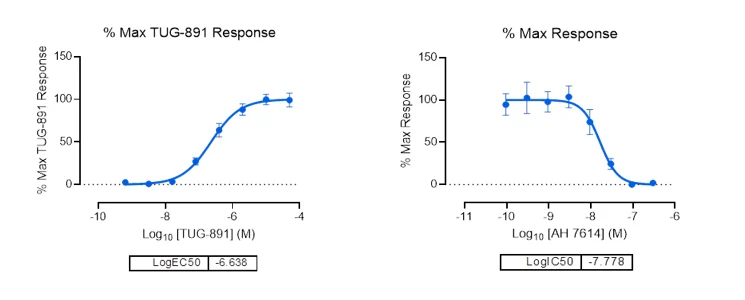
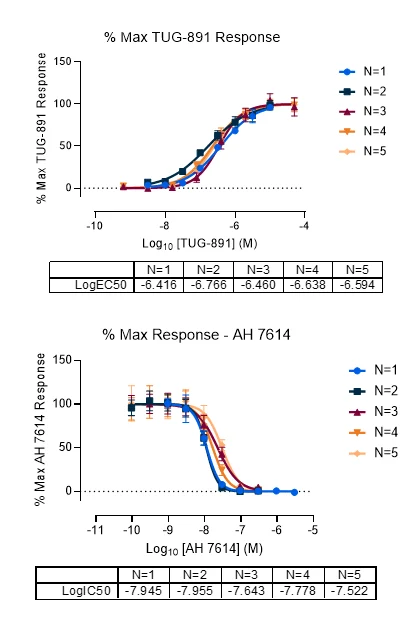
After selecting the best clone, this was subsequently characterized using both the selective agonist TUG-891 and the reference antagonist AH7614 to confirm pharmacological responsiveness and receptor-specific activity (Figure 5). The tests were carried out in different independent experiments to determine the assay reproducibility, as well as the consistency in GPR120 expression across passages of the same cell line (Figure 6).
This workflow, from construct validation through stable clone selection and pharmacological characterization, is essential for reducing risks in high throughput screening projects and generating confidence in downstream discovery decisions.
GPR120 is part of a broader family of metabolically relevant GPCR targets that continue to attract significant research investment.
Many drug discovery groups are increasingly evaluating targets such as GLP-1R, GIPR, GCGR, MC4R, Apelin receptors, and emerging orphan GPCRs as part of integrated metabolic disease strategies. The ability to evaluate these targets using validated, pathway-relevant assay platforms can help researchers compare mechanisms, assess selectivity, and better understand complex metabolic biology.
As therapeutic approaches evolve beyond single-target interventions, access to robust functional pharmacology platforms will remain an important component of metabolic drug discovery success.
Interest in GPR120 reflects a broader shift toward understanding and targeting the interconnected biology underlying metabolic disease.
As researchers seek novel approaches to address obesity, type 2 diabetes, and liver disease, GPR120 offers a compelling combination of biological relevance and therapeutic potential. However, realizing that potential depends on the ability to evaluate receptor function using robust, biologically meaningful screening tools.
By combining expertise in GPCR pharmacology, cell line engineering, assay development, and screening science, Sygnature Discovery has developed a screening-ready GPR120 platform designed to support the interrogation of this increasingly important metabolic target.



Peak Proteins, NuChem Sciences, and SB Drug Discovery have now fully integrated with Sygnature Discovery.