



Featured Resources
-
STORM Therapeutics: From Lead to Pre-Candidate Nomination in 18 Months

STORM Therapeutics: From Lead to Pre-Candidate Nomination in 18 Months
Case study




Discover precise insights into brain neurochemistry with Sygnature Discovery's in vivo microdialysis and cOFM services. With over 20 years of expertise, we design bespoke studies that reveal how compounds modulate neurotransmitter systems in health and disease. Using UHPLC/HPLC with electrochemical detection or mass spectrometry, we deliver robust PK/PD data to support confident CNS decision making.


July 30, 2015

Inobrodib, an exciting, first-in-class oral anti-cancer drug in clinical development by CellCentric, was collaboratively designed, synthesised and supported on its pre-clinical journey by an integrated project team at Sygnature Discovery. Inobrodib is now showing promising results in Phase I and II trials for multiple myeloma and other cancer types.

In drug discovery, generating targets is no longer the challenge. The real question is how to identify the few worth investing months of research and significant resources to pursue. Hear expert perspectives on how AI, pathway analysis and scientific expertise are shaping modern target identification.
July 7, 2026

Stay up to date with the latest company updates, milestones, and announcements.
Explore upcoming conferences and scientific meetings where you can connect with our team.

At Sygnature Discovery, we deliver world-leading drug discovery solutions to accelerate your compound from idea to clinic.

Our leadership team brings diverse experience and insight, driving collaboration and innovation across drug discovery.

Explore careers at Sygnature Discovery and join a global team committed to science, collaboration, and integrity.
Inobrodib, an exciting, first-in-class oral anti-cancer drug in clinical development by CellCentric, was collaboratively designed, synthesised and supported on its pre-clinical journey by an integrated project team at Sygnature Discovery. Inobrodib is now showing promising results in Phase I and II trials for multiple myeloma and other cancer types.
At Sygnature Discovery, we deliver world-leading drug discovery solutions to accelerate your compound from idea to clinic.
Our leadership team brings diverse experience and insight, driving collaboration and innovation across drug discovery.
Explore careers at Sygnature Discovery and join a global team committed to science, collaboration, and integrity.
Well-known for its capability for rapid screening, it’s particularly well-suited for most analgesic targets. The model delves into both central and peripheral mechanisms of pain, with its Phase 2 often regarded as a ‘surrogate’ for neuropathic pain models, thereby expanding its utility.
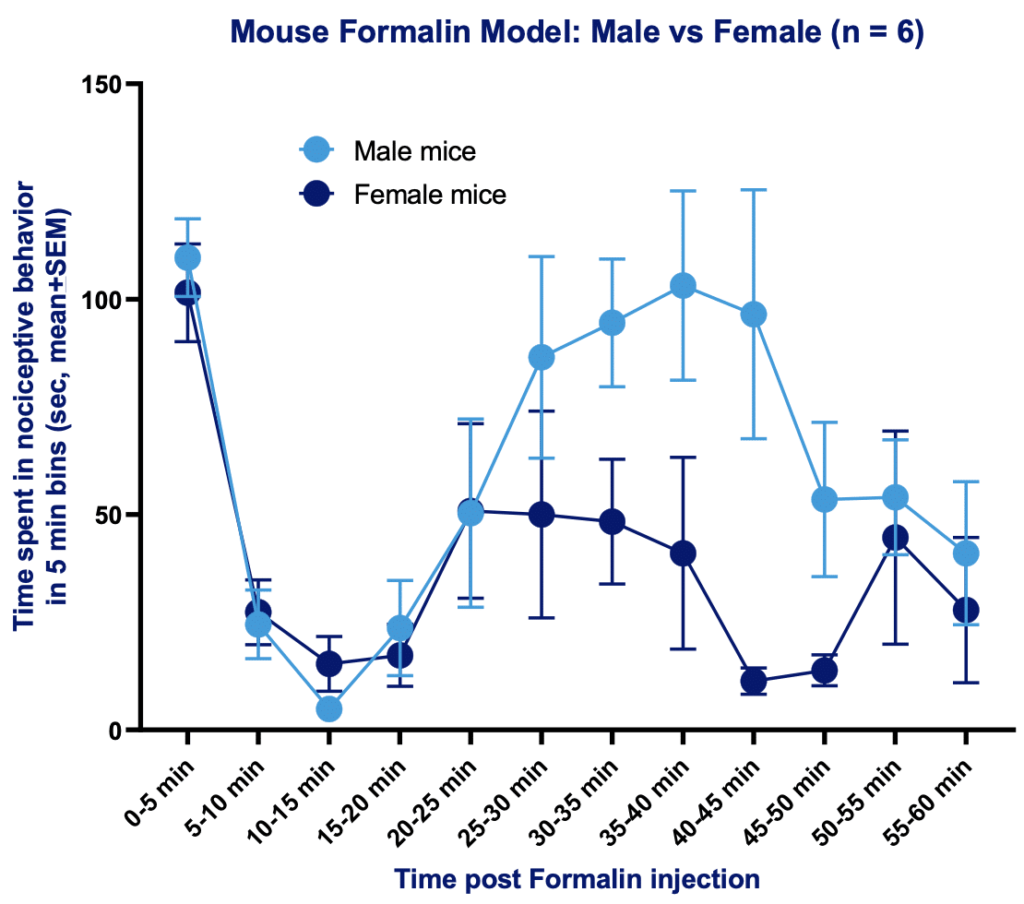
The induction of this model involves the careful injection of a diluted formalin solution into the mouse’s paw. Post-injection, observable behaviors such as biting, licking, and guarding provide crucial indicators of pain reactions. The model’s response is classified into two distinct phases, 0-5 minutes representing Phase 1, and the duration from 15-60 minutes designated as Phase 2 while 5-15 minutes represents a quiescent interphase.
Sygnature Discovery’s standard study design for this model generally comprises 4-6 groups, with each group containing 10 subjects to maintain data integrity and robustness. A range of positive controls, including Duloxetine, Gabapentin, Mexiletine, and Diclofenac, have been tested to ascertain the model’s reliability and scope. To ensure consistent results and uphold the highest standards of scientific investigation, the model is meticulously validated for the C57BL6 mouse species.
In the comprehensive evaluation of the mouse-formalin pain model, a salient observation is the pronounced pain response exhibited by male mice compared with the females, a factor that underpins our choice to utilize males for the model. Their heightened sensitivity offers a more robust platform to discern and quantify pain reactions, making the analysis more nuanced and informative.
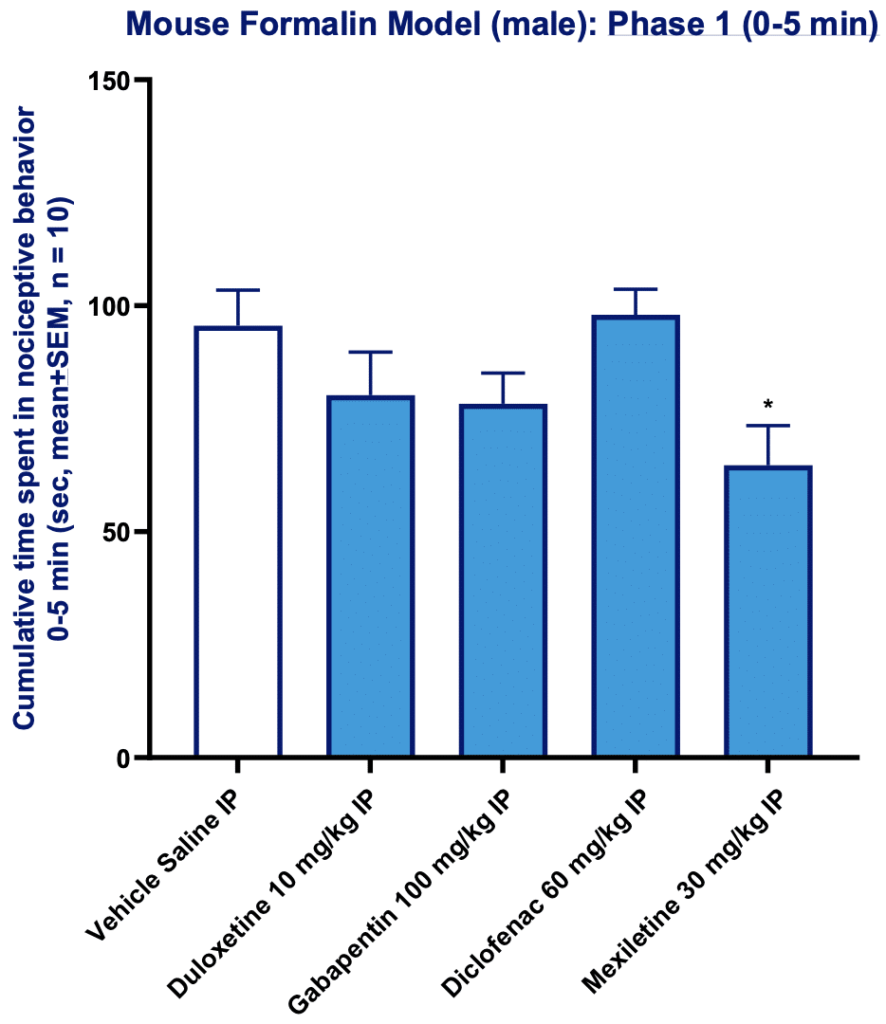
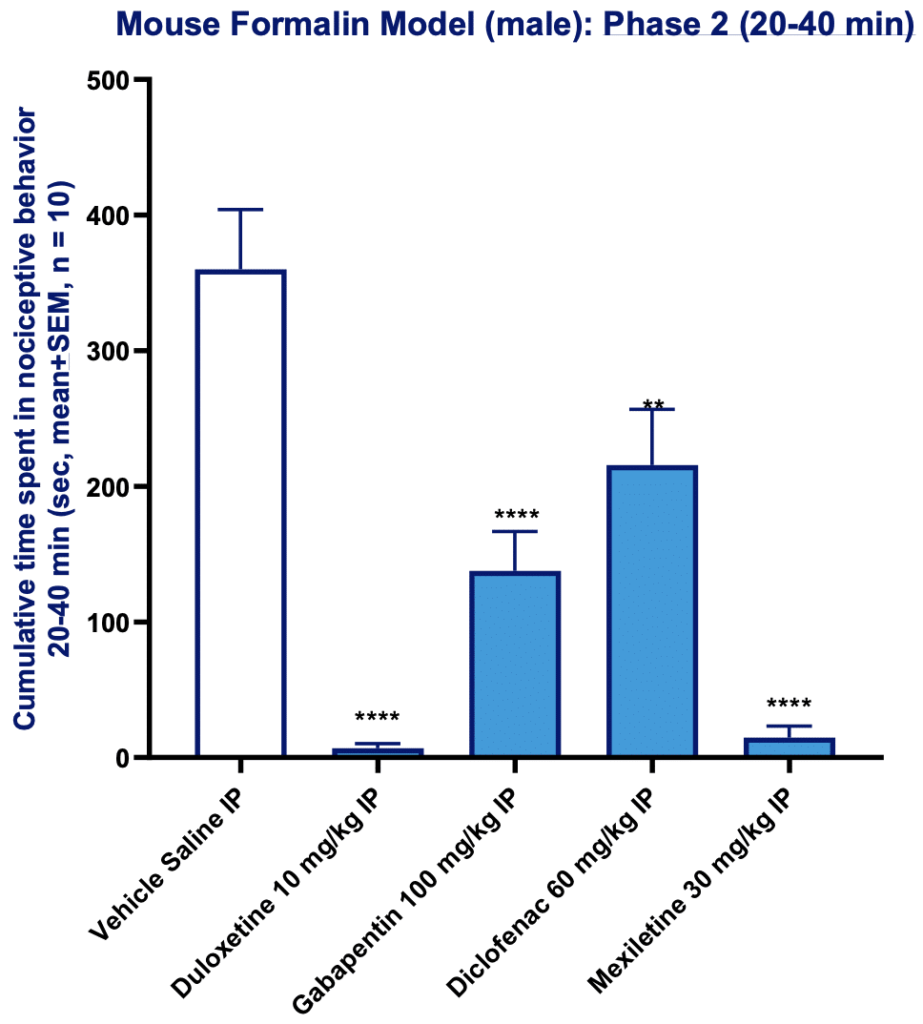
The four clinically used prototype analgesic drugs were then tested in male mice in this model. For rapid screening purpose, 0-5 minutes and 20-40 minutes are often taken as representation of Phase 1 and Phase 2, respectively, of this model. In the Phase 1 of formalin pain model, except for Mexiletine producing a very minor analgesic effect, none of the other analgesic drugs could produce any analgesia. In the Phase 2 of formalin pain model, all four analgesic drugs produced significant and strong analgesic effects indicating higher back-transitional face value of the Phase 2 of formalin pain model. The order of analgesia of the four analgesic drugs was as follows: duloxetine ˃ mexiletine ˃ gabapentin ˃ diclofenac, which is also consistent with their clinical efficacy often seen in chronic pain. In this regard, it’s crucial to accentuate the predictive prowess of Phase 2 within the model. This phase, replicating certain facets of neuropathic pain, proves especially potent in forecasting the potential of analgesic targets. The pronounced responsiveness in Phase 2 serves as an invaluable predictor, often aligning closely with the efficacy and mode of action of analgesic compounds. In essence, the male mouse as the chosen specimen, coupled with the distinct utility of Phase 2, augments the mouse-formalin pain model’s credibility and value in our quest to decipher and modulate pain pathways.

Peak Proteins, NuChem Sciences, and SB Drug Discovery have now fully integrated with Sygnature Discovery.