



Featured Resources
-
STORM Therapeutics: From Lead to Pre-Candidate Nomination in 18 Months

STORM Therapeutics: From Lead to Pre-Candidate Nomination in 18 Months
Case study




Discover precise insights into brain neurochemistry with Sygnature Discovery's in vivo microdialysis and cOFM services. With over 20 years of expertise, we design bespoke studies that reveal how compounds modulate neurotransmitter systems in health and disease. Using UHPLC/HPLC with electrochemical detection or mass spectrometry, we deliver robust PK/PD data to support confident CNS decision making.


July 30, 2015

Inobrodib, an exciting, first-in-class oral anti-cancer drug in clinical development by CellCentric, was collaboratively designed, synthesised and supported on its pre-clinical journey by an integrated project team at Sygnature Discovery. Inobrodib is now showing promising results in Phase I and II trials for multiple myeloma and other cancer types.

In drug discovery, generating targets is no longer the challenge. The real question is how to identify the few worth investing months of research and significant resources to pursue. Hear expert perspectives on how AI, pathway analysis and scientific expertise are shaping modern target identification.
July 7, 2026

Stay up to date with the latest company updates, milestones, and announcements.
Explore upcoming conferences and scientific meetings where you can connect with our team.

At Sygnature Discovery, we deliver world-leading drug discovery solutions to accelerate your compound from idea to clinic.

Our leadership team brings diverse experience and insight, driving collaboration and innovation across drug discovery.

Explore careers at Sygnature Discovery and join a global team committed to science, collaboration, and integrity.
Inobrodib, an exciting, first-in-class oral anti-cancer drug in clinical development by CellCentric, was collaboratively designed, synthesised and supported on its pre-clinical journey by an integrated project team at Sygnature Discovery. Inobrodib is now showing promising results in Phase I and II trials for multiple myeloma and other cancer types.
At Sygnature Discovery, we deliver world-leading drug discovery solutions to accelerate your compound from idea to clinic.
Our leadership team brings diverse experience and insight, driving collaboration and innovation across drug discovery.
Explore careers at Sygnature Discovery and join a global team committed to science, collaboration, and integrity.
One of the well-established eukaryotic expression systems used at Peak Proteins for expressing secreted, intracellular and membrane proteins is the flashBACTM baculovirus insect cell system (licensed from Oxford Expression Technologies (OET). We routinely use Sf9 and Sf21 cultured insect cells isolated from Spodoptera frugiperda (Fall Armyworm). Different clients often express a preference for one cell line over the other and we wanted a better understanding of which cell host is likely to be preferable. Fluorescent proteins, including the monomeric bright red fluorescent protein mCherry derived from dSRed of Discosoma sea anemones, are a powerful tool for cell biology. We utilised a 6-His tagged mCherry construct to undertake a simple time course in Sf9 and Sf21 cells.
Sf9 cells were used to directly generate intracellular mCherry recombinant P0 virus. In this study, either Sf21 cells or Sf9 cells at a point of infection cell density of 2.5x10⁶cells/ml were then infected with this recombinant baculovirus to produce the mCherry red fluorescent protein. Samples were taken at 24 hr, 48 hr, 72 hr and 96 hr post-infection.
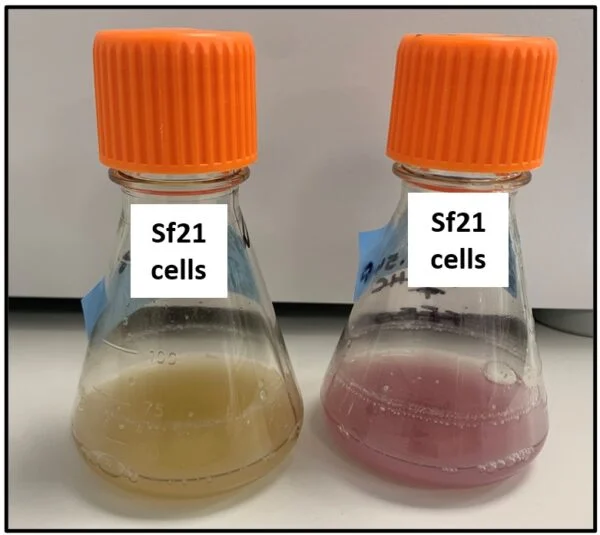
Sf21 cells infected with recombinant 6His tagged mCherry baculovirus were harvested 48 hours post infection. Cells were spun down and protein was purified from the pellet using Nickel-NTA affinity chromatography. ES-MS/MS peptide-mapping confirmed the presence of mCherry.
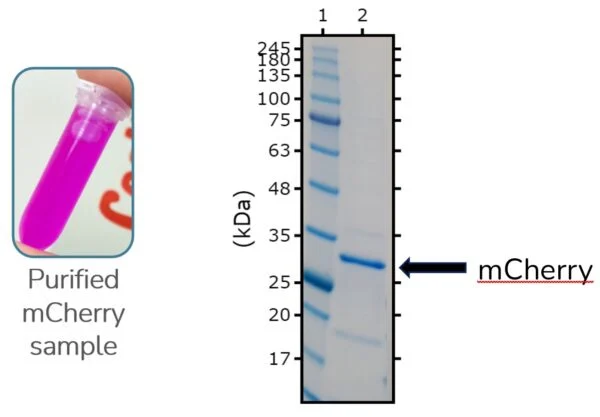
Purified mCherry was used to create a calibration curve of known concentrations using a 96-well fluorescence microplate reader. Samples taken from Sf9 and Sf21 cells infected with mCherry baculovirus were read on a fluorescence microplate reader. The calibration curve was used to identify the concentration of intracellular mCherry protein expression in each sample taking into account the cell viability.
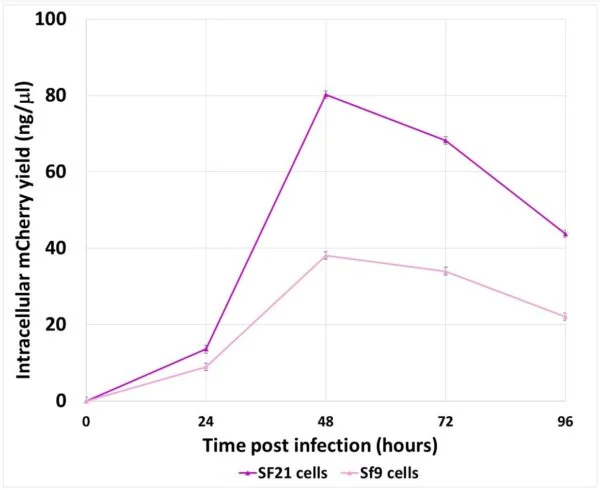
There is significantly greater intracellular mCherry protein expression in Sf21 cells compared to Sf9 cells validating why Sf21 cells are our insect cell line of choice for intracellular protein expression. We routinely harvest expression cultures 48 hours post infection with recombinant virus and this study confirms this time-point gives optimum protein expression.
Studies with secreted mCherry recombinant virus are now taking place to further investigate optimum cell lines and conditions for secreted proteins in the flashBACTM baculovirus insect cell system. Furthermore, quantification of secreted or intracellular mCherry expression levels are proving to be valuable controls in our mammalian expression systems, highlighting what a powerful tool mCherry protein is in cell biology protein expression studies.



Peak Proteins, NuChem Sciences, and SB Drug Discovery have now fully integrated with Sygnature Discovery.