


Ressources
-
STORM Therapeutics: From Lead to Pre-Candidate Nomination in 18 Months

STORM Therapeutics: From Lead to Pre-Candidate Nomination in 18 Months
Case study




Discover precise insights into brain neurochemistry with Sygnature Discovery's in vivo microdialysis and cOFM services. With over 20 years of expertise, we design bespoke studies that reveal how compounds modulate neurotransmitter systems in health and disease. Using UHPLC/HPLC with electrochemical detection or mass spectrometry, we deliver robust PK/PD data to support confident CNS decision making.


juillet 30, 2015

Inobrodib, an exciting, first-in-class oral anti-cancer drug in clinical development by CellCentric, was collaboratively designed, synthesised and supported on its pre-clinical journey by an integrated project team at Sygnature Discovery. Inobrodib is now showing promising results in Phase I and II trials for multiple myeloma and other cancer types.

In drug discovery, generating targets is no longer the challenge. The real question is how to identify the few worth investing months of research and significant resources to pursue. Hear expert perspectives on how AI, pathway analysis and scientific expertise are shaping modern target identification.
juillet 7, 2026

Tenez‑vous au courant des dernières mises à jour de l’entreprise, des étapes clés et des annonces importantes.
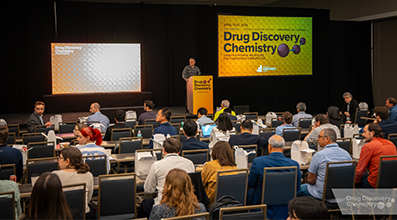
Découvrez les conférences et rencontres scientifiques à venir, où vous pourrez échanger avec notre équipe.

Chez Sygnature Discovery, nous fournissons des solutions de découverte de médicaments de classe mondiale pour accélérer la progression de vos composés, de l’idée jusqu’à la clinique.

Notre équipe de direction rassemble une diversité d’expériences et de ressources, favorisant la collaboration et l’innovation dans l’ensemble du processus de découverte de médicaments.

Explorez les opportunités de carrière chez Sygnature Discovery. Rejoignez une équipe internationale qui obtient des résultats exceptionnels grâce à la collaboration, à l’innovation et à l’intégrité.
Inobrodib, an exciting, first-in-class oral anti-cancer drug in clinical development by CellCentric, was collaboratively designed, synthesised and supported on its pre-clinical journey by an integrated project team at Sygnature Discovery. Inobrodib is now showing promising results in Phase I and II trials for multiple myeloma and other cancer types.
Chez Sygnature Discovery, nous fournissons des solutions de découverte de médicaments de classe mondiale pour accélérer la progression de vos composés, de l’idée jusqu’à la clinique.
Notre équipe de direction rassemble une diversité d’expériences et de ressources, favorisant la collaboration et l’innovation dans l’ensemble du processus de découverte de médicaments.
Explorez les opportunités de carrière chez Sygnature Discovery. Rejoignez une équipe internationale qui obtient des résultats exceptionnels grâce à la collaboration, à l’innovation et à l’intégrité.
Successful drug discovery begins with a detailed understanding of target biology and the signaling pathways that underpin disease. Translating this understanding into robust cellular models and screening assays is critical for identifying and progressing new therapeutics. For emerging targets, this requires more than assay development alone. It demands cellular systems that accurately reproduce complex signaling biology while delivering the robustness required for screening, lead optimization and characterization.
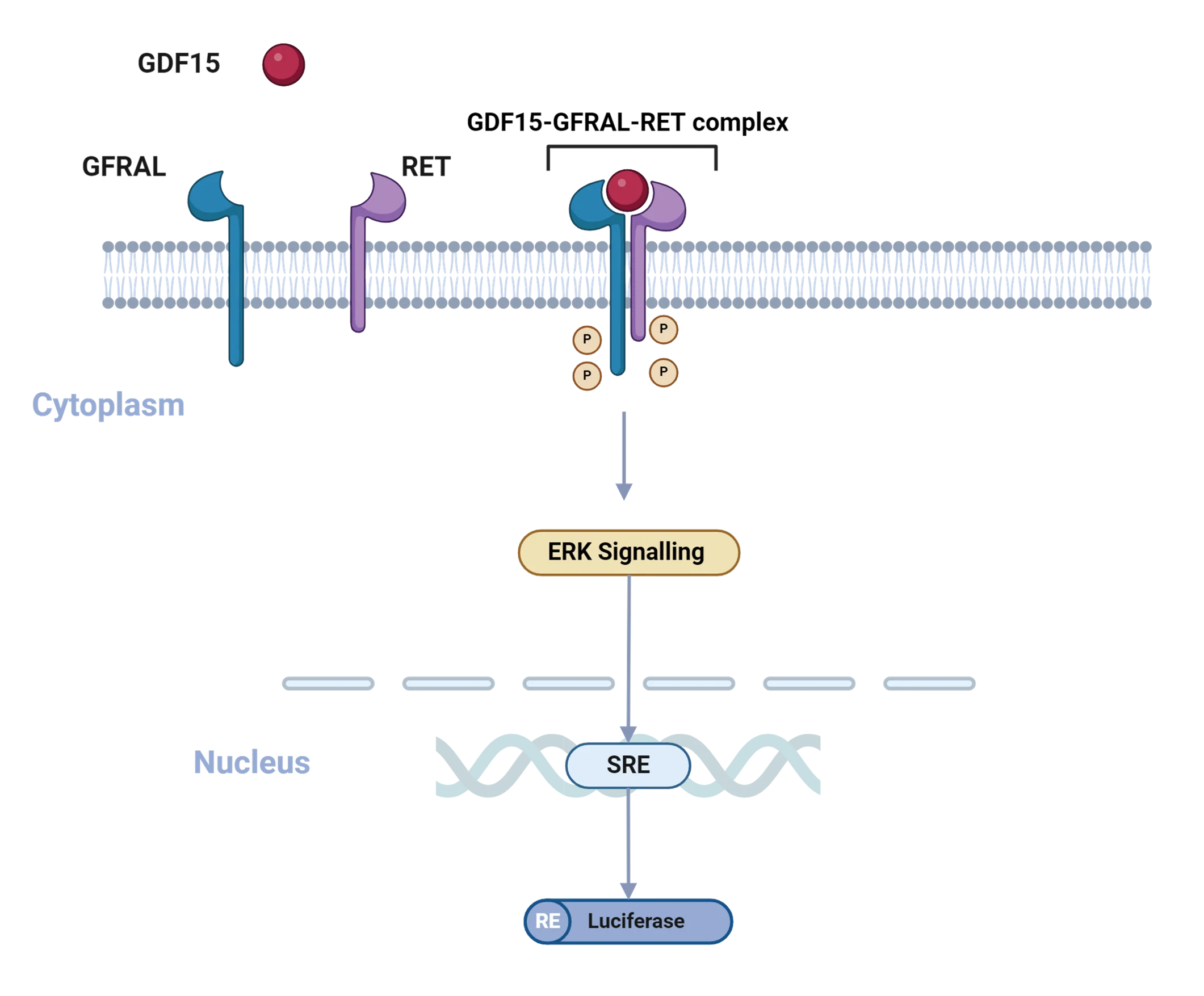
This challenge was central to a program focused on the GDF15-GFRAL pathway, an emerging therapeutic target attracting significant interest in metabolic disease, obesity, cachexia and oncology. GDF15 signaling is mediated through binding to GFRAL, which subsequently recruits the RET co-receptor to activate downstream signaling pathways, including ERK (Figure 1). Successfully modelling this biology requires coordinated expression of multiple receptor components while maintaining functional coupling to intracellular signaling mechanisms, creating a significant challenge for cell line generation and assay development.
To address these challenges, Sygnature Discovery combined expertise in cell line generation, receptor pharmacology and assay development to establish a stable inducible GDF15-GFRAL-RET cellular platform and complementary assay formats that support both compound screening and pharmacological confirmation.
Establishing receptor expression is only the first stage of development. For a cell line to support drug discovery, it must demonstrate robust, reproducible and pharmacologically meaningful responses to pathway activation.
Our team therefore implemented an extensive clone selection strategy focused on functional performance. HEK cells were engineered to co-express GFRAL and RET under an inducible system and expressing (induced) and non-expressing (uninduced) clones were screened using a pERK ELISA assay to identify cell populations capable of generating robust and reproducible responses to GDF15 stimulation (Figure 2).
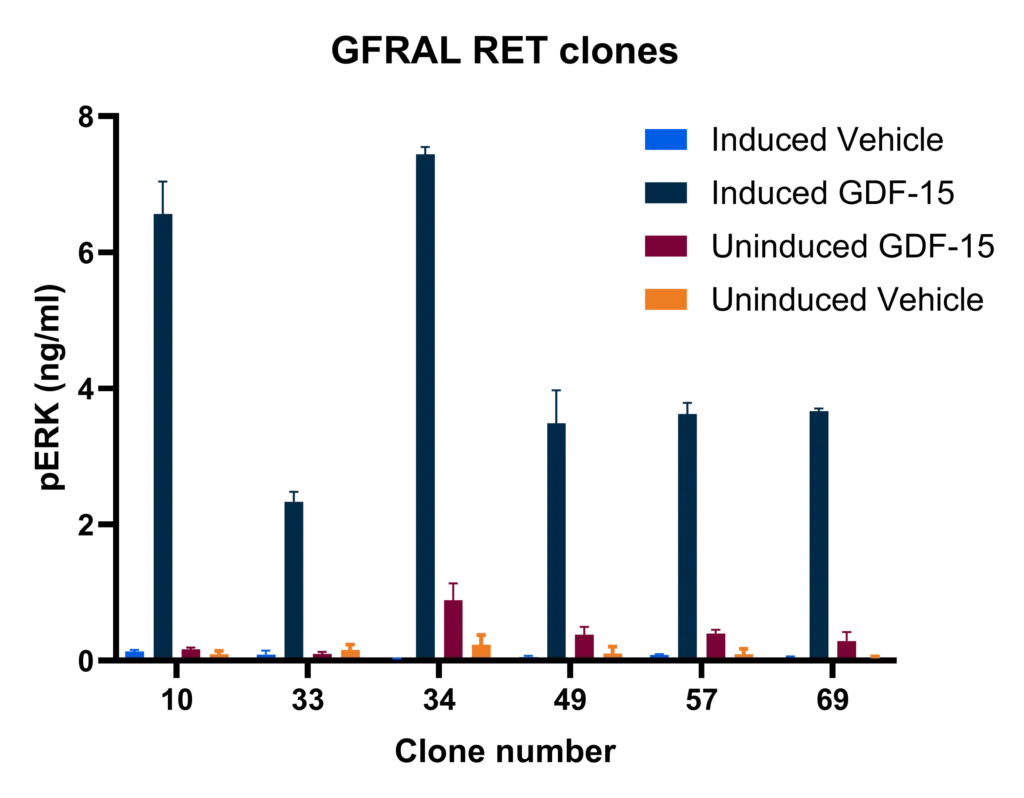
Screening revealed significant differences in pathway responsiveness between candidate clones, highlighting the importance of rigorous functional validation during cell line development. Through systematic evaluation, scientists identified clones that combined strong signal generation, reproducible pharmacology and the stability required for downstream screening applications.
For drug discovery teams, this stage is critical. Selecting the correct clone can determine whether an assay delivers meaningful insight or becomes limited by variability and poor assay performance.
A robust signal alone is insufficient for modern drug discovery. As part of our quality control process, assay reproducibility is evaluated across multiple test days.
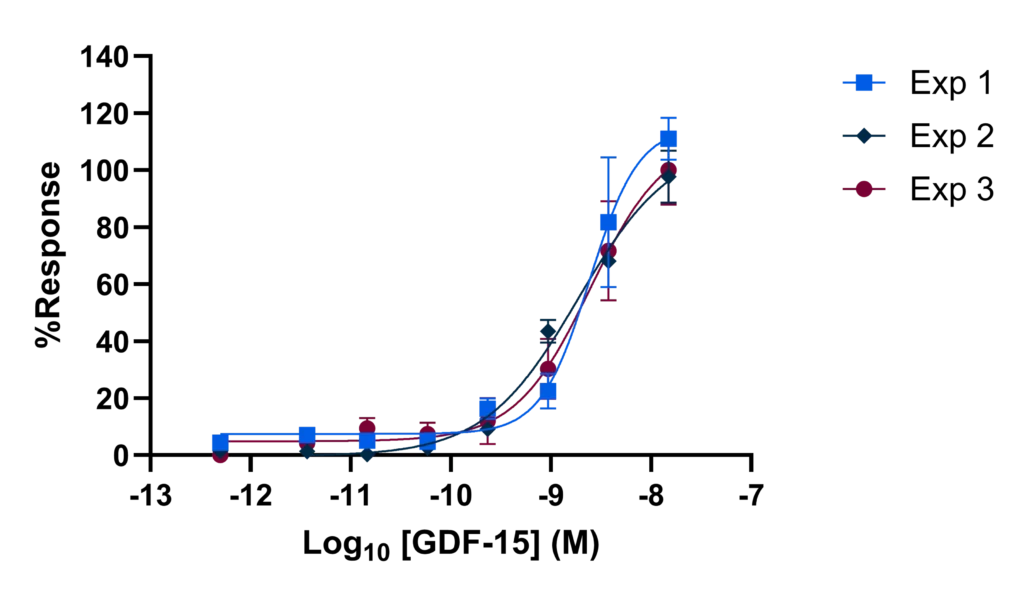
To evaluate platform stability, top-performing clones were tested across multiple independent experiments using GDF15 stimulation (Figure 3). The resulting concentration-response curves showed a high degree of agreement across studies, demonstrating stable pathway activation and sustained performance over time. This level of consistency is essential for drug discovery, providing confidence that compound activity can be measured reliably and reflects authentic target biology, while supporting progression into larger screening campaigns.
While pERK assays provide a biologically relevant measure of pathway activation, their transient nature makes them highly time dependent. To expand platform utility, Sygnature Discovery developed an SRE-luciferase reporter assay in selected GFRAL/RET clones, providing a robust high-throughput readout (Figure 4). Individual reporter clones were subsequently screened for assay performance (Figure 5).
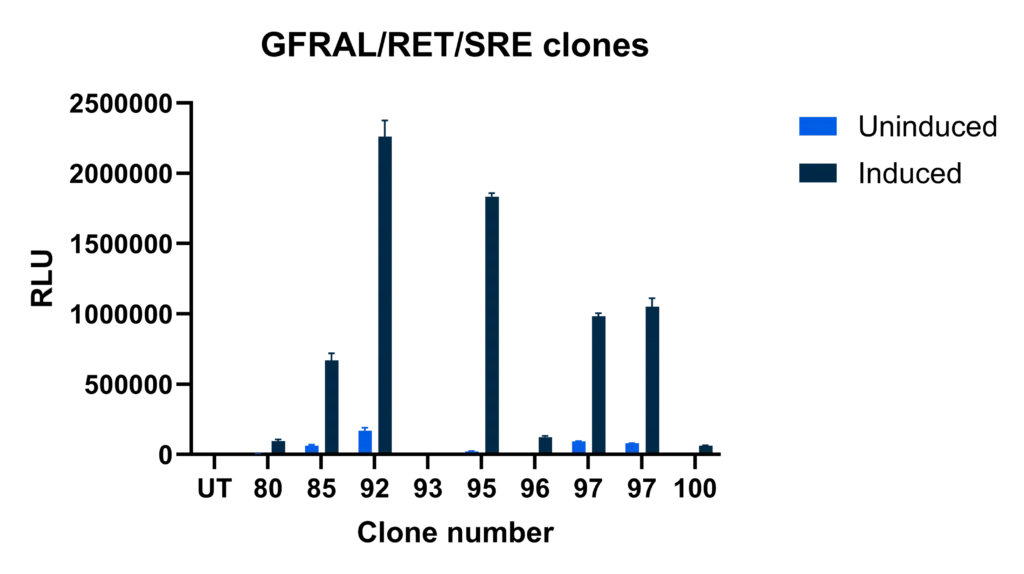
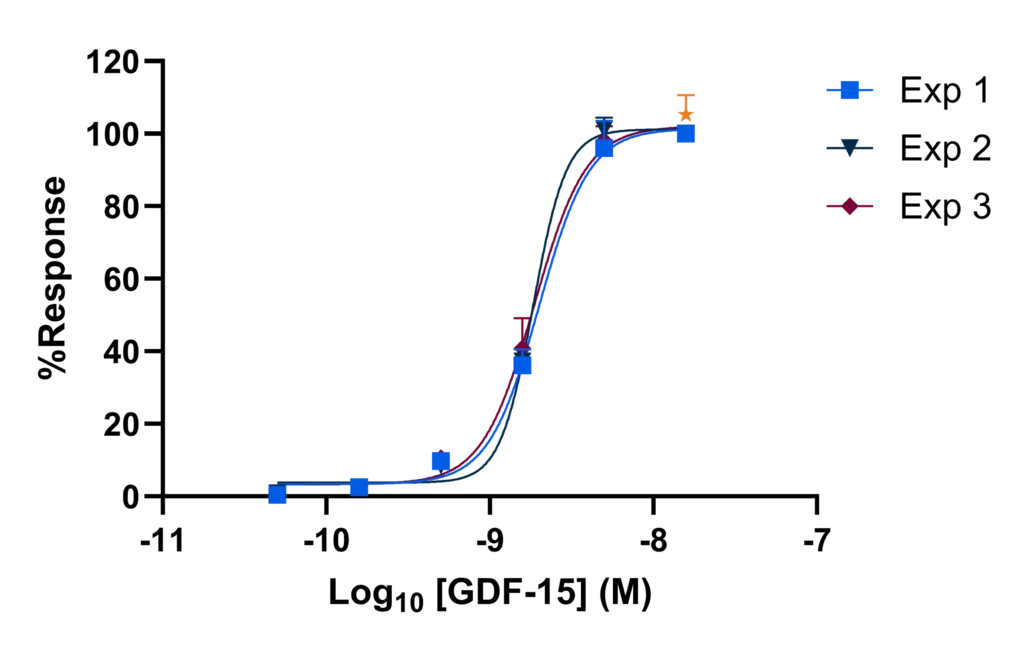
The development of this reporter system transformed the platform from a single functional assay into a flexible, high-throughput screening solution capable of supporting multiple stages of a discovery program. Coupled with a sensitive luciferase readout, the assay can be readily deployed in 96-, 384- or 1536-well formats, enabling efficient screening of large compound libraries.
Establishing Pharmacological Consistency Across Orthogonal Assay Formats
A key objective was to ensure that both assay formats accurately reflected the underlying GDF15-GFRAL-RET biology. GDF15-mediated activation and inhibitor X-mediated pathway inhibition were therefore evaluated in both the pERK and SRE reporter assays (Figure 6).
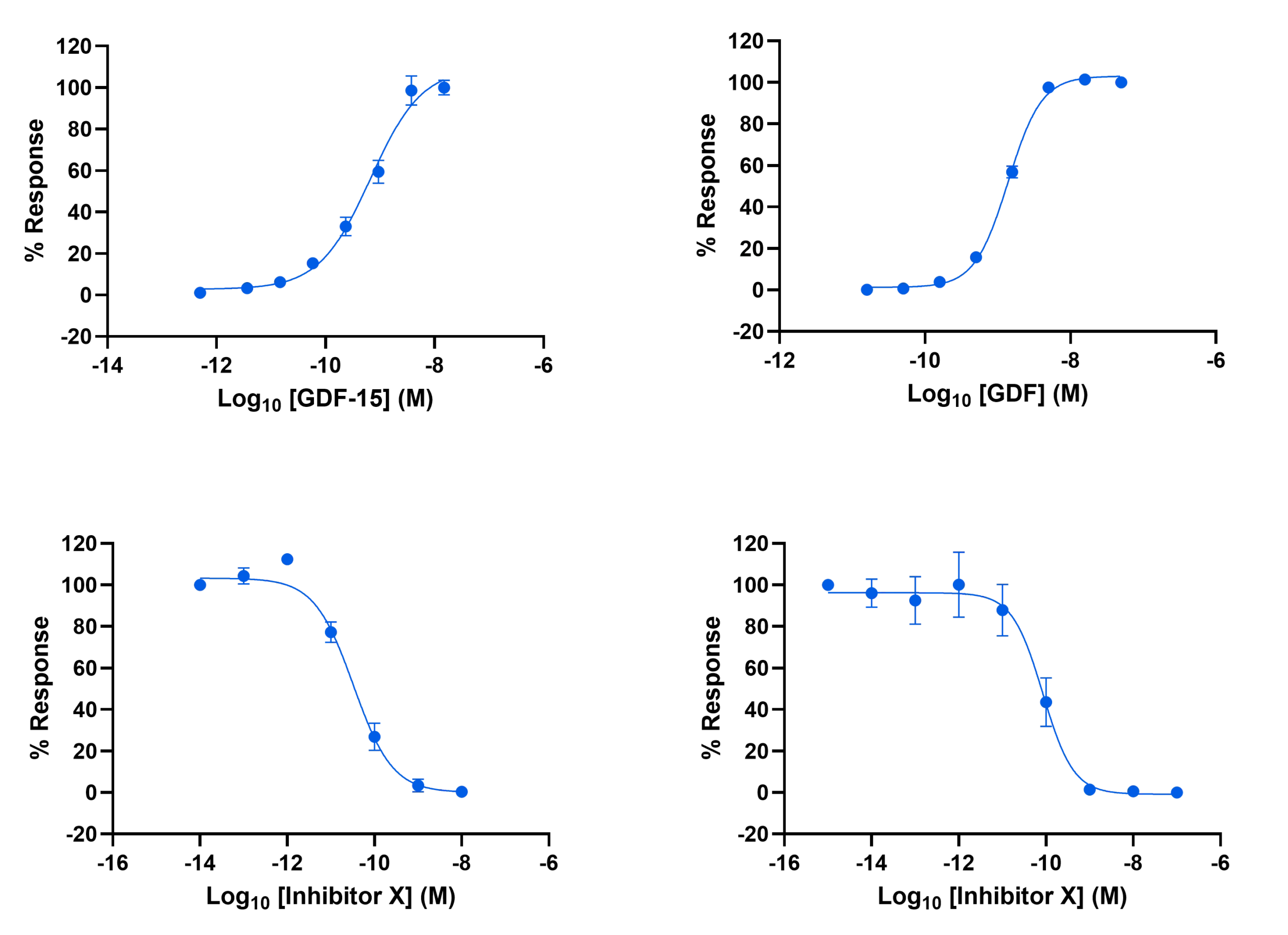
GDF15 produced concentration-dependent activation in both assay formats, with comparable EC50 values in the pERK and SRE assays. Inhibitor X likewise produced concentration-dependent inhibition across both readouts, demonstrating consistent pharmacology between proximal and downstream endpoints.
Together, the data supports the use of the SRE assay for high-throughput screening and the pERK assay for orthogonal confirmation of compound activity.
This project demonstrates Sygnature’s ability to combine cell line generation, receptor pharmacology and assay development to enable efficient drug discovery. Our scientists transformed a complex multi-component receptor system into a screening-ready platform that supports compound screening, hit confirmation and further pharmacological investigation.
If you are looking to develop cell lines and screening assays for challenging targets, contact Sygnature Discovery to discuss how we can support your discovery program.
Peak Proteins, NuChem Sciences et SB Drug Discovery sont désormais pleinement intégrés à Sygnature Discovery.