
It’s important to lay strong foundations for successful drug discovery at this first stage of the process. Our integrated target identification and validation platform combines AI with expert insights, and rigorous lab validation to guide targets through robust evaluation, ready for hit discovery.
Validated, high-quality hits, delivered through integrated technologies and expert collaboration, give you a confident starting point for faster drug discovery.
Turning promising leads into clinical candidates with speed, precision, and the scientific expertise to generate high-quality data and deliver real patient impact.
Delivering integrated, modality-agnostic drug discovery to tackle complex biology, accelerate development, and advance innovative therapies with confidence.
Advancing next-generation ADCs through payload-focused design, integrated expertise, and collaborative innovation to deliver safer, more selective therapies.
Driving biologics innovation through integrated design, structural biology, and multidisciplinary expertise to accelerate next-generation therapies from concept to clinic.
Combining deep therapeutic expertise with translational insight to design strategies, reduce risk, and accelerate discovery programs toward clinical success.
Accelerating oncology drug discovery through integrated expertise, innovative modalities, and translational insight to deliver candidates with real clinical impact.
Driving immunology and inflammation drug discovery through tailored assays, translational models, and integrated expertise for faster clinical success.
Advancing CNS drug discovery through integrated models, translational biomarkers, and multidisciplinary expertise to overcome complexity and accelerate therapeutic innovation.
Designing and advancing differentiated small-molecule therapies for obesity and diabetes through integrated expertise, mechanistic insight, and translational strategies.
Inobrodib, an exciting, first-in-class oral anti-cancer drug in clinical development by CellCentric, was collaboratively designed, synthesised and supported on its pre-clinical journey by an integrated project team at Sygnature Discovery. Inobrodib is now showing promising results in Phase I and II trials for multiple myeloma and other cancer types.
It’s important to lay strong foundations for successful drug discovery at this first stage of the process. Our integrated target identification and validation platform combines AI with expert insights, and rigorous lab validation to guide targets through robust evaluation, ready for hit discovery.
Validated, high-quality hits, delivered through integrated technologies and expert collaboration, give you a confident starting point for faster drug discovery.
Turning promising leads into clinical candidates with speed, precision, and the scientific expertise to generate high-quality data and deliver real patient impact.
Delivering integrated, modality-agnostic drug discovery to tackle complex biology, accelerate development, and advance innovative therapies with confidence.
Advancing next-generation ADCs through payload-focused design, integrated expertise, and collaborative innovation to deliver safer, more selective therapies.
Driving biologics innovation through integrated design, structural biology, and multidisciplinary expertise to accelerate next-generation therapies from concept to clinic.
Combining deep therapeutic expertise with translational insight to design strategies, reduce risk, and accelerate discovery programs toward clinical success.
Accelerating oncology drug discovery through integrated expertise, innovative modalities, and translational insight to deliver candidates with real clinical impact.
Driving immunology and inflammation drug discovery through tailored assays, translational models, and integrated expertise for faster clinical success.
Advancing CNS drug discovery through integrated models, translational biomarkers, and multidisciplinary expertise to overcome complexity and accelerate therapeutic innovation.
Designing and advancing differentiated small-molecule therapies for obesity and diabetes through integrated expertise, mechanistic insight, and translational strategies.
Inobrodib, an exciting, first-in-class oral anti-cancer drug in clinical development by CellCentric, was collaboratively designed, synthesised and supported on its pre-clinical journey by an integrated project team at Sygnature Discovery. Inobrodib is now showing promising results in Phase I and II trials for multiple myeloma and other cancer types.
Why Membrane Proteins Matter – and Why They’re So Hard to Study!
Over the coming months, we’ll be sharing a series of blog posts and case studies that aim to spotlight our work on membrane proteins: from protein production and structural biology to biophysical characterisation and drug discovery.
But before diving into the details, it’s worth stepping back to ask two fundamental questions:

Why do membrane proteins matter?
Why is working with them so uniquely challenging?
Why do we work with membrane proteins?
Personally, I believe that membrane proteins are among the most fascinating and functionally critical molecules in biology. These molecular machines are embedded in or associated with the phospholipid bilayer that surrounds every cell, acting as gatekeepers, messengers, and regulators of cellular behaviour.
Membranes are essential for life. Every living cell is defined by its membrane — a dynamic, selectively permeable barrier made of a phospholipid bilayer. This structure is impermeable to ions and hydrophilic molecules, meaning that without specialised proteins, essential processes like nutrient uptake, waste removal, and signal transduction simply wouldn’t happen.
Membrane proteins mediate communication and control. These proteins enable the movement of solutes, water, and ions across the membrane and are central to how cells sense and respond to their environment.
They are prime drug targets. Membrane proteins account for around two-thirds of all drug targets. G protein-coupled receptors (GPCRs) alone represent approximately 35% of approved drug targets, and about 12% of all protein targets with approved drugs are GPCRs1.
They hold the key to understanding disease. Because they regulate so many critical cellular functions, membrane proteins are often implicated in diseases ranging from cancer and cardiovascular disorders to neurological conditions and infectious diseases.
What do membrane proteins look like?
Membrane proteins come in a variety of structural forms, each adapted to their specific roles within the cell membrane. Broadly, they can be classified into several categories based on how they interact with the lipid bilayer:
Peripheral (or membrane-associated) proteins
These proteins are not embedded in the membrane itself but are loosely attached to either the inner or outer surface. They often interact with integral membrane proteins or with the polar head groups of lipids.
Integral membrane proteins
These span or are embedded within the membrane and can be further divided into two major structural classes:
Beta-barrel membrane proteins Found primarily in the outer membranes of bacteria, mitochondria, and chloroplasts, these proteins form cylindrical structures made of beta-sheets. They are less numerous in human cells but are important in certain transport and signalling functions.
Alpha-helical membrane proteins. These are the most common type in eukaryotic cells and can be further divided into:
Single-pass alpha-helical proteins, which cross the membrane once.
Multi-pass alpha-helical proteins, which weave in and out of the membrane multiple times.
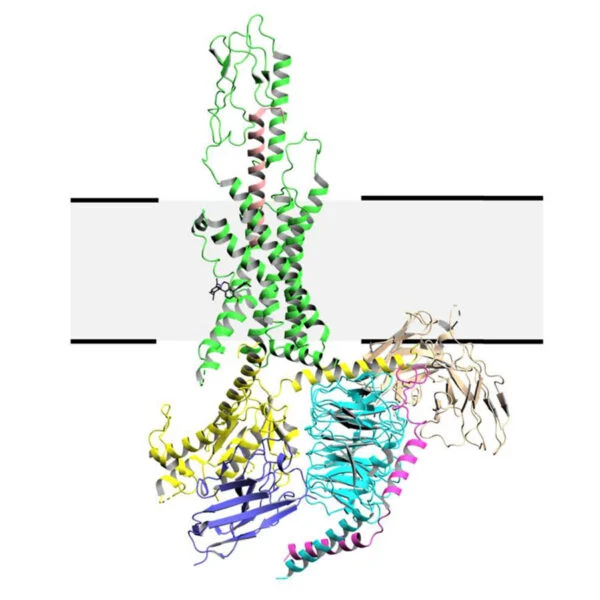
Among these, multi-pass alpha-helical membrane proteins are particularly significant — and notoriously difficult to work with. They include some of the most pharmacologically important protein families, such as G protein-coupled receptors (GPCRs), ion channels, and transporters.
These proteins are embedded within the membrane, making them challenging to express, purify, and stabilise outside of their native environment. Yet, because they play such central roles in cell signalling and homeostasis, they remain top priorities for drug discovery and structural biology.
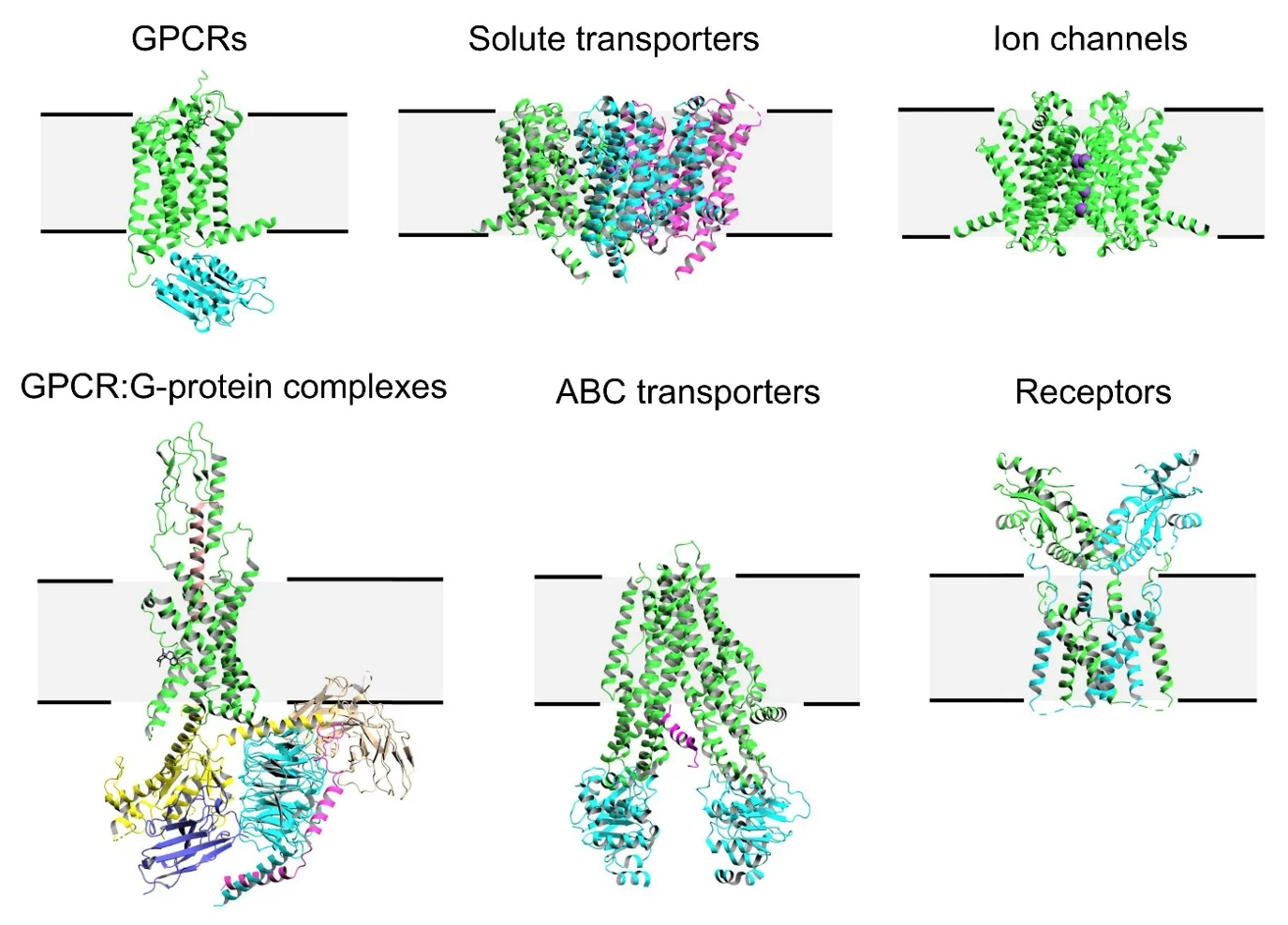
Multi-pass alpha-helical proteins – A snapshot of the membrane protein families that contain some of the most pharmacologically important targets, such as G protein-coupled receptors (GPCRs), ion channels, and transporters.
Why are membrane proteins so hard to work with?
Despite their biological importance and therapeutic potential, membrane proteins remain some of the most technically challenging targets in molecular biology and drug discovery.
Low expression yields. Unlike soluble proteins, membrane proteins are often expressed at very low levels in both native and recombinant systems. Achieving sufficient quantities for structural or functional studies can be a major bottleneck.
Extraction from the membrane. These proteins are embedded in the lipid bilayer, so they must be carefully solubilised using detergents or other membrane mimetics. The choice of solubilisation strategy can make or break downstream success.
Purification tag selection. Affinity tags are commonly used to purify proteins, but for membrane proteins, tag placement and type can significantly affect folding, stability, and function.
Labile and unstable nature. Human membrane proteins, in particular, are often fragile and prone to degradation or aggregation once removed from their native environment.
Unfolding or inactivation during purification. Even if expression and solubilisation are successful, membrane proteins can lose their native conformation or activity during purification — especially if handled under non-physiological conditions.
Lack of generic quality control assays. Assessing whether a membrane protein is properly folded and functional is not straightforward. Unlike soluble proteins, there are few universal assays, and many require custom development.
These challenges underscore the need for specialised expertise, tools, and workflows – which is exactly what we aim to highlight in this blog series.
What happens after purification?
Purifying membrane proteins is a major milestone — but it’s often just the beginning. Within the Protein Sciences department at Sygnature Discovery, we support a range of downstream applications, whether that means delivering high-quality reagents to our clients or carrying out further analysis in-house.
High-Quality Protein Reagents
We routinely produce membrane proteins for delivery as research-grade reagents. These are suitable for a wide range of downstream applications, whether performed by your team or as part of a broader collaboration with us. Every batch is produced with a focus on yield, purity, and functional integrity.
In-House Expertise for Downstream Characterisation
When required, we can take your membrane protein research to the next stage in-house and apply a suite of techniques to further characterise and validate membrane proteins. These include:
Microscale Thermophoresis (MST) – interaction quantification in solution
Thermal Shift Assays (TSA, CPM assay) – protein stability profiling
Flow-Induced Dispersion Analysis (FIDA) – sizing and interaction studies
Structural Biology
To gain atomic-level insights into structure and mechanism:
Lipidic Cubic Phase (LCP) Crystallisation and X-ray Diffraction – for high-resolution structures
Cryo-Electron Microscopy (Cryo-EM) – ideal for large, flexible, or complex membrane proteins
These capabilities allow us to not only confirm the quality of the protein but also generate valuable insights into its mechanism, function, and drugability
Conclusion
We hope this short article has given you a sense of why we’re so passionate about membrane protein research — and why producing high-quality membrane protein tools is essential for advancing both basic science and drug discovery.
References
Sriram K, Insel PA. G Protein-Coupled Receptors as Targets for Approved Drugs: How Many Targets and How Many Drugs? doi: 10.1124/mol.117.111062