


Featured Resources
-
STORM Therapeutics: From Lead to Pre-Candidate Nomination in 18 Months

STORM Therapeutics: From Lead to Pre-Candidate Nomination in 18 Months
Case study
📣From lead to pre-candidate nomination in 18 months. Explore the STORM Therapeutics case study




July 30, 2015

Inobrodib, an exciting, first-in-class oral anti-cancer drug in clinical development by CellCentric, was collaboratively designed, synthesised and supported on its pre-clinical journey by an integrated project team at Sygnature Discovery. Inobrodib is now showing promising results in Phase I and II trials for multiple myeloma and other cancer types.

At Sygnature Discovery, we deliver world-leading drug discovery solutions to accelerate your compound from idea to clinic.

Our leadership team brings diverse experience and insight, driving collaboration and innovation across drug discovery.

Explore careers at Sygnature Discovery and join a global team committed to science, collaboration, and integrity.
Inobrodib, an exciting, first-in-class oral anti-cancer drug in clinical development by CellCentric, was collaboratively designed, synthesised and supported on its pre-clinical journey by an integrated project team at Sygnature Discovery. Inobrodib is now showing promising results in Phase I and II trials for multiple myeloma and other cancer types.
At Sygnature Discovery, we deliver world-leading drug discovery solutions to accelerate your compound from idea to clinic.
Our leadership team brings diverse experience and insight, driving collaboration and innovation across drug discovery.
Explore careers at Sygnature Discovery and join a global team committed to science, collaboration, and integrity.
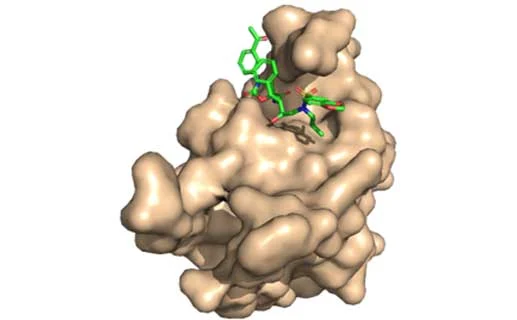
Understanding how small molecules interact with proteins is central to drug discovery and Nuclear Magnetic Resonance (NMR) offers a uniquely sensitive approach to probing these interactions. Whether you’re screening fragments, validating hits, or exploring binding kinetics, NMR provides insights that complement other structural techniques and help guide decision-making throughout the discovery pipeline.
Nuclear Magnetic Resonance (NMR) is a technique that exploits the magnetic properties of certain atomic nuclei — most commonly hydrogen (1H), carbon (13C), nitrogen (15N) ), and phosphorus (31P) — to gain detailed information about molecular structure and dynamics.
Unlike crystallography, protein NMR allows the investigation of proteins in solution, thereby more closely mimicking physiological conditions. Furthermore, it can cope with folded, intrinsically disordered and highly dynamic proteins. This makes it ideal for probing dynamic processes such as conformational changes, binding kinetics, and allosteric modulation. The technique does of course have its limitations. (see our structure technique comparison blog for more details). In general, the protein has to be produced in E. coli, cell free or insect cell systems to allow specific labelling. However, for ligand observed (LO)-NMR the protein can be unlabelled and therefore produced in any expression host cell line.
Protein NMR is a versatile and sensitive technique that plays a valuable role in small molecule drug discovery. It enables researchers to observe molecular interactions in solution, offering insights into binding events, kinetics, and conformational changes, often in ways that other structural methods cannot. Below are some of the key ways we apply NMR in our drug discovery workflows:
1. Protein:Ligand interactions
2. Investigating dynamic processes upon compound binding
3. 3D structure of proteins and protein complexes
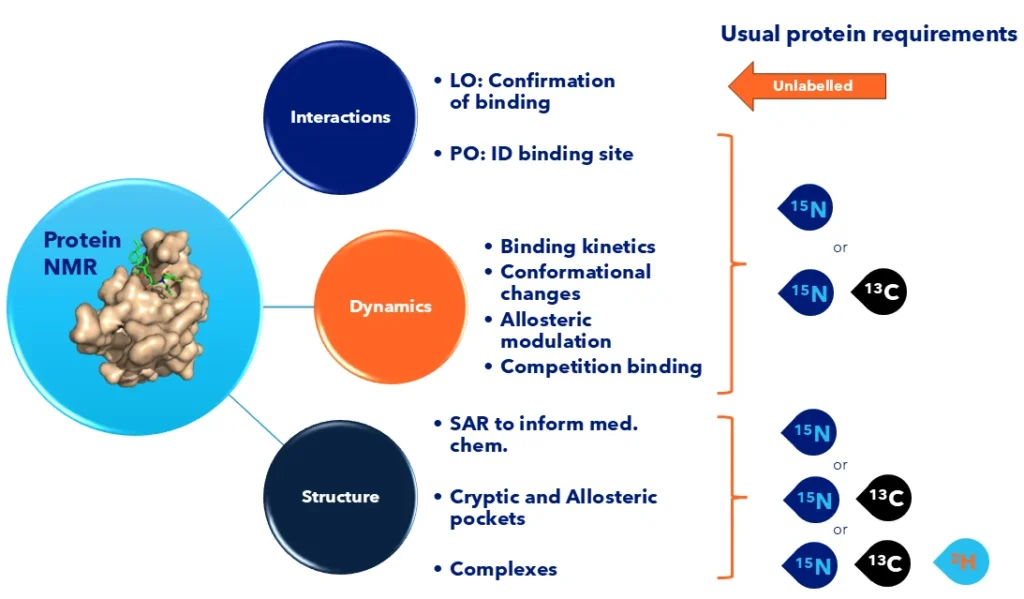
Protein NMR is especially valuable as a follow up in fragment-based drug discovery (FBDD), where small molecular fragments are initially screened for binding to target proteins. We then use ligand observed LO- NMR to confirm binding of the fragments using unlabelled protein and follow up with protein observed PO-NMR (requiring uniform 15N labelled protein) aiming to identify the site of binding at the amino acid level. This can be a critical part of the hit triage process and allows identification of ‘true binders’ which can then be used to validate other elements of the screening cascade (e.g., SPR). In our experience this has enabled many projects, especially those that have had no tool compounds.
NMR in solution enables the identification of low-affinity binders (kD = µM-mM), as well as the characterisation of their interaction sites. In addition, NMR allows better understanding of whether hits target the same site or different sites through competition studies. These data can then guide the rational design of more potent compounds.
LO-NMR NMR methodologies allow the identification of hits in a reasonable time frame of few hours (0.5-4 h) depending on ligand solubility. A typical initial experiment will just look to define if the ligand is a simple “binder” or “non-binder”.
Studying protein:ligand binding kinetics using NMR provides several advantages over other static techniques. We often recommend using NMR as an orthogonal method during a drug development program.
Real-Time Monitoring: Protein NMR can monitor and characterise the binding modes of the ligand in real time. This allows direct measurement of not just equilibrium affinity constants (KD), but also association (on-rate, kon) and dissociation (off-rate, koff) rates. This is critical for understanding how long a drug remains bound to its target — a key determinant of efficacy. Data obtained can therefore allow the ranking of hits to help inform further chemistry.
Physiologically Relevant Conditions: Furthermore, NMR is performed in solution, with the aim being to mimic as closely as possible the physiological environment of the target protein. This makes the observed kinetics more representative of in vivo conditions and is a key advantage over techniques such as SPR where the protein is immobilised on a chip, where sometimes the binding sites are spatial occluded from the solvent as result of the immobilisation strategy. The protein can also be tag free, avoiding any issues where fragments or ligands are suspected to bind to tags or linkers.
To determine the structure of a protein target will require the production of 15N, 13C labelled (and potentially partially 2H) protein.
Structure-activity relationship (SAR) studies: When it is possible to determine the NMR structure of a protein target with ligands bound, it provides excellent data to support medicinal chemistry structure-activity relationship (SAR) studies . Modifications made to ligands are evaluated to see how they affect binding, thereby helping to drive the design – make – test (DMT) cycle. A lot of information can be gained from just resonance assignment, particularly if there are known structures or structures of homologous proteins. This allows identification of binding site and can guide in-silico modelling studies.
Allosteric and Multi-Site Binding: NMR’s atomic resolution allows detection of subtle shifts in atomic environments. This can reveal complex binding mechanisms such as allosteric interactions, conformational selection, or induced fit. These types of insights are simply not available using other techniques.
Cryptic Pockets: We have also had success using NMR to identify a novel cryptic pocket in a cytokine. Watch this space for more information in the near future.
Protein NMR continues to be a vital tool in the drug discovery toolkit — especially when flexibility, sensitivity, and solution-phase insights are needed. At Sygnature Discovery, we combine deep technical expertise with a tailored approach to ensure NMR delivers meaningful data for each unique project. If you’re working with challenging targets or need complementary structural insights, our team is ready to help.
|
Pros
|
Cons
|
|---|---|
|
|
Protein NMR continues to be a vital tool in the drug discovery toolkit — especially when flexibility, sensitivity, and solution-phase insights are needed. At Sygnature Discovery, we combine deep technical expertise with a tailored approach to ensure NMR delivers meaningful data for each unique project. If you’re working with challenging targets or need complementary structural insights, our team is ready to help.

Peak Proteins, NuChem Sciences, and SB Drug Discovery have now fully integrated with Sygnature Discovery.
