


Featured Resources
-
STORM Therapeutics: From Lead to Pre-Candidate Nomination in 18 Months

STORM Therapeutics: From Lead to Pre-Candidate Nomination in 18 Months
Case study
📣From lead to pre-candidate nomination in 18 months. Explore the STORM Therapeutics case study




July 30, 2015

Inobrodib, an exciting, first-in-class oral anti-cancer drug in clinical development by CellCentric, was collaboratively designed, synthesised and supported on its pre-clinical journey by an integrated project team at Sygnature Discovery. Inobrodib is now showing promising results in Phase I and II trials for multiple myeloma and other cancer types.

At Sygnature Discovery, we deliver world-leading drug discovery solutions to accelerate your compound from idea to clinic.

Our leadership team brings diverse experience and insight, driving collaboration and innovation across drug discovery.

Explore careers at Sygnature Discovery and join a global team committed to science, collaboration, and integrity.
Inobrodib, an exciting, first-in-class oral anti-cancer drug in clinical development by CellCentric, was collaboratively designed, synthesised and supported on its pre-clinical journey by an integrated project team at Sygnature Discovery. Inobrodib is now showing promising results in Phase I and II trials for multiple myeloma and other cancer types.
At Sygnature Discovery, we deliver world-leading drug discovery solutions to accelerate your compound from idea to clinic.
Our leadership team brings diverse experience and insight, driving collaboration and innovation across drug discovery.
Explore careers at Sygnature Discovery and join a global team committed to science, collaboration, and integrity.
Proximity-based therapeutics have emerged as powerful tools in drug discovery and come in a wide range of different types, including molecular glues and PROTACs (Proteolysis Targeting Chimeras). In all cases a molecule is used to bring together two cellular proteins: for PROTACs and molecular glue degraders this is the target protein and an E3 ubiquitin ligase. These ligases are part of the protein degradation pathway and bringing them in close proximity to another protein triggers targeted protein degradation (TPD), selectively reducing the level of the target protein within the cell.
One such E3 ligase is Cereblon, which is a key substrate-recognition component of the CRL4 (Cullin-RING E3 Ligase 4) E3 ubiquitin ligase complex. Along with VHL, Cereblon is a popular E3 ligase for drug development due to its established success in TPD, where it has been demonstrated to very efficiently degrade new substrates targeted by PROTACs or molecular glues. Purified Cereblon is a valuable tool in TPD development, for example by allowing assessment of compound affinity, ternary complex formation and assessment of cooperativity.
Degraders offer several advantages compared to traditional inhibitors. In principle, they can be used at lower doses due to their ability to degrade multiple copies of their target protein. As they are not restricted to catalytic binding sites any surface pocket or patch can be targeted, opening up the possibility of working on targets previously considered un-druggable and increasing the value of tightly binding but inactive lead compounds. Finally, in cancer, mutations near the inhibitor binding site can lead to drug resistance by reducing or nullifying the effectiveness of inhibition. Degraders, however, may overcome this challenge by forming transient interactions that induce functional knockdown of their target proteins. Sygnature Discovery has experience of designing, testing, and evaluating targeted protein degraders in customers’ drug discovery projects. Our CHARMED platform allows rapid assessment of the feasibility of a degrader project for your protein of interest.
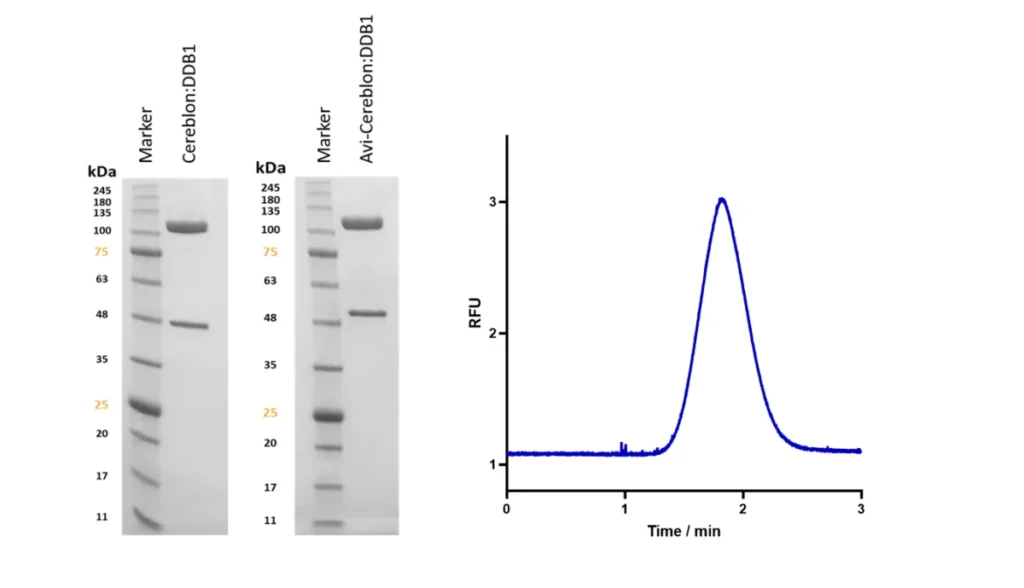
Within the Protein & Structure department at Sygnature Discovery, we pride ourselves in producing high quality protein for drug development and Cereblon is no exception. We expressed Avi-tagged Cereblon as a complex with full-length DDB1 in HEK cells and developed a purification strategy resulting in highly pure, homogeneous protein. Our first attempt produced a reasonable amount of protein, but we felt there was room for improvement. Our cell science team designed a series of experiments, strategically varying parameters such as feed types and timings and when we applied this to a larger scale culture, the yield improved almost 10-fold. We further streamlined the purification strategy allow incorporation of an in vitro biotinylation step while maintaining activity. While we have the ability to biotinylate by co-expression we decided to stick to the in vitro process to allow us to generate tagged and untagged protein from the same batch. This allows for flexibility in downstream assay design.
We confirmed the addition of biotin by peptide mapping and protein identification (LCMSMS) and used the Fida platform (Flow-Induced Dispersion Analysis) to determine the integrity of the complex. This technology measures diffusion under laminar flow and based on the shape and width of the peak we can calculate the complex size (4.6 nm, good agreement with crystal structures) and PDI (< 0.0001, indicating high homogeneity). The lack of spikes demonstrates that there are no aggregates in the sample so we can be confident that the proteins have formed a stable complex.
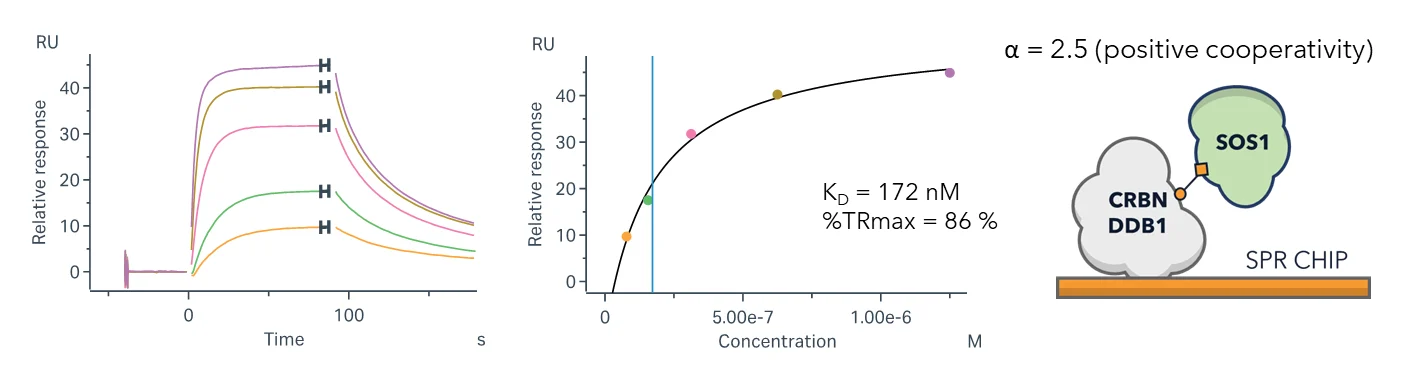
Our biophysics team used this batch of Cereblon in an SPR experiment to demonstrate the formation of binary and ternary complexes using an SOS1 degrader PROTAC and SOS1 that was also produced in-house at Sygnature Discovery. For both binary and ternary interactions, our Cereblon was shown to be highly active by SPR (>85%), and much higher than similar material from alternative suppliers. This indicates that the immobilized Cereblon/DDB1 complex on the SPR chip surface is well-folded and accessible for PROTAC binding.

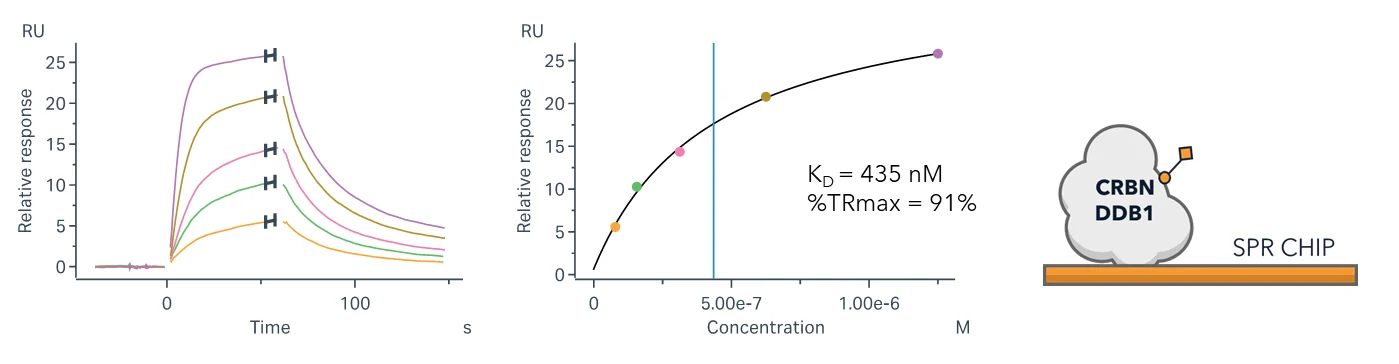
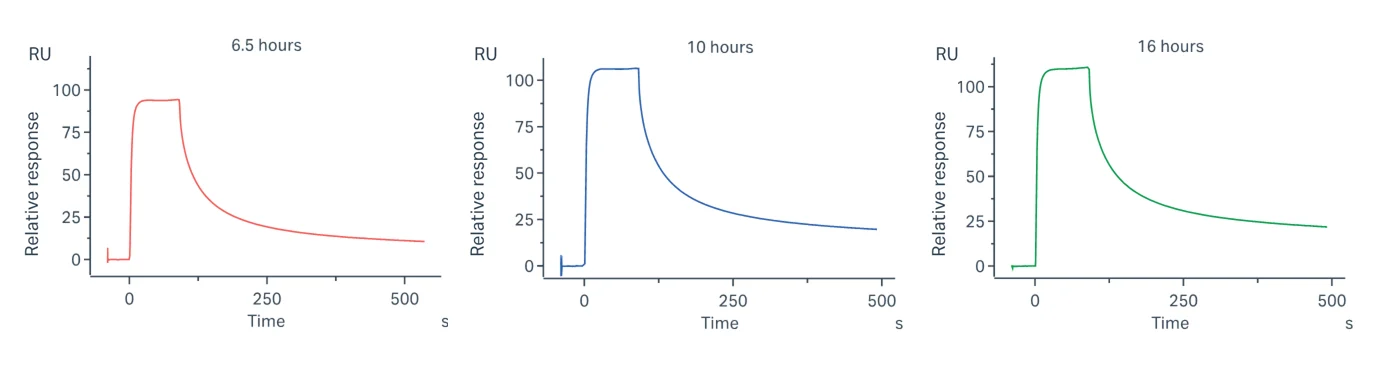
To assess if the assay was compatible with library screening, surface stability was assessed over time. We found that the CRBN/DDB1 surface retained full capacity to form a ternary complex with SOS1 after 16 h, indicating that the assay is compatible with library screening over this period.
Sygnature Discovery has demonstrated we can deliver highly active, purified Cereblon:DDB1 for your drug development needs. We have experience producing other degrader E3-ligases too, included VHL / VCB and multiple DCAF proteins. Degrader studies also often require high-quality target protein, and our highly qualified and experienced team are well placed to produce your protein of interest. At Sygnature we can offer the full drug discovery package with close integration with our biophysics team to find lead compounds, study degrader interactions and the potential of the CHARMED platform to deliver rapid synthesis, screening and characterisation of bifunctional lead compounds from existing binders.
If you would like to learn more about our protein services or other services, please get in touch.
Peak Proteins, NuChem Sciences, and SB Drug Discovery have now fully integrated with Sygnature Discovery.
