



Featured Resources
-
STORM Therapeutics: From Lead to Pre-Candidate Nomination in 18 Months

STORM Therapeutics: From Lead to Pre-Candidate Nomination in 18 Months
Case study
📣From lead to pre-candidate nomination in 18 months. Explore the STORM Therapeutics case study




July 30, 2015

Inobrodib, an exciting, first-in-class oral anti-cancer drug in clinical development by CellCentric, was collaboratively designed, synthesised and supported on its pre-clinical journey by an integrated project team at Sygnature Discovery. Inobrodib is now showing promising results in Phase I and II trials for multiple myeloma and other cancer types.

At Sygnature Discovery, we deliver world-leading drug discovery solutions to accelerate your compound from idea to clinic.

Our leadership team brings diverse experience and insight, driving collaboration and innovation across drug discovery.

Explore careers at Sygnature Discovery and join a global team committed to science, collaboration, and integrity.
Inobrodib, an exciting, first-in-class oral anti-cancer drug in clinical development by CellCentric, was collaboratively designed, synthesised and supported on its pre-clinical journey by an integrated project team at Sygnature Discovery. Inobrodib is now showing promising results in Phase I and II trials for multiple myeloma and other cancer types.
At Sygnature Discovery, we deliver world-leading drug discovery solutions to accelerate your compound from idea to clinic.
Our leadership team brings diverse experience and insight, driving collaboration and innovation across drug discovery.
Explore careers at Sygnature Discovery and join a global team committed to science, collaboration, and integrity.
We were tasked with developing a higher-throughput assay from a client. The assay is a coupled enzyme assay that measures cyclic nucleotide phosphodiesterase (PDE) activity by the downstream consumption of NADH that can be kinetically measured via fluorescence intensity (Figure 1). PDEs are key enzymes that regulate the intracellular levels of the secondary messengers’ cAMP and cGMP. There exist 11 different PDE families with different isoforms and splice variants offering the opportunity to selectively target a specific diseased state PDE as exemplified by the clinical and commercial successes of numerous drugs that include sildenafil (Viagra), theophylline (Theolair), and apremilast (Otezla).1-2
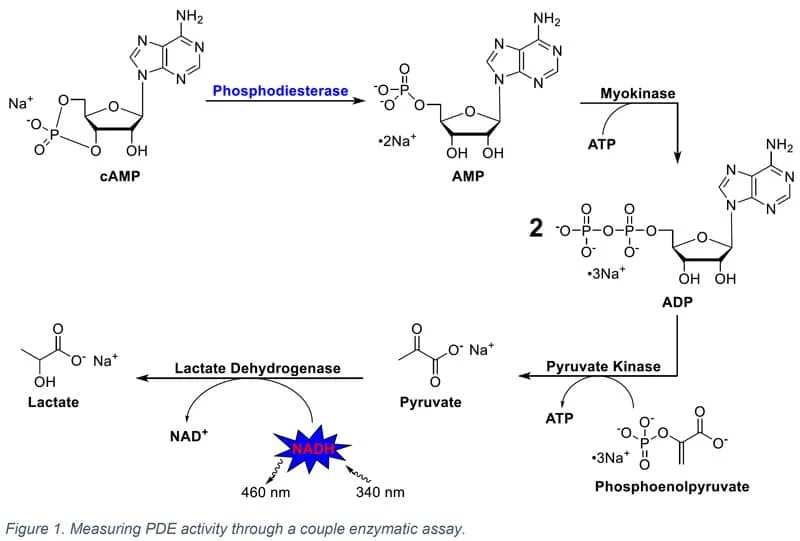
The initial challenge with converting the assay over to a 384-well format was the kinetics of the reaction would occur far too quickly to obtain enough data points (>12 points) to generate a good fit of the linear portion of the reaction. In a 96-well format, it would take ~5 minutes for 12 cycles to occur, whereas in 384-well format that time is doubled to ~10 minutes. To overcome this first hurdle, the enzyme concentration dropped significantly. This decrease had a twofold beneficial effect on the reaction. Firstly, the rate of the reaction was reduced enough to remain linear throughout the first 10 minutes. Secondly, the lower enzyme concentration allowed for a lower limit of detection for the highly potent inhibitors as the lowest EC50 that can be detected would be half of the enzyme concentration.
We also noted that pre-incubation at room temperature was important for maximal enzymatic activity. Measuring PDE enzymes after adding it to the reaction mixture and leaving them at room temperature for a variable amount of time would increase enzymatic activity. We determined that ~30 min was sufficient time at room temperature to obtain the most activity from our PDEs. Other parameters were re-tested in the 384-well format, such as the Km of the substrate and the concentrations of the coupling enzymes. Overall, the only major change needed to port the assay to 384-well format was the reduction of the PDEs concentration.
Developing the assay for our liquid handling robot posed some initial challenges with automation given the diverse range of liquids (i.e., 100% DMSO, 40% DMSO, and buffer containing BSA) that we used and maintaining accuracy with each one. Initial testing focused on tuning and dialing the robot to accurately pipette each type of liquid repetitively.
Once all the parameters were adjusted with the robot, the next step was to evaluate the reproducibility of our assay under fully automated conditions. We then started by evaluating the statistics between the positive and negative controls where the %C.V. and Z’ were below 5% and above 0.7, respectively, passing our quality control criteria. Next, we evaluated our control compounds that are used in the PDE screen. We found that the EC50 curves we generated were almost indistinguishable from assays prepared by hand. Following that, we further expanded our efforts to include a wide range of different compounds that had been vigorously tested by hand and found that the assays behaved in a similar fashion whether they were prepared the robot or by hand. This gave us the confidence that we could now begin using the fully automated assay.
Through vigorous testing, we increased the number of compounds that could be tested per plate from 4 to 16 compounds per plate with a 10-point EC50 determination. The robustness of the assay allows us to detect high pico-molar inhibitors as lower enzyme concentrations had to be employed. Transitioning our assay to a liquid handling robot, while it posed some initial challenges with pipetting accuracy, once solved, this enabled a robust and reliable automated assay, effectively increasing throughput, assay reliability, and a significant ergonomic benefit for employees.



Peak Proteins, NuChem Sciences, and SB Drug Discovery have now fully integrated with Sygnature Discovery.
