


Featured Resources
-
STORM Therapeutics: From Lead to Pre-Candidate Nomination in 18 Months

STORM Therapeutics: From Lead to Pre-Candidate Nomination in 18 Months
Case study




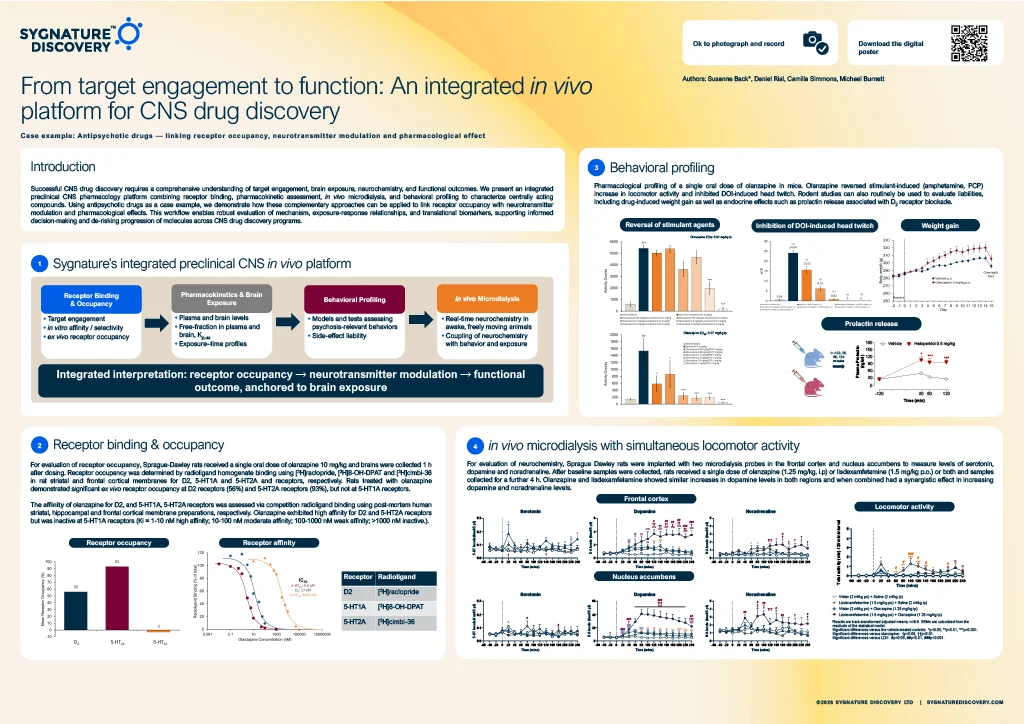
Discover precise insights into brain neurochemistry with Sygnature Discovery's in vivo microdialysis and cOFM services. With over 20 years of expertise, we design bespoke studies that reveal how compounds modulate neurotransmitter systems in health and disease. Using UHPLC/HPLC with electrochemical detection or mass spectrometry, we deliver robust PK/PD data to support confident CNS decision making.


July 30, 2015

Inobrodib, an exciting, first-in-class oral anti-cancer drug in clinical development by CellCentric, was collaboratively designed, synthesised and supported on its pre-clinical journey by an integrated project team at Sygnature Discovery. Inobrodib is now showing promising results in Phase I and II trials for multiple myeloma and other cancer types.

In drug discovery, generating targets is no longer the challenge. The real question is how to identify the few worth investing months of research and significant resources to pursue. Hear expert perspectives on how AI, pathway analysis and scientific expertise are shaping modern target identification.
July 7, 2026

Stay up to date with the latest company updates, milestones, and announcements.
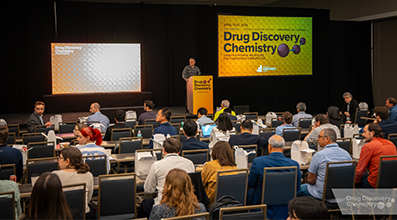
Explore upcoming conferences and scientific meetings where you can connect with our team.

At Sygnature Discovery, we deliver world-leading drug discovery solutions to accelerate your compound from idea to clinic.

Our leadership team brings diverse experience and insight, driving collaboration and innovation across drug discovery.

Explore careers at Sygnature Discovery and join a global team committed to science, collaboration, and integrity.
Inobrodib, an exciting, first-in-class oral anti-cancer drug in clinical development by CellCentric, was collaboratively designed, synthesised and supported on its pre-clinical journey by an integrated project team at Sygnature Discovery. Inobrodib is now showing promising results in Phase I and II trials for multiple myeloma and other cancer types.
At Sygnature Discovery, we deliver world-leading drug discovery solutions to accelerate your compound from idea to clinic.
Our leadership team brings diverse experience and insight, driving collaboration and innovation across drug discovery.
Explore careers at Sygnature Discovery and join a global team committed to science, collaboration, and integrity.
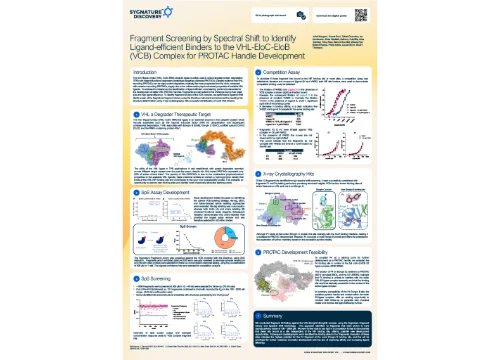
The Von Hippel-Lindau (VHL) E3 ligase is one of the most widely used protein degradation targets in PROTAC discovery. However, the limited range of available VHL ligands and their challenging physicochemical properties continue to restrict the development of orally bioavailable VHL-recruiting degraders.
This post explored how fragment-based screening can uncover novel ligand-efficient starting points for VHL ligand discovery. Using Spectral Shift (SpS) technology and the Sygnature Fragment Library, researchers identified previously unknown binders of the VHL-ElonginC-ElonginB (VCB) complex and characterized their binding sites through X-ray crystallography.
Fragment-based approached are well suited to discovering novel binding sites and generating high ligand-efficiency starting points for medicinal chemistry optimization. In this study, approximately 1,600 fragments were screened against the VCB complex, leading to the identification of 12 confirmed binders with reproducible affinities. Subsequent competition assays and structural studies revealed binding sites distinct from well-characterized HIF pocket.
Download the poster to learn more about:
Structural analysis identified a particularly promising fragment, F4, binding within a previously unexploited pocket on Elongin B. Unlike known binding sites that overlap with critical protein-protein interaction interfaces, this novel site appears accessible within the active E3 ligase complex and offers a potential avenue for developing alternative VHL-recruiting ligands.
These findings demonstrate how combining fragment screening, biophysical characterization, and structural biology can uncover new opportunities in targeted protein degradation and support the development of next-generation degrader therapeutics.
Loading form…
Thank you! Your download will begin shortly.
Peak Proteins, NuChem Sciences, and SB Drug Discovery have now fully integrated with Sygnature Discovery.