



Featured Resources
-
STORM Therapeutics: From Lead to Pre-Candidate Nomination in 18 Months

STORM Therapeutics: From Lead to Pre-Candidate Nomination in 18 Months
Case study
📣From lead to pre-candidate nomination in 18 months. Explore the STORM Therapeutics case study




July 30, 2015

Inobrodib, an exciting, first-in-class oral anti-cancer drug in clinical development by CellCentric, was collaboratively designed, synthesised and supported on its pre-clinical journey by an integrated project team at Sygnature Discovery. Inobrodib is now showing promising results in Phase I and II trials for multiple myeloma and other cancer types.

At Sygnature Discovery, we deliver world-leading drug discovery solutions to accelerate your compound from idea to clinic.

Our leadership team brings diverse experience and insight, driving collaboration and innovation across drug discovery.

Explore careers at Sygnature Discovery and join a global team committed to science, collaboration, and integrity.
Inobrodib, an exciting, first-in-class oral anti-cancer drug in clinical development by CellCentric, was collaboratively designed, synthesised and supported on its pre-clinical journey by an integrated project team at Sygnature Discovery. Inobrodib is now showing promising results in Phase I and II trials for multiple myeloma and other cancer types.
At Sygnature Discovery, we deliver world-leading drug discovery solutions to accelerate your compound from idea to clinic.
Our leadership team brings diverse experience and insight, driving collaboration and innovation across drug discovery.
Explore careers at Sygnature Discovery and join a global team committed to science, collaboration, and integrity.
A number of our mammalian expressed proteins, however, are secreted proteins and BirA is an intracellular protein. A method for biotinylation within the secretory pathway was reported in 2008. This method involved the co-expression of BirA and the target protein from a bicistronic plasmid, with BirA being fused to the signal leader peptide from a mouse immunoglobulin heavy chain; the idea being that both the target protein and BirA translocate to the endoplasmic reticulum (ER) where biotinylation occurs.
To provide further options for our clients’ projects, we decided to try a similar approach in our proprietory HEK293-6E cell expression system. We fused BirA to an IgK secretary leader signal in a separate plasmid for co-transfection and expression with the target protein. This trans approach was adopted to allow us to produce both non-biotinylated and biotinylated forms of the protein, if needed.
We chose a heterodimeric, secreted cytokine protein we have previously expressed and biotinylated successfully in vitro, as a case study protein to test this approach. One of the proteins was tagged with the short AviTag required for site specific biotinylation.
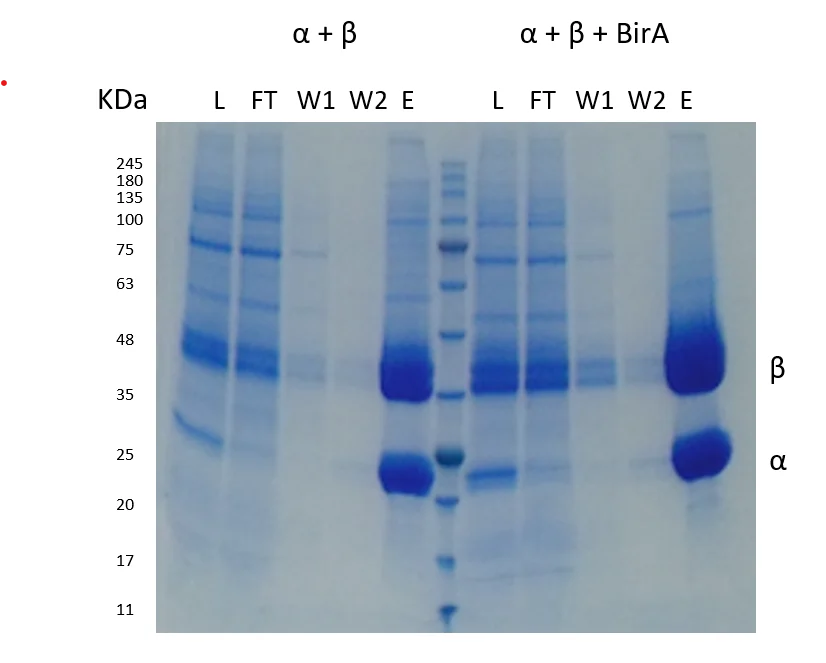
HEK293 cells were co-transfected with three plasmids expressing proteins with secretory signal signals: the two target heterodimeric proteins (α + β) and BirA. The BirA expression plasmid was transfected at a 10-fold lower level than the two target plasmids and cells were grown, supplemented with biotin. Expression was also performed without BirA present.
Cells were spun down and the supernatant was purified by nickel chelate affinity chromatography, showing two clear bands in the nickel eluate.
Protein samples were loaded onto a Sciex X500B mass spectrometer, to obtain an intact mass value. This is something we do routinely as part of our QC for clients but also offer it as a separate mass spectrometry service for clients.
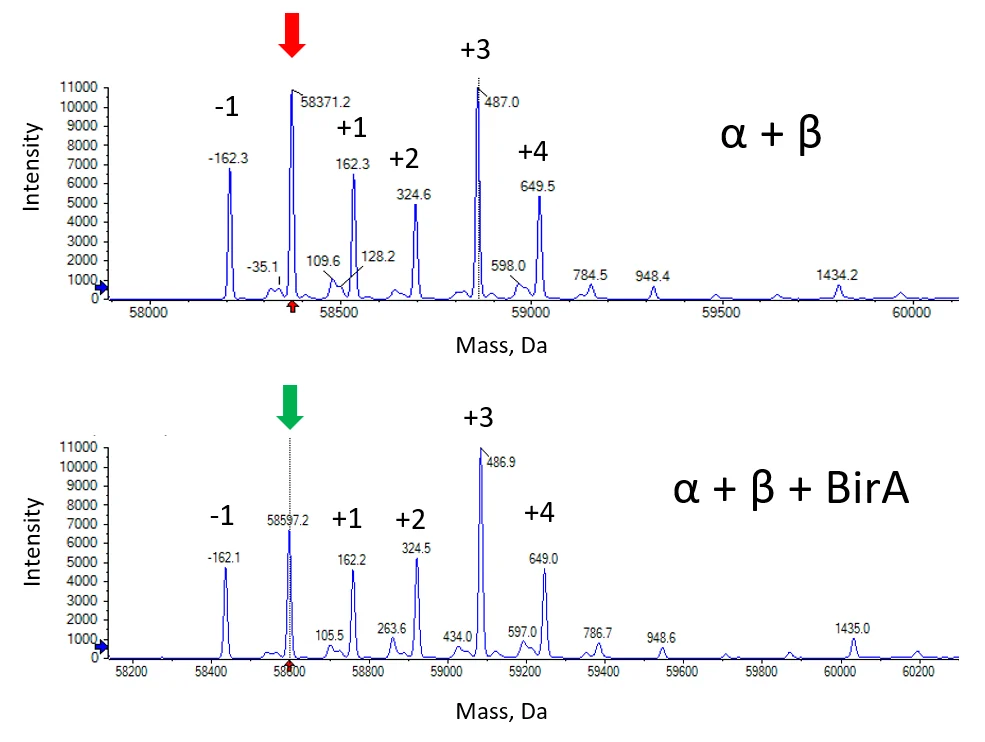
The combined size was predicted to be 57,004 based on the mass of proteins α and β but was anticipated to be higher due to additional glycosylation mass The main species in both conditions is highlighted above with an arrow and other species are relative to this species. These other species are various additions of multiples of +/- 162 Da, attributed to hexose, a common glycosylation in mammalian cells systems.
The main species was 226 Da larger when expressed with BirA. This size increase correlates with biotinylation of a single lysine – the site-specific residue in the AviTag. Furthermore, the shift in size was 100%, indicating we had achieved complete biotinylation of all the expressed protein.
This secreted in vivo biotinylation strategy was shown to be very effective and will provide another tool for our protein expression and purification service. The published strategy was shown to be successful for secretory and membrane proteins and with both N- and C-terminal tags suggesting this could be widely applied.





Peak Proteins, NuChem Sciences, and SB Drug Discovery have now fully integrated with Sygnature Discovery.
