
Itโs important to lay strong foundations for successful drug discovery at this first stage of the process. Our integrated target identification and validation platform combines AI with expert insights, and rigorous lab validation to guide targets through robust evaluation, ready for hit discovery.
Validated, high-quality hits, delivered through integrated technologies and expert collaboration, give you a confident starting point for faster drug discovery.
Turning promising leads into clinical candidates with speed, precision, and the scientific expertise to generate high-quality data and deliver real patient impact.
Delivering integrated, modality-agnostic drug discovery to tackle complex biology, accelerate development, and advance innovative therapies with confidence.
Advancing next-generation ADCs through payload-focused design, integrated expertise, and collaborative innovation to deliver safer, more selective therapies.
Driving biologics innovation through integrated design, structural biology, and multidisciplinary expertise to accelerate next-generation therapies from concept to clinic.
Combining deep therapeutic expertise with translational insight to design strategies, reduce risk, and accelerate discovery programs toward clinical success.
Accelerating oncology drug discovery through integrated expertise, innovative modalities, and translational insight to deliver candidates with real clinical impact.
Driving immunology and inflammation drug discovery through tailored assays, translational models, and integrated expertise for faster clinical success.
Advancing CNS drug discovery through integrated models, translational biomarkers, and multidisciplinary expertise to overcome complexity and accelerate therapeutic innovation.
Designing and advancing differentiated small-molecule therapies for obesity and diabetes through integrated expertise, mechanistic insight, and translational strategies.
Inobrodib, an exciting, first-in-class oral anti-cancer drug in clinical development by CellCentric, was collaboratively designed, synthesised and supported on its pre-clinical journey by an integrated project team at Sygnature Discovery. Inobrodib is now showing promising results in Phase I and II trials for multiple myeloma and other cancer types.
Itโs important to lay strong foundations for successful drug discovery at this first stage of the process. Our integrated target identification and validation platform combines AI with expert insights, and rigorous lab validation to guide targets through robust evaluation, ready for hit discovery.
Validated, high-quality hits, delivered through integrated technologies and expert collaboration, give you a confident starting point for faster drug discovery.
Turning promising leads into clinical candidates with speed, precision, and the scientific expertise to generate high-quality data and deliver real patient impact.
Delivering integrated, modality-agnostic drug discovery to tackle complex biology, accelerate development, and advance innovative therapies with confidence.
Advancing next-generation ADCs through payload-focused design, integrated expertise, and collaborative innovation to deliver safer, more selective therapies.
Driving biologics innovation through integrated design, structural biology, and multidisciplinary expertise to accelerate next-generation therapies from concept to clinic.
Combining deep therapeutic expertise with translational insight to design strategies, reduce risk, and accelerate discovery programs toward clinical success.
Accelerating oncology drug discovery through integrated expertise, innovative modalities, and translational insight to deliver candidates with real clinical impact.
Driving immunology and inflammation drug discovery through tailored assays, translational models, and integrated expertise for faster clinical success.
Advancing CNS drug discovery through integrated models, translational biomarkers, and multidisciplinary expertise to overcome complexity and accelerate therapeutic innovation.
Designing and advancing differentiated small-molecule therapies for obesity and diabetes through integrated expertise, mechanistic insight, and translational strategies.
Inobrodib, an exciting, first-in-class oral anti-cancer drug in clinical development by CellCentric, was collaboratively designed, synthesised and supported on its pre-clinical journey by an integrated project team at Sygnature Discovery. Inobrodib is now showing promising results in Phase I and II trials for multiple myeloma and other cancer types.
Explore the effective mice model of cytokine release during inflammation
Inflammation is a complex biological response of the bodyโs immune system to harmful stimuli, such as pathogens, damaged cells, or irritants. It is a protective mechanism that involves immune cells, blood vessels, and molecular mediators which work together to eliminate the initial cause of cell injury, clear out damaged cells, and tissues, and establish a repair process. Among all molecular mediators involved, cytokines play a pivotal role in the orchestration of the inflammatory response. These small proteins are secreted by various immune cells and affect the behavior of other cells by binding to specific receptors on their surface. Cytokines can be pro-inflammatory, driving the inflammation process, or anti-inflammatory, mitigating the response to prevent excessive damage and each cytokine have its own role to play. The balance and secretion of cytokines determines the outcome of the inflammatory response, which can range from resolution and healing to chronic inflammation and tissue destruction. Understanding the dynamics of cytokine secretion during inflammation is crucial for developing therapeutic interventions for a wide array of inflammatory diseases.
The critical role of mouse models in inflammatory cytokine research
The immune systemโs response to a pathogen is a complex process and the use of animal models stands as a cornerstone in the study of inflammatory cytokines, providing invaluable information. The advantages of animal models for the study of inflammation include:
Physiological relevance: Animal models offer a whole-organism context, incomparable with in vitro assay, that closely mimics human physiological processes. This allows for a more accurate representation of how inflammatory cytokines interact within a living system, providing insights that are more relevant and translatable to human conditions.
Controlled experimental condition:ย These models offer a controlled environment, such as the genetic background, the environment, and the timing and dosage of pathogen exposure. This control is crucial for understanding the specific roles and mechanisms of cytokines in the immune system and for the reproducibility of studies.
Mimic human inflammatory diseases:ย There are numerous animal models that replicate human inflammatory diseases ranging from genetic modification to the injection of pathogens or the use of chemical agents. Thus, mouse models can reproduce diseases such as rheumatoid arthritis, inflammatory bowel disease, and psoriasis.
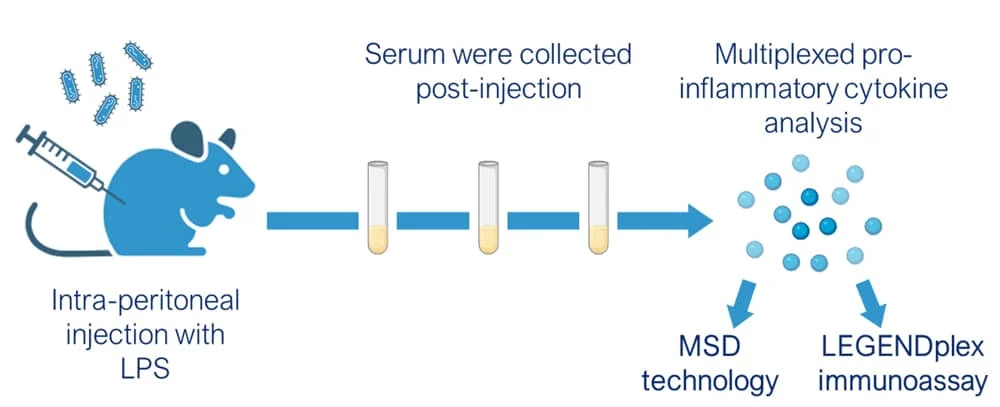
Figure 1:ย Experimental model for studying Systemic Inflammatory Response and Sepsis (SIRS) in humans and the role of pro-inflammatory cytokines. Lipopolysaccharide (LPS), a major component of the outer membrane of gram-negative bacteria, is administrated in the peritoneum and results in general inflammation. Cytokines are detected in the bloodstream.
The tools to explore the cytokine storm
There are several tools and techniques to explore and measure cytokine storm, a hyperinflammatory state that develops due to excessive cytokine release in response to an infection. Because this response involves many different cytokines, a multiplexed analysis is required to obtain accurate quantification. Two relevant techniques are described below:
MSD (Meso Scale Discoveryยฎ is a method based on MULTI-ARRAYยฎ technology, which combines electrochemiluminescence detection using labels that emit light when electrochemically stimulated and patterned arrays.
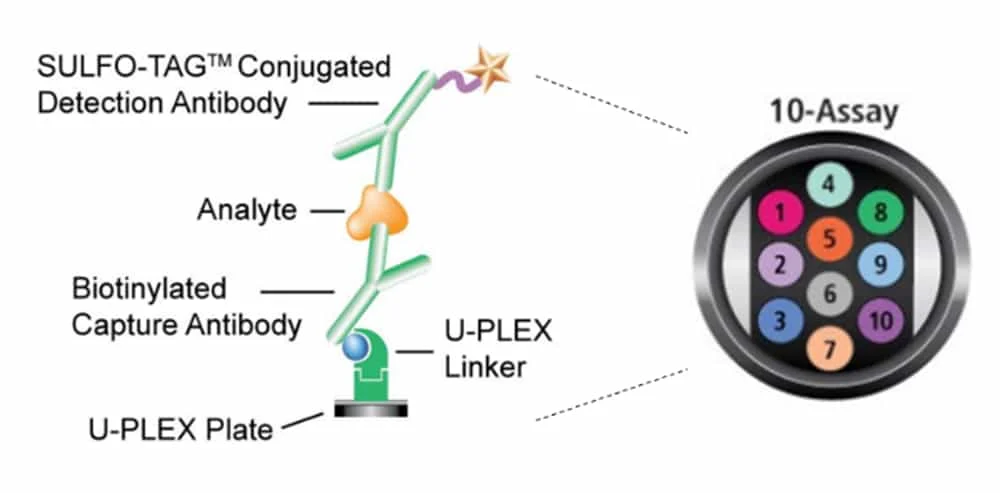
Figure 2:ย Biotinylated capture antibodies are immobilized on a U-plex plate through coupling to a U-plex linker. The analytes in the sample bind to the capture reagents. Detection antibodies conjugated with electro-chemiluminescent labels (SULFO-TAG) bind to the analytes to complete the sandwich immunoassay. The instrument (MSDโขย QuickPlex SQ 120MM) detects the intensity of emitted light and provides a quantitative measure of each analyte.ย Source:ย https://www.mesoscale.com/
LEGENDplexโข allows for cytokine quantification in a multiplex assay by utilizing beads pre-coated with antibodies for their intended target. Analysis can be carried out using most common flow cytometers.
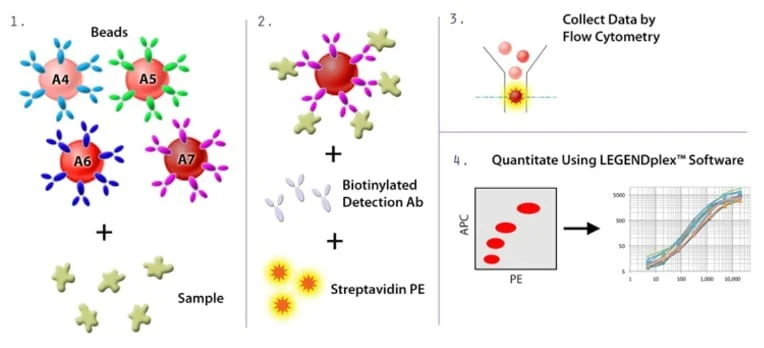
Figure 3:ย Beads are differentiated by size and internal fluorescence intensities. Each bead set is conjugated with a specific antibody on its surface and serves as the capture beads for a particular analyte. Biotinylated detection antibody and Streptavidin-PE complete the reaction. On a flow cytometer, analyte-specific populations can be segregated by size and the analyte concentration is determined using fluorescence intensity.ย Source:ย https://www.biolegend.com/en-us/immunoassays/legendplex
Both tools are used for the quantification of pro-inflammatory cytokines, providing high sensitivity and a broad dynamic range for the detection of these critical immune markers. Their multiplexing capabilities allow for the simultaneous measurement of multiple cytokines in a single sample, streamlining the analysis and improving the efficiency of inflammation-related research.
Case study: Using MSD technologyยฎ to measure Eotaxin, an eosinophil-specific chemokine
Eotaxin, also known as CCL11 (C-C motif chemokine ligand 11), is a chemokine involved in inflammation, particularly in the recruitment of eosinophils, a type of white blood cell. During inflammatory responses, eotaxin is secreted by various types of cells, including endothelial cells, fibroblasts, and epithelial cells, in response to cytokines such as IL-4 and IL-13, which are released during allergic reactions or other types of inflammation.
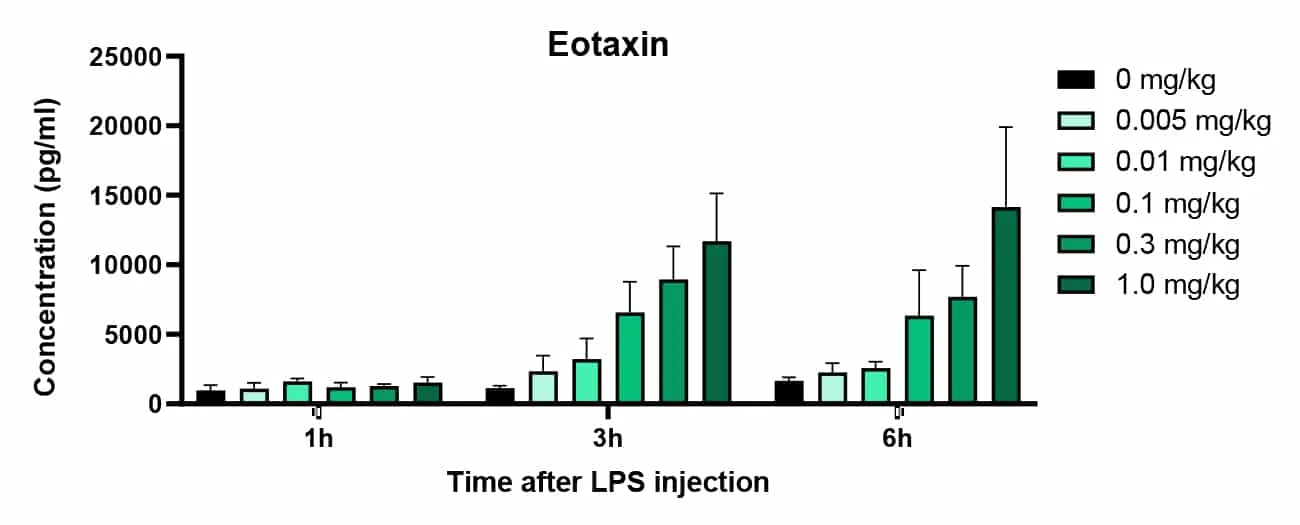
Figure 4:ย The concentration of eotaxin in mice serum after intra-peritoneal injection of increasing doses of LPS. The chemokine was analyzed by MSD technologyยฎ. The elevation in eotaxin levels is proportional to the amount of administered pathogenic agent. This secretion becomes effective 3 hours post-injection, and the concentration of eotaxin remains sustained until the animals are sacrificed at 6 hours.
Numerous other cytokines, such as IL-1ฮฒ, IL-6, IFN-ฮณor TNF-ฮฑ, were assessed during the sepsis shock in our mouse model. The multiplex measurement of these pro-inflammatory cytokines was carried out with the MSD technologyยฎ and the LegendPlexโข to compare their sensitivity and methodologies. To discover all the facets of this study, please click on this link, which will take you to the full research paper.

References
Kany S, Vollrath JT, Relja B. Cytokines in Inflammatory Disease. Int J Mol Sci. 2019 Nov 28;20(23):6008. doi: 10.3390/ijms20236008.
Zhang JM, An J. Cytokines, inflammation, and pain. Int Anesthesiol Clin. 2007 Spring;45(2):27-37. doi: 10.1097/AIA.0b013e318034194e.
Lewis AJ, Seymour CW, Rosengart MR. Current Murine Models of Sepsis. Surg Infect (Larchmt). 2016 Aug;17(4):385-93. doi: 10.1089/sur.2016.021. Epub 2016 Jun 15
Dabitao D, Margolick JB, Lopez J, Bream JH. Multiplex measurement of proinflammatory cytokines in human serum: comparison of the Meso Scale Discovery electrochemiluminescence assay and the Cytometric Bead Array. J Immunol Methods. 2011 Sep 30;372(1-2):71-7. doi: 10.1016/j.jim.2011.06.033. Epub 2011 Jul 18.
Williams TJ. Eotaxin-1 (CCL11). Front Immunol. 2015 Feb 24;6:84. doi: 10.3389/fimmu.2015.00084.