


Featured Resources
-
STORM Therapeutics: From Lead to Pre-Candidate Nomination in 18 Months

STORM Therapeutics: From Lead to Pre-Candidate Nomination in 18 Months
Case study
📣From lead to pre-candidate nomination in 18 months. Explore the STORM Therapeutics case study




July 30, 2015

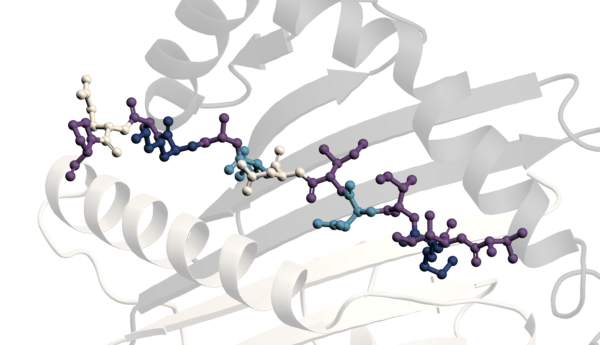
Inobrodib, an exciting, first-in-class oral anti-cancer drug in clinical development by CellCentric, was collaboratively designed, synthesised and supported on its pre-clinical journey by an integrated project team at Sygnature Discovery. Inobrodib is now showing promising results in Phase I and II trials for multiple myeloma and other cancer types.

At Sygnature Discovery, we deliver world-leading drug discovery solutions to accelerate your compound from idea to clinic.

Our leadership team brings diverse experience and insight, driving collaboration and innovation across drug discovery.

Explore careers at Sygnature Discovery and join a global team committed to science, collaboration, and integrity.
Inobrodib, an exciting, first-in-class oral anti-cancer drug in clinical development by CellCentric, was collaboratively designed, synthesised and supported on its pre-clinical journey by an integrated project team at Sygnature Discovery. Inobrodib is now showing promising results in Phase I and II trials for multiple myeloma and other cancer types.
At Sygnature Discovery, we deliver world-leading drug discovery solutions to accelerate your compound from idea to clinic.
Our leadership team brings diverse experience and insight, driving collaboration and innovation across drug discovery.
Explore careers at Sygnature Discovery and join a global team committed to science, collaboration, and integrity.
In our study, we explored various aspects of mitochondrial function using an in vitro model of dysfunction, offering valuable insights into the development of treatments for neurodegenerative disorders. We assessed mitochondrial membrane potential, oxidative stress, Ca2+ homeostasis, oxygen consumption rate, and various metabolic factors, enabling us to enhance the speed and translational value of CNS…
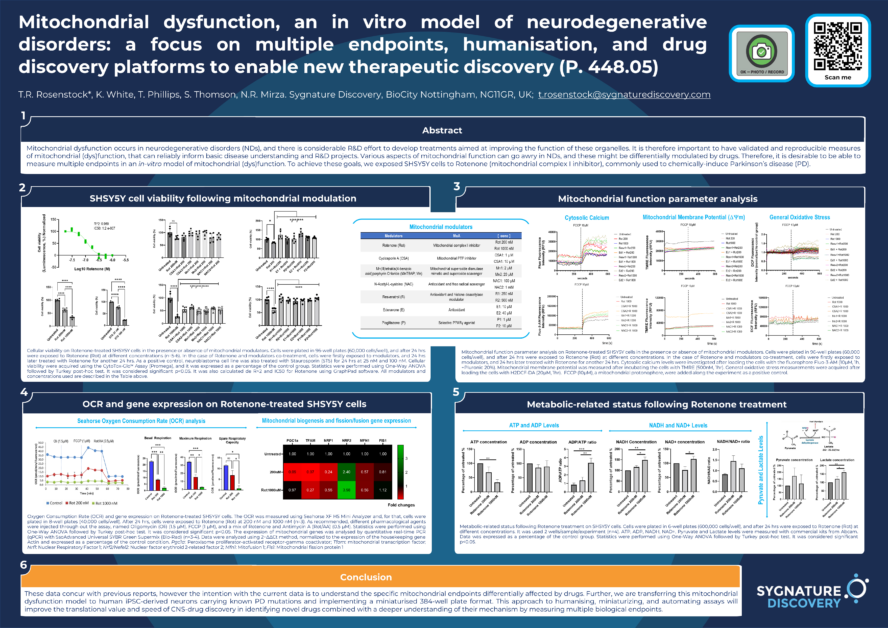
Mitochondrial dysfunction is a common feature in several neurodegenerative disorders (NDs), and there is considerable R&D effort to develop treatments aimed at improving the function of these organelles. Therefore, validated and reproducible measures of mitochondrial (dys)function are crucial to reliably inform basic disease understanding and R&D projects.
We analysed various aspects of mitochondrial function in an in vitro model of mitochondrial dysfunction. To induce this dysfunction, we used SHSY5Y cells exposed to Rotenone, a mitochondrial complex I inhibitor commonly used to induce Parkinson’s disease. Our assessments included mitochondrial membrane potential (MMP), oxidative stress, Ca2+ homeostasis, oxygen consumption rate (OCR), ATP, ADP, Pyruvate, Lactate, NAD+, and NADH levels. This knowledge is used to study mitochondrial function in fibroblasts from PD patients and human iPSC-derived neurons with PD mutations, using a miniaturized 384-well plate format. This approach humanizes, miniaturizes, and automates assays, enhancing the translational value and speed of CNS drug discovery for novel treatments.
Processing…
Thank you! Your download will begin shortly.


Peak Proteins, NuChem Sciences, and SB Drug Discovery have now fully integrated with Sygnature Discovery.
