



Featured Resources
-
STORM Therapeutics: From Lead to Pre-Candidate Nomination in 18 Months

STORM Therapeutics: From Lead to Pre-Candidate Nomination in 18 Months
Case study
📣 Connected drug discovery, united under one name. Discover the story behind our refreshed identity.




July 30, 2015

Inobrodib, an exciting, first-in-class oral anti-cancer drug in clinical development by CellCentric, was collaboratively designed, synthesised and supported on its pre-clinical journey by an integrated project team at Sygnature Discovery. Inobrodib is now showing promising results in Phase I and II trials for multiple myeloma and other cancer types.

At Sygnature Discovery, we deliver world-leading drug discovery solutions to accelerate your compound from idea to clinic.

Our leadership team brings diverse experience and insight, driving collaboration and innovation across drug discovery.

Explore careers at Sygnature Discovery and join a global team committed to science, collaboration, and integrity.
Inobrodib, an exciting, first-in-class oral anti-cancer drug in clinical development by CellCentric, was collaboratively designed, synthesised and supported on its pre-clinical journey by an integrated project team at Sygnature Discovery. Inobrodib is now showing promising results in Phase I and II trials for multiple myeloma and other cancer types.
At Sygnature Discovery, we deliver world-leading drug discovery solutions to accelerate your compound from idea to clinic.
Our leadership team brings diverse experience and insight, driving collaboration and innovation across drug discovery.
Explore careers at Sygnature Discovery and join a global team committed to science, collaboration, and integrity.
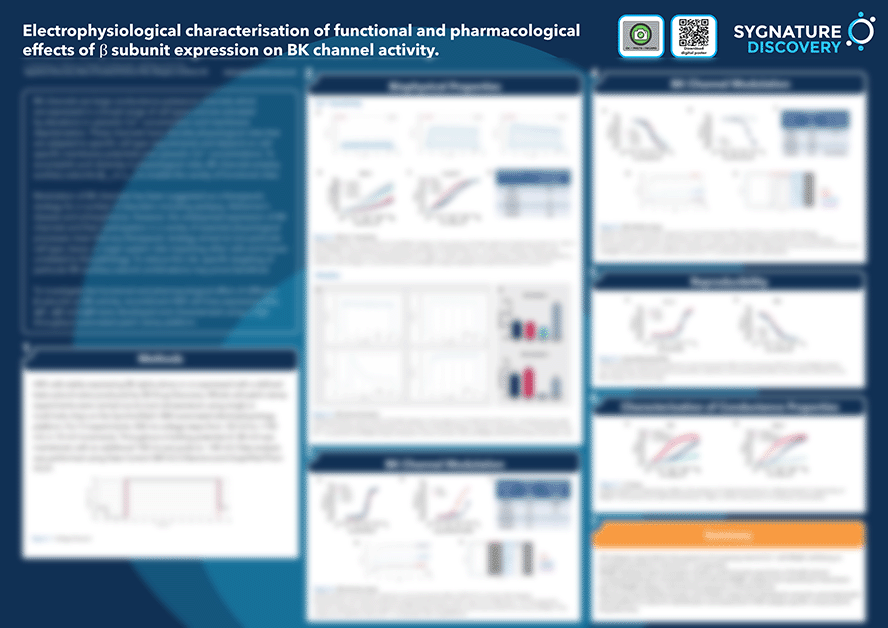
BK channels are large conductance potassium channels which are expressed in a broad range of excitable as well as non-excitable cell types and are activated by elevations in cytosolic Ca2+ concentration and membrane depolarization. It is thought that these channels have discrete physiological roles that are adapted to the specific cell type requirements and depend on cell-specific membrane potentials and cytosolic Ca2+ concentrations. To accomplish such a broad diversity in physiological roles, BK channels consist of a pore forming α subunit and employ auxiliary subunits (β1-4 or γ1-4) to enable the variety of functional roles.
Modulation of BK channels has been suggested as a therapeutic strategy for a number of disorders including epilepsy, Alzheimer’s disease and schizophrenia. However, the widespread expression of BK channels and their participation in a variety of essential physiological processes mean that any therapeutic strategy aimed at one particular cell type, tissue, or organ system risks impacting other cells and tissues unrelated to the pathology, perhaps with highly undesirable consequences. To reduce this risk, specific targeting of particular BK / auxiliary subunit combinations may prove beneficial, with the aim to selectively modulate specific BK subsets and reduce unwanted side-effects.
To investigate the functional and pharmacological effect of different β subunits on BK activity, recombinant HEK cell lines expressing BK α, αβ1, αβ2 and αβ4 combinations were developed and characterized using a high throughput automated patch clamp platform. Simultaneous assessment of multiple BK subtypes allowed for rapid optimization and characterization. Firstly, the current-voltage (IV) relationship was assessed in the presence of various free internal Ca2+ concentrations (0, 1, 3, and 10 µM), with the β containing BK channels displaying increased sensitivity to intracellular Ca2+ in line with literature values. The general BK activator NS1619 was assessed with calculated EC50 values in the range of 10-20 µM, while the activator Arachidonic Acid was selective for αβ1 over α only expressing cells.
In inhibitor mode, the calculated IC50 of the BK antagonist Paxilline was in the range of 30-130 nM depending on the specific BK αβ subunit complex, while Iberiotoxin was selective for BKα alone, in line with previous studies.
The characterization performed here enables the identification of pharmacological compounds targeting particular BK αβ subunit combinations and provides opportunities to selectively target BK channels involved in particular physiological disorders.
Processing…
Thank you! Your download will begin shortly.


Peak Proteins, NuChem Sciences, and SB Drug Discovery have now fully integrated with Sygnature Discovery.
